

Every durable startup I have advised—from two-founder garage teams to seed-stage SaaS companies—shared one non-negotiable habit: disciplined Business Planning. Yet many early-stage founders still treat Business Planning as a tedious chore done once to satisfy an angel investor or a bank loan officer. That mindset burns precious runway and invites catastrophic failure. Done properly, Business Planning turns a vague pitch deck into a measurable, actionable roadmap.
In this comprehensive guide, I will walk you through the startup Business Planning process exactly as I apply it with my early-stage consulting clients. You will finish this article with a practical Business Planning framework you can implement with your co-founders this very week.
What is Startup Business Planning?
Quick Answer: Startup Business Planning is the rigorous discipline of testing core assumptions before spending limited capital. It acts as the scientific method applied to your new company, replacing guesswork with validated learning.
Definition and Purpose
Startup Business Planning is the rigorous discipline of testing core assumptions before spending limited capital. Think of Business Planning as the scientific method applied to your new company. The primary purpose of Business Planning is to replace dangerous guesswork with validated customer learning. A useful strategic document answers three vital questions: Who is the exact customer? What is their painful problem? How do we solve it profitably?
Importance and Business Value
The business value is incredibly concrete. Research published in the Harvard Business Review consistently shows founders who engage in formal Business Planning are significantly more likely to secure seed funding and achieve product-market fit. According to the U.S. Small Business Administration (SBA), a well-researched strategy is the strongest signal of founder competence.
Why Business Planning Matters for Early-Stage Ventures
The compounding benefits of Business Planning are most visible in the chaotic early days of a venture:
- Clarity — Everyone knows the single top priority.
- Funding Readiness — Institutional investors demand a solid Business Planning document before writing a check.
- Risk Reduction — Cash forecasting exposes fatal gaps before they kill the startup.
- Alignment — Co-founders stop pulling in opposite directions.
Monthly Business Planning reviews also catch small product pivots while they are still cheap to execute. In short, rigorous Business Planning is the cheapest and most effective insurance policy a startup can buy. It transforms entrepreneurial optimism into engineered execution, ensuring every dollar spent moves the needle toward viability.
Objectives of Startup Business Planning
Short-term objectives focus entirely on survival and traction: achieving initial product-market fit, getting the first ten paying customers, and extending the cash runway. Long-term objectives address market dominance, brand equity, and eventual exit strategies for the founders and early investors. Growth planning sets the sustainable pace for user acquisition and revenue scaling.
Clear, measurable objectives turn Business Planning from a static pitch deck into a dynamic management system. I always recommend writing objectives in pairs—a specific metric plus a hard deadline—so every goal in your Business Planning cycle is objectively verifiable. When objectives cascade cleanly, budget allocation aligns with strategy automatically.
Types of Startup Plans (Lean vs Traditional)
Mature enterprises use traditional 40-page documents, but early-stage startups should keep Business Planning incredibly lean and agile.
| Plan Type | Primary Focus | Best For |
|---|---|---|
| Lean Startup Plan | Problem, solution, metrics | Internal alignment, early pivots |
| Traditional Plan | Operations, deep financials | Commercial bank loans |
| Pitch Deck | Visual storytelling, market size | Venture capitalists, angel syndicates |
A highly visual Business Planning presentation designed specifically for venture capitalists is often called a pitch deck. Early ventures must prioritize speed and iteration, making the lean approach to Business Planning the vastly superior choice for modern entrepreneurs navigating uncertainty.
Core Components of a Startup Business Plan
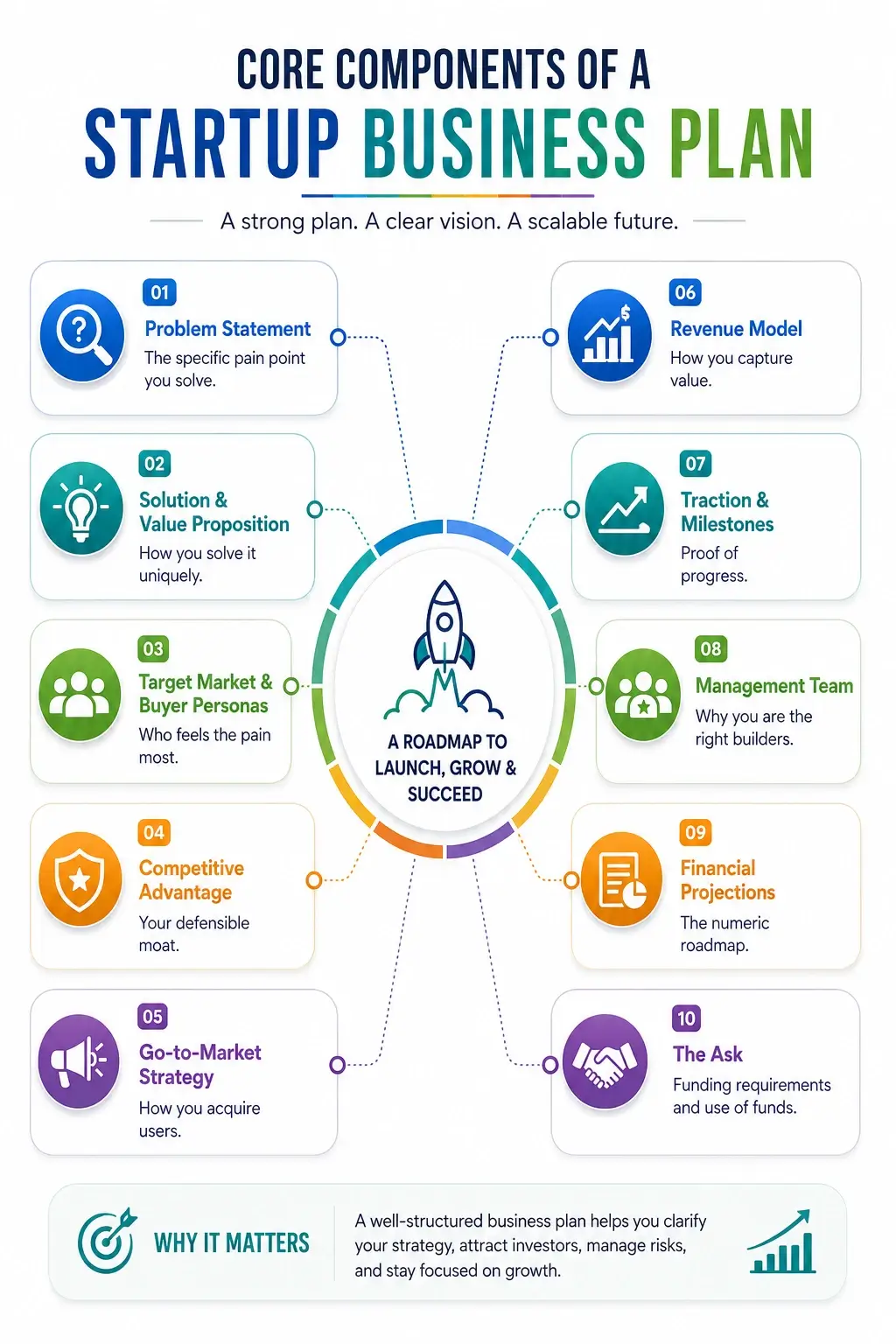
A complete Business Planning file for an early-stage startup contains ten tightly connected components. Keep each section incredibly concise; missing pieces or fluff severely weaken Business Planning credibility with sophisticated angel investors.
- Problem Statement — The specific pain point you solve.
- Solution & Value Proposition — How you solve it uniquely.
- Target Market & Buyer Personas — Who feels the pain most.
- Competitive Advantage — Your defensible moat.
- Go-to-Market Strategy — How you acquire users.
- Revenue Model — How you capture value.
- Traction & Milestones — Proof of progress.
- Management Team — Why you are the right builders.
- Financial Projections — The numeric roadmap.
- The Ask — Funding requirements and use of funds.
Step-by-Step Guide to Startup Business Planning
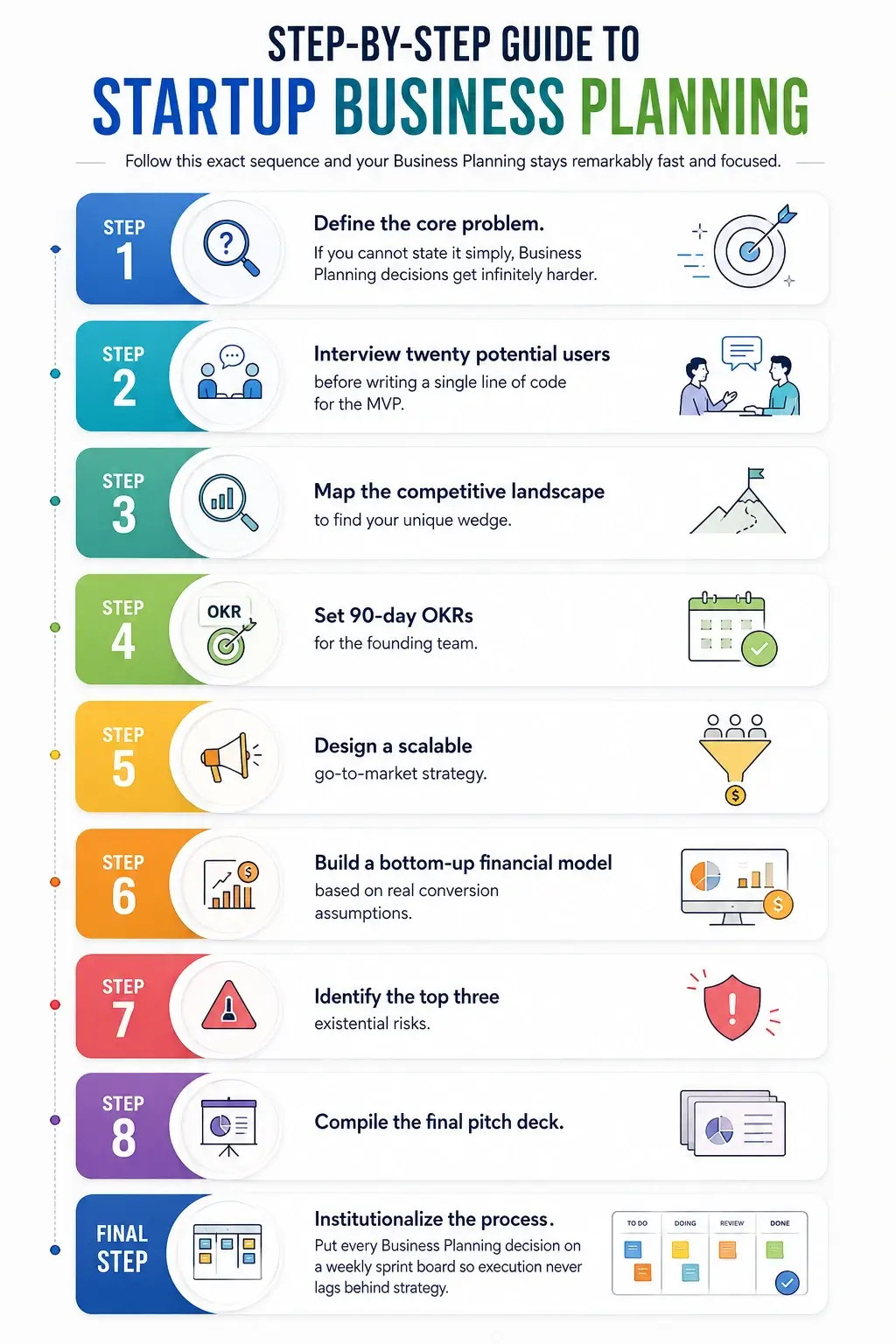
Follow this exact sequence and your Business Planning stays remarkably fast and focused. I have used this exact sprint structure with dozens of pre-seed teams.
Step 1: Define the core problem. If you cannot state it simply, Business Planning decisions get infinitely harder.
Step 2: Interview twenty potential users before writing a single line of code for the MVP.
Step 3: Map the competitive landscape to find your unique wedge.
Step 4: Set 90-day OKRs for the founding team.
Step 5: Design a scalable go-to-market strategy.
Step 6: Build a bottom-up financial model based on real conversion assumptions.
Step 7: Identify the top three existential risks.
Step 8: Compile the final pitch deck.
Final Step: Institutionalize the process. Put every Business Planning decision on a weekly sprint board so execution never lags behind strategy.
Market Research for Startup Business Planning
Deep market research keeps Business Planning brutally honest. Start with TAM (Total Addressable Market), SAM (Serviceable Available Market), and SOM (Serviceable Obtainable Market) calculations to realistically size the addressable opportunity. Then conduct deep competitor analysis to find the wedge you can exploit.
Customer discovery interviews are the absolute heart of startup Business Planning. Track early adopter feedback weekly so your strategic document ages well and adapts to real-world signals. A rigorous PESTLE analysis can also help you spot regulatory or technological shifts before they disrupt your launch.
Financial Business Planning for Pre-Revenue Startups
Financial forecasting is the numeric core of Business Planning. Estimate your monthly burn rate honestly, including founder salaries, legal fees, and cloud infrastructure costs. Build a revenue forecast from bottom-up conversion assumptions, not top-down hockey stick fantasies.
| Financial Component | Startup Application |
|---|---|
| Burn Rate | Monthly cash consumption |
| Runway | Months until cash reaches zero |
| CAC / LTV | Unit economics viability |
| Break-Even | Volume needed to cover fixed costs |
List operating expenses by category, then project cash flow monthly for the next 18 months. Institutional lenders and VCs read this section first, so let Business Planning numbers stay fiercely conservative. Calculate your exact break-even point and your remaining runway in months to avoid sudden insolvency.
Strategic Business Planning and Product-Market Fit
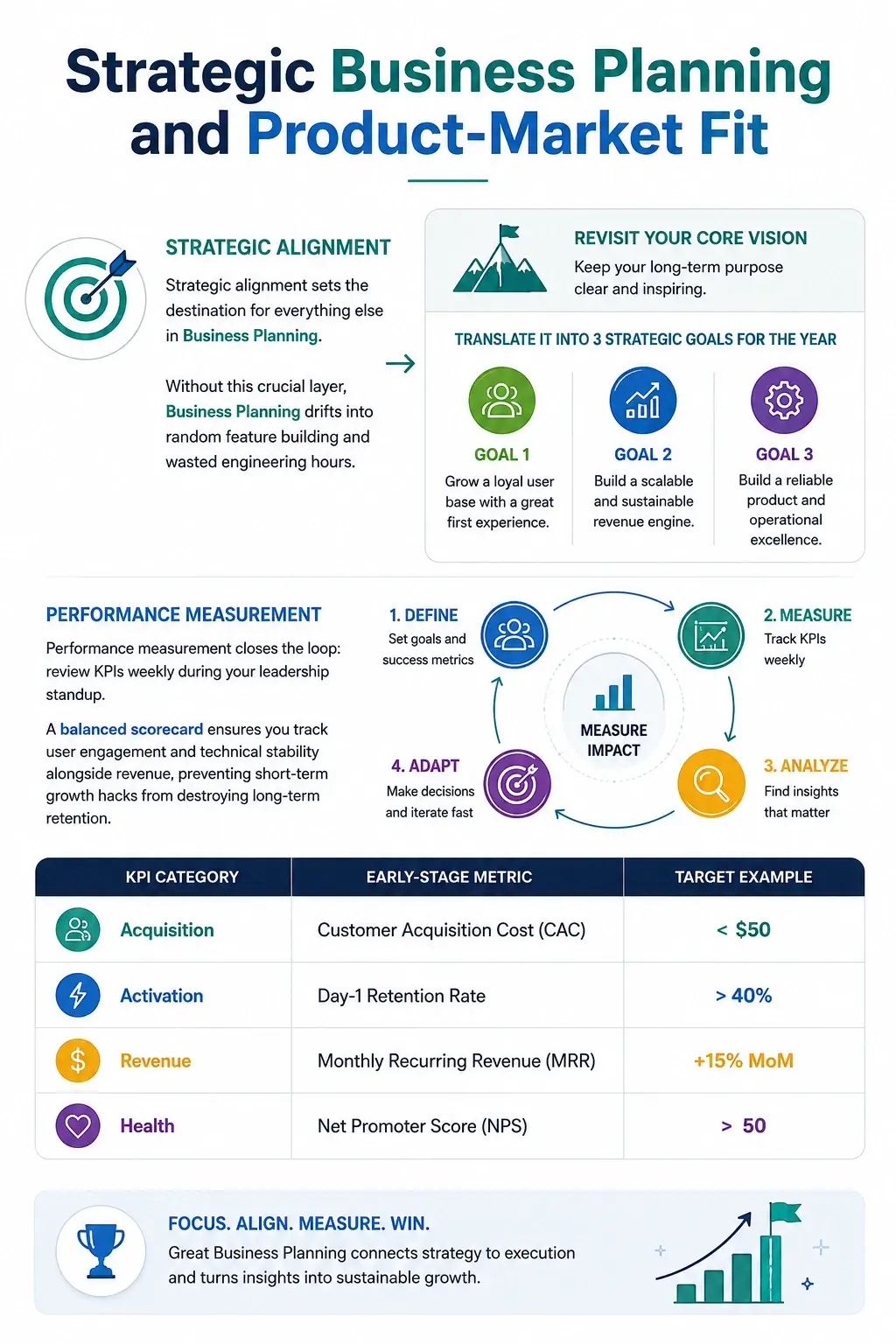
Strategic alignment sets the destination for everything else in Business Planning. Without this crucial layer, Business Planning drifts into random feature building and wasted engineering hours. Revisit your core vision, then translate it into three strategic goals for the year.
Performance measurement closes the loop: review KPIs weekly during your leadership standup. A balanced scorecard ensures you track user engagement and technical stability alongside revenue, preventing short-term growth hacks from destroying long-term retention.
| KPI Category | Early-Stage Metric | Target Example |
|---|---|---|
| Acquisition | Customer Acquisition Cost (CAC) | < $50 |
| Activation | Day-1 Retention Rate | > 40% |
| Revenue | Monthly Recurring Revenue (MRR) | +15% MoM |
| Health | Net Promoter Score (NPS) | > 50 |
Marketing Strategy for Startups
A sharp marketing strategy turns positioning into early market traction. Start with crystal-clear branding and messaging that resonates with your ideal customer profile. For most modern startups, SEO and content marketing compound beautifully over time. Add paid acquisition for speed, but ruthlessly track Customer Acquisition Cost against Lifetime Value. Disciplined Business Planning loves fast paybacks and high retention rates. Every channel needs an owner, or execution stalls.
Operations and Scaling
Operations planning describes exactly how the MVP gets delivered to the end user. Map core processes end-to-end and list the resources needed for each step. Design your technology stack with future scalability firmly in mind. Strong operations turn the bold promises in your Business Planning documents into repeatable, delightful user experiences. Measure cycle time and defect rate to ensure quality scales with volume.
Risk Management in Early-Stage Business Planning
Proactive risk management stress-tests your Business Planning. Identify risks across technical debt, founder burnout, and sudden market shifts. Evaluate each threat by likelihood and potential financial impact. Write concrete mitigation strategies for the top three vulnerabilities. Review the risk register monthly; risks that get reviewed get managed effectively.
| Risk Type | Startup Example | Mitigation Strategy |
|---|---|---|
| Market | Competitor launches free tier | Double down on premium support |
| Financial | Payment processor holds funds | Maintain two merchant accounts |
| Operational | Lead developer quits | Pair programming and documentation |
Startup Business Planning Tools
The right digital tools make Business Planning significantly faster and more visual. The Lean Canvas maps nine crucial building blocks on a single page. Notion or Coda can host your living Business Planning document for easy team collaboration. Modern financial modeling software automates complex projections and scenario analysis. Start with one simple canvas; lightweight tools keep Business Planning moving forward without administrative bloat.
Technology and AI in Startup Business Planning
Modern technology has changed Business Planning from an annual ritual to a continuous, real-time system. AI copilots can draft first-pass market summaries and competitor scans in minutes. Automation updates executive dashboards without manual data entry. The ultimate result is data-driven decision making, where Business Planning moves at the exact speed of the market. Cloud-based business intelligence platforms allow distributed teams to collaborate on strategy seamlessly.
Common Startup Business Planning Mistakes
Most failed startups die from the exact same wounds in Business Planning:
- Building in secret — Solution: Talk to real users early and often.
- Unrealistic TAM assumptions — Solution: Use bottom-up market sizing.
- Ignoring unit economics — Solution: Track CAC and LTV from day one.
Fixing these three errors upgrades Business Planning quality immensely and saves precious capital. Avoid the trap of treating the strategy document as a one-time event; it must evolve as you learn.
Best Practices for Founders
Professional standards for Business Planning are remarkably consistent across top-tier accelerators like Y Combinator and Techstars. Keep the strategic document short and highly readable. Write assumptions explicitly so debates stay honest. Update financial forecasts monthly. Assign one owner per OKR. Treat the plan as a living management system, not a static artifact.
Real-World Startup Business Planning Example
Case study: “FinFlow“, a B2B SaaS startup I advised last year. Their Business Planning started with deep customer discovery showing massive demand for automated invoicing. The Lean Canvas flagged high CAC as the key weakness, so the financial plan sequenced a content-led growth strategy instead of paid ads. Result: ARR grew 300% in year one. The team now treats Business Planning as its core operating rhythm, reviewing metrics every Monday morning.
Startup Business Planning Checklist
Use this checklist to keep your Business Planning complete and investor-ready.
| Phase | Action Item | Status |
|---|---|---|
| Discovery | Problem and solution validated with real users | [ ] |
| Market | TAM, SAM, SOM calculated realistically | [ ] |
| Financial | 18-month cash flow model built and stress-tested | [ ] |
| Strategy | Go-to-market strategy drafted with clear channels | [ ] |
| Pitch | Pitch deck finalized and rehearsed | [ ] |
Frequently Asked Questions
1. What is startup Business Planning?
It is the process of defining your startup’s goals and mapping out the strategy, finances, and operations needed to achieve them while minimizing risk.
2. Why is Business Planning important for seed funding?
Investors fund evidence, not just ideas. A clear plan shows market research, realistic financials, and risk awareness, proving you can execute.
3. How long should a startup plan be?
Long enough to cover the core components, short enough to read: typically 10–15 pages for a lean plan, or a 15-slide pitch deck.
4. What is the difference between a pitch deck and a business plan?
The deck is a visual summary for presentations; the plan is the detailed operational document. Both stem from the same strategic process.
5. How often should startup Business Planning be updated?
Review KPIs weekly, refresh financial forecasts monthly, and rewrite the full strategy annually. Treat it as a continuous cycle, not a one-time event.
6. Can this process guarantee startup success?
No. It raises probabilities and speeds up correction when reality disagrees with your initial assumptions.
7. What skills do founders need for this process?
Market research, financial literacy, strategic thinking, and clear communication. A good facilitator also helps run productive strategy sessions.
8. Is this only for tech startups?
No. Hardware, retail, and service startups benefit immensely because one bad decision costs more when capital is tight.
9. When should I start this process?
Before you spend serious money or quit your day job. Early validation is cheap; late pivots are usually fatal.
10. How do I handle co-founder disagreements during this process?
Use data from customer interviews to settle debates. Evidence beats opinion every time.
11. What is the biggest risk in early-stage strategy?
Building a product nobody wants. Customer discovery mitigates this entirely.
12. Where can I find templates for my startup?
Accelerators like Y Combinator and Techstars offer excellent free templates for lean canvases and financial models.
Future Trends in Startup Strategy
The next era of Business Planning is already visible in top accelerators. AI copilots will draft forecasts and competitor scans in minutes. Automation will keep dashboards live without analysts. Sustainability metrics will sit beside revenue in the financial section. The firms winning in 2026 already embed these into their daily routines, practicing continuous strategy formulation rather than annual retreats.
Conclusion
This process is not paperwork; it is the operating rhythm of every company that lasts. We covered definitions, types, components, financials, and future trends. Start small: run the checklist, set three goals, and book a monthly review. Begin improving your Business Planning today—your future balance sheet will reflect the discipline you install this quarter. Momentum compounds, and consistent strategic alignment will keep you steering while competitors drift.

 Inar Learn