
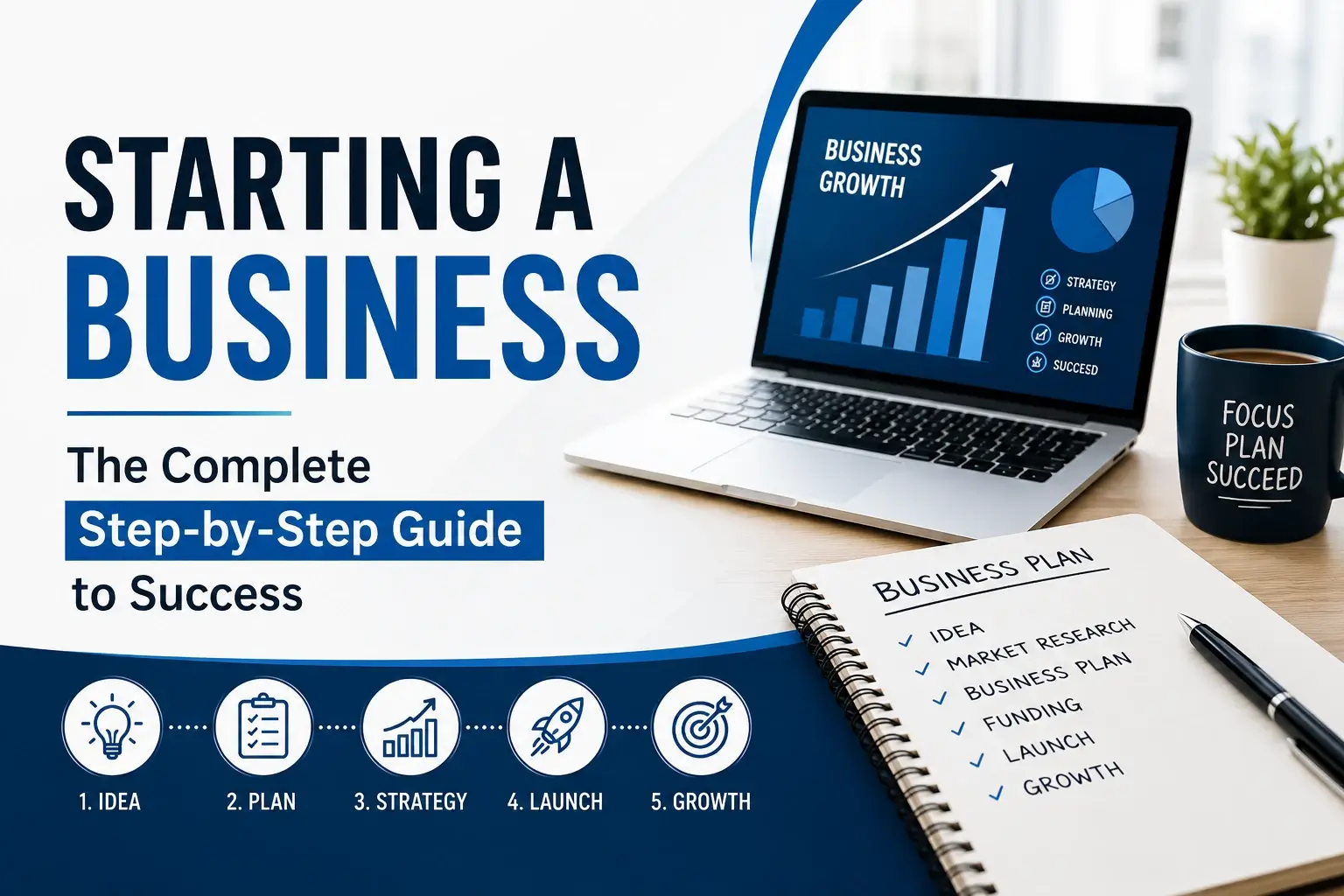
Starting a business represents one of the most exciting and challenging endeavors you can undertake. In today’s rapidly evolving economic landscape, more people than ever are taking the leap into entrepreneurship. Whether you’re dreaming of launching a tech startup, opening a local café, or building an e-commerce empire, starting a business requires careful planning, dedication, and the right knowledge.
The statistics are compelling. According to the U.S. Small Business Administration, small businesses create two out of every three new jobs in America. Yet, despite this opportunity, many aspiring entrepreneurs hesitate because they don’t know where to begin. This comprehensive guide will walk you through every essential aspect of starting a business, from validating your idea to securing funding and beyond.
Starting a business isn’t just about having a great idea—it’s about executing that idea with precision and persistence. Throughout this article, you’ll discover proven strategies, avoid common pitfalls, and gain the confidence you need to turn your entrepreneurial dreams into reality. Let’s dive into everything you need to know about starting a business in 2026.
What Is Starting a Business?
Starting a business means transforming an idea into a functioning commercial enterprise. This process involves multiple critical steps, including developing a viable concept, conducting thorough market research, creating a comprehensive business plan, securing funding, registering your company, and establishing operations. Starting a business requires entrepreneurs to wear many hats—from CEO to marketing director to accountant—especially in the early stages.
When you’re starting a business, you’re essentially creating value for customers while building an asset that can generate income and potentially grow over time. The journey from concept to launch typically takes anywhere from a few weeks to several months, depending on the complexity of your business model and industry requirements.
Modern entrepreneurship has evolved significantly. Today’s entrepreneurs can start a business from their laptop with minimal upfront investment, thanks to digital tools, e-commerce platforms, and remote work capabilities. However, regardless of your business type, certain fundamentals remain constant: you need a clear value proposition, a target market, and a sustainable revenue model.
Why Starting a Business Matters
Economic Impact
Starting a business contributes significantly to economic growth and innovation. Small businesses account for 44% of U.S. economic activity and create approximately 1.6 million jobs annually. When you’re starting a business, you’re not just creating opportunities for yourself—you’re contributing to job creation, community development, and economic diversification.
Entrepreneurs drive innovation by identifying gaps in the market and developing creative solutions. This innovation cycle benefits consumers through better products, improved services, and increased competition that keeps prices reasonable. Starting a business in emerging sectors can even create entirely new industries, as we’ve seen with companies like Uber, Airbnb, and countless tech startups.
Personal Fulfillment
Beyond economic contributions, starting a business offers profound personal rewards. Entrepreneurs enjoy autonomy over their work, the ability to pursue their passions, and the potential for unlimited earning capacity. Many business owners report higher job satisfaction compared to traditional employment because they’re building something that reflects their values and vision.
The learning curve when starting a business is steep but rewarding. You’ll develop skills in leadership, financial management, marketing, and problem-solving that serve you throughout your career. Even if your first venture doesn’t succeed as planned, the experience gained from starting a business proves invaluable for future endeavors.
Benefits of Starting a Business
Starting a business comes with numerous advantages that attract aspiring entrepreneurs:
- Financial Independence: When you’re starting a business, you control your earning potential. Unlike salaried positions with fixed income, successful businesses can generate substantial profits and build long-term wealth.
- Flexibility and Control: Business owners set their own schedules, choose their projects, and make strategic decisions. This autonomy proves especially valuable for those seeking work-life balance or wanting to prioritize family commitments.
- Creative Expression: Starting a business allows you to bring your unique ideas to life. Whether you’re passionate about sustainable fashion, innovative technology, or artisanal food products, entrepreneurship provides the platform to express your creativity.
- Legacy Building: Many entrepreneurs start a business to create something lasting that can be passed down to future generations or sold for significant returns.
- Tax Advantages: Business owners can deduct legitimate business expenses, potentially reducing their overall tax burden compared to traditional employees.
- Personal Growth: The challenges of starting a business accelerate personal development, building resilience, adaptability, and confidence.
Challenges Entrepreneurs Face
While starting a business offers exciting opportunities, it’s essential to understand the challenges ahead:
- Financial Uncertainty: Most new businesses don’t generate profit immediately. Entrepreneurs often face months or even years of limited income while building their customer base. According to the Bureau of Labor Statistics, approximately 20% of new businesses fail within the first two years, and 50% don’t survive past five years.
- Long Hours and Workload: Starting a business demands significant time investment. Many entrepreneurs work 60-80 hour weeks during the startup phase, balancing multiple responsibilities simultaneously.
- Risk and Stress: Financial risk, market uncertainty, and the pressure of making critical decisions create substantial stress. Entrepreneurs must develop coping strategies and maintain mental resilience.
- Limited Resources: New businesses typically operate with constrained budgets, requiring creative problem-solving and prioritization. You’ll need to do more with less, especially early on.
- Isolation: Unlike traditional employment, starting a business can be lonely. Entrepreneurs must proactively build networks and seek mentorship to combat isolation.
- Regulatory Complexity: Navigating licenses, permits, tax obligations, and compliance requirements proves challenging, particularly for first-time business owners.
Despite these challenges, proper planning and preparation significantly improve your chances of success when starting a business.
Choosing the Right Business Idea
Identifying Your Passion and Skills
The foundation of starting a business successfully begins with choosing the right idea. The best business concepts typically align with your passions, skills, and market demand. Start by asking yourself critical questions:
- What activities energize rather than drain you?
- What skills have you developed through education or work experience?
- What problems do you encounter regularly that need solving?
- What do people frequently ask you for help with?
When starting a business in an area you’re passionate about, you’ll maintain motivation through inevitable challenges. However, passion alone isn’t enough. You must also possess or be willing to develop the necessary skills to execute your vision effectively.
Consider conducting a personal SWOT analysis (Strengths, Weaknesses, Opportunities, Threats) to evaluate your readiness for starting a business in your chosen field. This self-assessment helps identify gaps you’ll need to address through learning, hiring, or partnerships.
Evaluating Market Demand
A great business idea must solve a real problem for a sufficient number of people willing to pay for the solution. When starting a business, validate demand before investing significant resources:
- Research Search Volume: Use tools like Google Trends, Google Keyword Planner, or SEMrush to determine if people are actively searching for solutions related to your business concept.
- Analyze Competitor Success: If competitors exist and are thriving, that’s actually a positive sign—it proves market demand. Your job becomes differentiating your offering.
- Conduct Surveys and Interviews: Talk directly to potential customers about their pain points and willingness to pay for solutions. Starting a business based on assumptions rather than data increases failure risk.
- Test with Minimum Viable Product (MVP): Before fully launching, create a simplified version of your product or service to gauge interest. This lean approach to starting a business minimizes risk while providing valuable feedback.
Conducting Market Research
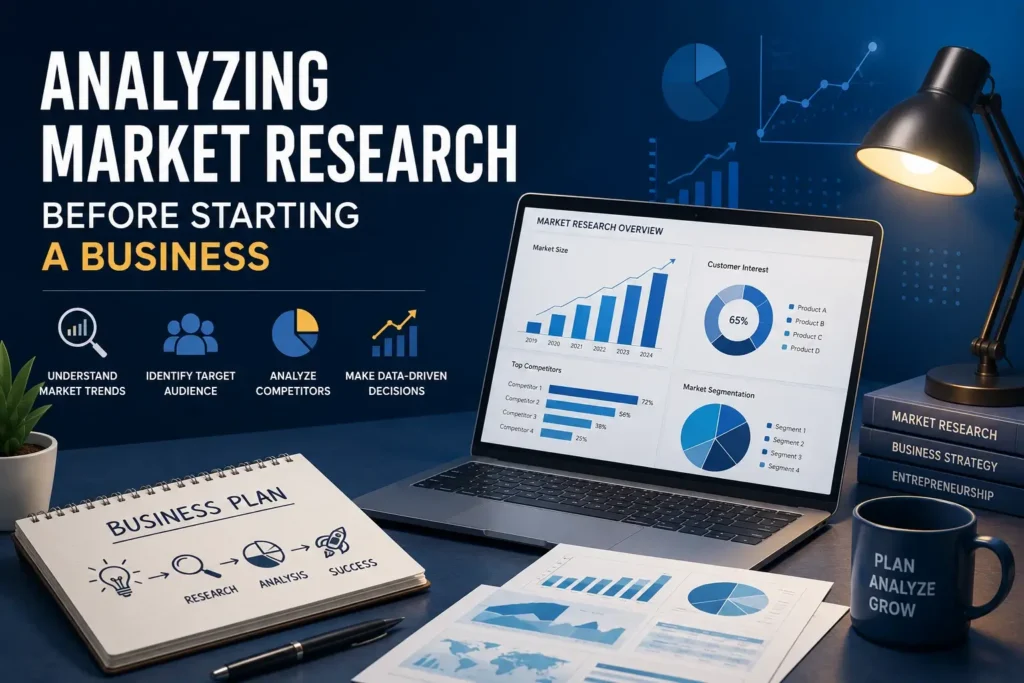
Understanding Your Target Audience
Thorough market research proves essential when starting a business. You must deeply understand who your customers are, what they need, and how they make purchasing decisions.
- Create Customer Personas: Develop detailed profiles of your ideal customers, including demographics, psychographics, behaviors, and pain points. For example, if you’re starting a business selling premium pet food, your persona might be “Sarah, 35, urban professional, earns $85,000 annually, values organic products, spends $200 monthly on her dog’s health.”
- Identify Customer Journey: Map out how potential customers discover solutions, evaluate options, and make purchase decisions. Understanding this journey helps you position your marketing effectively when starting a business.
- Determine Market Size: Calculate your total addressable market (TAM), serviceable available market (SAM), and serviceable obtainable market (SOM). These metrics help investors understand your growth potential and guide your strategic planning.
Analyzing Competitors
Competitive analysis provides crucial insights when starting a business:
- Direct Competitors: Identify businesses offering similar products or services to the same target market. Study their pricing, marketing strategies, customer reviews, and unique selling propositions.
- Indirect Competitors: Recognize alternative solutions customers might choose instead of your offering. For instance, if you’re starting a business selling meal kits, indirect competitors include restaurants, grocery stores, and food delivery apps.
- Competitive Advantages: Determine what will differentiate your business. This could be superior quality, better pricing, exceptional customer service, innovative features, or niche specialization. When starting a business, clear differentiation proves critical for standing out in crowded markets.
Use tools like SWOT analysis to evaluate competitors’ strengths, weaknesses, opportunities, and threats. This analysis reveals market gaps you can exploit when starting a business.
Creating a Business Plan

Executive Summary
A comprehensive business plan serves as your roadmap when starting a business. While some entrepreneurs skip this step, research shows that businesses with formal plans grow 30% faster than those without. Your business plan should include:
- Executive Summary: This section provides an overview of your entire plan, written last but appearing first. Include your business concept, mission statement, products or services, target market, competitive advantages, financial highlights, and funding requirements. Keep it concise—one to two pages maximum.
When starting a business, the executive summary often determines whether investors continue reading, so make it compelling and clear.
Market Analysis
Your market analysis demonstrates thorough research and understanding of your industry:
- Industry Description: Outline the current state of your industry, growth trends, and future projections. Include relevant statistics and cite authoritative sources.
- Target Market: Define your ideal customers with specificity. Include demographic data, geographic location, behavioral patterns, and purchasing power.
- Market Need: Clearly articulate the problem you’re solving and why existing solutions fall short.
- Competitive Landscape: Summarize your competitor analysis, highlighting your competitive advantages.
Financial Projections
Financial projections prove critical when starting a business, especially if seeking funding:
- Startup Costs: Itemize all expenses required to launch, including equipment, inventory, licenses, marketing, and working capital.
- Revenue Projections: Provide realistic sales forecasts for at least three years, broken down monthly for year one and quarterly thereafter. Base projections on market research, not optimism.
- Expense Budget: Detail operating expenses, including rent, utilities, salaries, marketing, insurance, and miscellaneous costs.
- Cash Flow Statement: Project monthly cash inflows and outflows. Cash flow problems cause many business failures, so this projection helps you anticipate and prevent shortfalls.
- Break-even Analysis: Calculate when your business will become profitable by determining how much revenue you need to cover all expenses.
Use spreadsheet software or business planning tools to create professional financial projections when starting a business.
Choosing a Business Structure
Sole Proprietorship
Selecting the right legal structure represents a crucial decision when starting a business. Your choice affects taxes, liability, registration requirements, and operational flexibility:
Sole Proprietorship: This simplest structure works well for low-risk businesses and solopreneurs. When starting a business as a sole proprietorship:
- Advantages: Easy and inexpensive to establish, complete control, simplified tax filing (profits reported on personal tax return)
- Disadvantages: Unlimited personal liability, difficulty raising capital, business ends with owner’s death
This structure suits freelancers, consultants, and very small operations when starting a business with minimal risk.
Partnership
Partnership: When two or more people start a business together, a partnership may be appropriate:
- General Partnership: All partners share management responsibilities and personal liability
- Limited Partnership: Includes general partners with liability and limited partners who are passive investors
Partnerships offer pass-through taxation and shared resources but require clear partnership agreements to prevent disputes when starting a business.
Limited Liability Company (LLC)
Limited Liability Company (LLC): This popular structure combines liability protection with tax flexibility:
- Advantages: Personal asset protection, flexible taxation (can choose corporate or pass-through), fewer formalities than corporations, no ownership restrictions
- Disadvantages: Self-employment taxes, varying state regulations, ownership transfer limitations
LLCs prove ideal for most small to medium-sized businesses when starting a business, offering protection without excessive complexity.
Corporation
Corporation: This structure creates a separate legal entity distinct from owners:
- C Corporation: Subject to corporate income tax; shareholders pay taxes again on dividends (double taxation)
- S Corporation: Avoids double taxation through pass-through taxation but has ownership restrictions
Corporations suit businesses planning to raise venture capital, go public, or offer extensive employee benefits when starting a business.
Consult with an attorney and accountant to determine the optimal structure for your specific situation when starting a business.
Registering Your Business
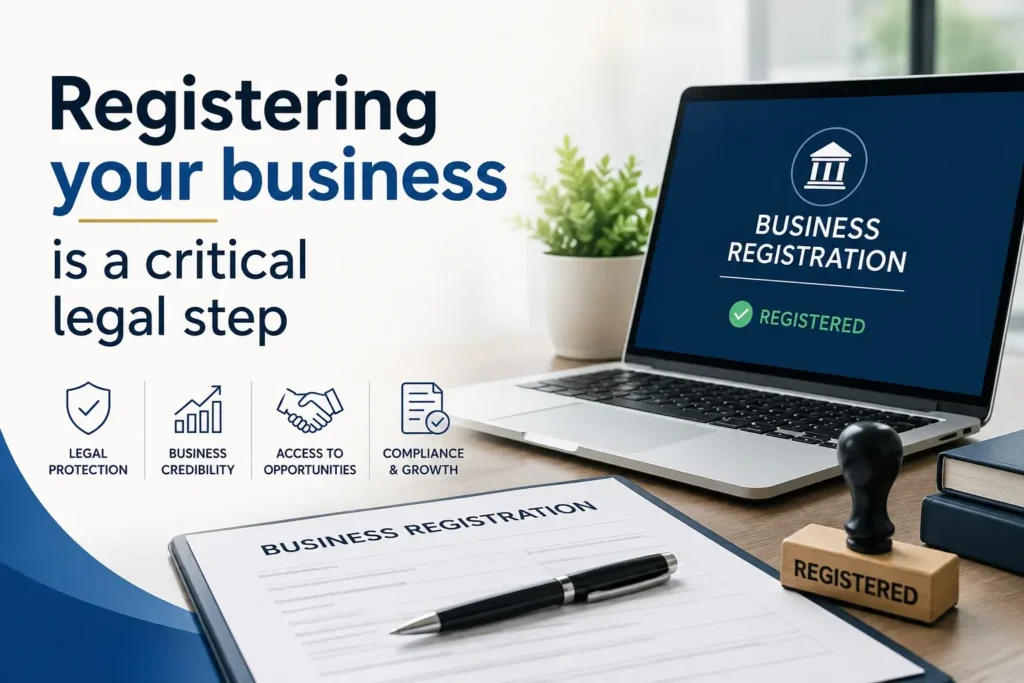
Business Name Registration
Once you’ve chosen your structure, you must officially register your business:
Business Name Registration: If operating under a name different from your legal name, file a “Doing Business As” (DBA) or fictitious name registration with your state or county. This public record informs customers who actually owns the business.
When starting a business, choose a name that’s memorable, easy to spell, available as a domain, and not already trademarked. Conduct thorough name searches through your state’s business registry and the U.S. Patent and Trademark Office.
State Registration: LLCs and corporations must file formation documents with your state:
- Articles of Organization (LLC)
- Articles of Incorporation (Corporation)
These documents typically require your business name, registered agent, business purpose, and filing fee ($50-$500 depending on state).
Obtaining an EIN
Obtaining an EIN: An Employer Identification Number (EIN) functions like a Social Security Number for your business. You’ll need an EIN when starting a business if you:
- Have employees
- Operate as a corporation or partnership
- File employment, excise, or alcohol/tobacco/firearms tax returns
- Open a business bank account
Apply for free through the IRS website. The process takes minutes, and you’ll receive your EIN immediately.
Registered Agent: Most states require businesses to designate a registered agent—someone available during business hours to receive legal documents. You can serve as your own registered agent or hire a professional service ($100-$300 annually).
Licenses and Permits
Compliance with licensing requirements proves essential when starting a business:
General Business License: Most cities and counties require a basic business license or tax registration certificate. Fees typically range from $50-$400 annually.
Professional Licenses: Certain professions require state-issued licenses, including:
- Healthcare providers
- Attorneys and accountants
- Real estate agents
- Contractors and electricians
- Cosmetologists
Industry-Specific Permits: Depending on your business type, you may need:
- Health department permits (restaurants, food service)
- Zoning permits (home-based businesses, retail locations)
- Environmental permits (manufacturing, waste disposal)
- Sign permits (exterior signage)
- Fire department permits (occupancy, safety)
Sales Tax Permit: If selling taxable goods or services, register for a sales tax permit with your state’s department of revenue. You’ll collect sales tax from customers and remit it to the state periodically.
Use the SBA’s license and permit lookup tool to identify requirements specific to your location and industry when starting a business. Non-compliance can result in fines, penalties, or business closure.
Funding Options
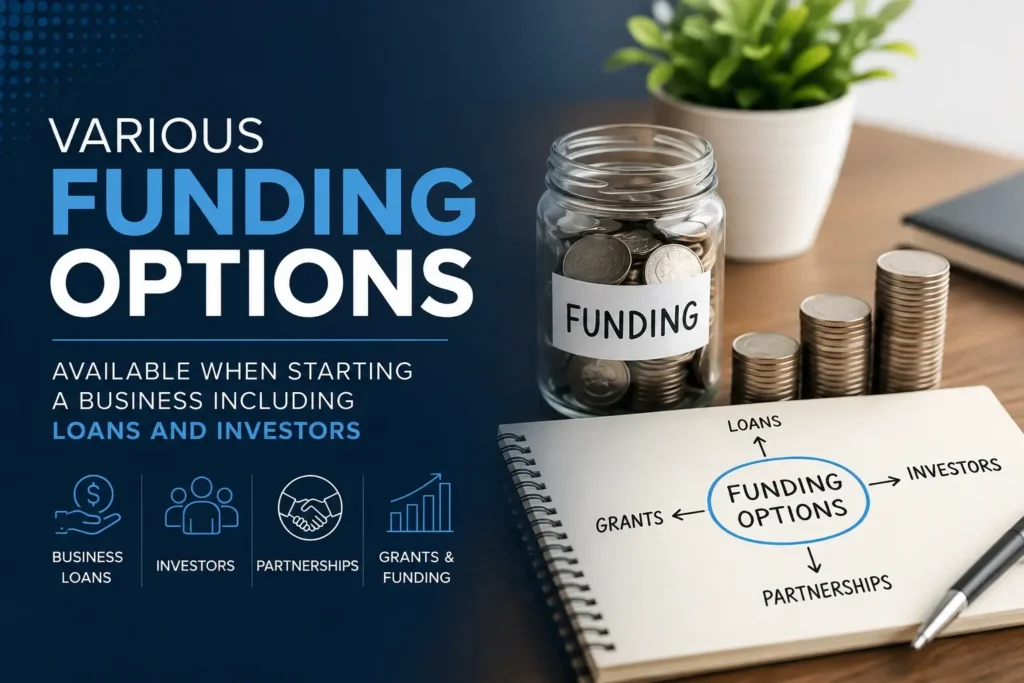
Self-Funding
Securing adequate funding represents one of the biggest challenges when starting a business. Explore these options:
Self-Funding (Bootstrapping): Many entrepreneurs start a business using personal savings, retirement funds, or assets. This approach offers complete control and avoids debt but limits growth potential and increases personal financial risk.
Approximately 80% of small business owners use personal savings when starting a business. While bootstrapping demonstrates commitment to investors, ensure you maintain an emergency fund separate from business capital.
Small Business Loans
Small Business Loans: Traditional financing options include:
- SBA Loans: The Small Business Administration guarantees loans through partner lenders, offering favorable terms. Popular programs include 7(a) loans (up to $5 million) and microloans (up to $50,000).
- Bank Loans: Traditional term loans require strong credit (typically 680+), collateral, and detailed business plans.
- Online Lenders: Fintech companies offer faster approval but higher interest rates than traditional banks.
When starting a business, lenders typically require:
- Personal and business credit scores
- Business plan with financial projections
- Collateral or personal guarantee
- Industry experience
- Down payment (10-30%)
Investors and Venture Capital
Investors and Venture Capital: If you’re starting a business with high growth potential, consider:
- Angel Investors: Affluent individuals who invest personal funds in exchange for equity. Typical investments range from $25,000 to $500,000.
- Venture Capital: Professional firms that invest in high-growth startups, usually requiring significant equity and board seats.
- Accelerators and Incubators: Programs providing funding, mentorship, and resources in exchange for equity (typically 5-10%).
These options suit technology startups and scalable businesses when starting a business, not traditional small businesses like restaurants or retail shops.
Crowdfunding
Crowdfunding: Platforms like Kickstarter, Indiegogo, and GoFundMe allow you to raise small amounts from many people:
- Reward-based: Backers receive products or perks
- Equity-based: Investors receive ownership stakes
- Debt-based: Borrowers repay with interest
Crowdfunding validates market demand while raising capital when starting a business, but requires significant marketing effort and compelling storytelling.
Startup Costs
Understanding and budgeting for startup costs prevents financial surprises when starting a business:
One-Time Startup Expenses:
- Business registration and legal fees: $500-$3,000
- Equipment and technology: $2,000-$50,000+
- Initial inventory: $1,000-$100,000+
- Branding and website development: $1,000-$15,000
- Office space deposits and improvements: $2,000-$50,000
- Insurance premiums: $500-$5,000
- Marketing and advertising launch: $1,000-$20,000
Ongoing Operating Expenses:
- Rent or mortgage: Varies widely
- Utilities: $200-$1,000/month
- Salaries and benefits: Major expense if hiring
- Marketing: 5-10% of projected revenue
- Insurance: $100-$1,000/month
- Software subscriptions: $50-$500/month
- Professional services (accountant, attorney): $100-$500/month
Working Capital: Maintain 3-6 months of operating expenses in reserve when starting a business. This cushion covers unexpected costs and revenue shortfalls during the launch phase.
Create a detailed spreadsheet categorizing all anticipated expenses. Research actual costs in your market rather than guessing. When starting a business, it’s better to overestimate expenses and underestimate revenue.
Branding Your Business
Strong branding differentiates your company when starting a business:
Brand Identity: Your brand encompasses more than a logo—it’s the complete perception customers have of your business. Develop:
- Brand Name: Memorable, distinctive, and relevant to your offerings
- Logo: Professional design that works across various sizes and mediums
- Color Palette: 2-4 colors that evoke desired emotions and ensure consistency
- Typography: Choose 2-3 fonts for different applications
- Brand Voice: Define your communication style (professional, friendly, authoritative, playful)
Brand Strategy: When starting a business, clarify:
- Mission Statement: Why your business exists beyond making money
- Vision Statement: Where you’re heading long-term
- Core Values: Principles guiding decisions and behavior
- Unique Value Proposition: What makes you different and better
Brand Guidelines: Create a document specifying how to use brand elements consistently across all touchpoints. This ensures cohesion as your business grows.
Invest in professional branding when starting a business—it’s difficult and expensive to rebrand later. Your brand represents your reputation and builds customer trust.
Creating a Marketing Strategy
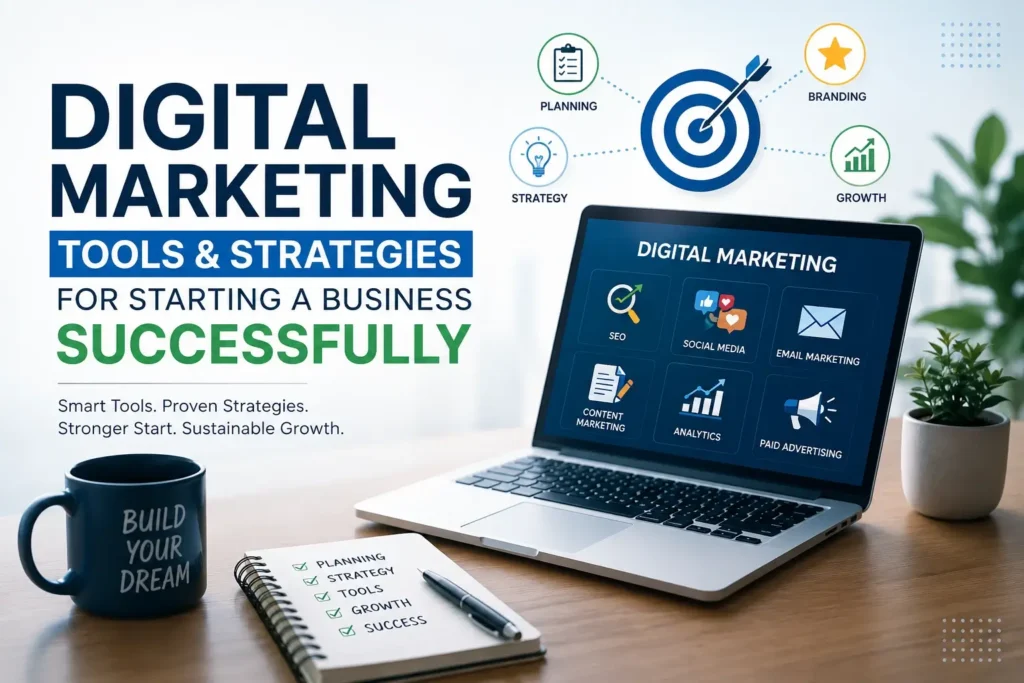
Digital Marketing
A comprehensive marketing strategy proves essential when starting a business. Without customers, even the best product fails:
Digital Marketing: Modern businesses need a strong online presence:
- Website: Your digital headquarters should be professional, mobile-responsive, fast-loading, and optimized for conversions. Include clear calls-to-action, contact information, and compelling content.
- Content Marketing: Create valuable blog posts, videos, podcasts, or infographics that attract and educate your target audience. Content establishes expertise and improves SEO when starting a business.
- Email Marketing: Build an email list from day one. Email provides direct communication with interested prospects and delivers excellent ROI ($42 for every $1 spent).
SEO for Businesses
SEO for Businesses: Search engine optimization helps customers find you organically:
- Keyword Research: Identify terms your target audience searches for when starting a business
- On-Page SEO: Optimize titles, meta descriptions, headers, and content for target keywords
- Technical SEO: Ensure fast loading speeds, mobile-friendliness, and proper site structure
- Local SEO: Claim your Google Business Profile, gather reviews, and maintain consistent NAP (name, address, phone) across directories
- Link Building: Earn backlinks from reputable websites to improve domain authority
SEO requires patience—results typically take 3-6 months when starting a business—but provides sustainable, cost-effective traffic long-term.
Social Media Marketing
Social Media Marketing: Choose platforms where your target audience spends time:
- B2B: LinkedIn, Twitter
- B2C: Instagram, Facebook, TikTok, Pinterest
- Visual Products: Instagram, Pinterest
- Professional Services: LinkedIn
Post consistently, engage authentically, and provide value rather than constant selling. Use social media management tools to schedule content and track performance when starting a business.
Paid Advertising: Consider Google Ads, Facebook Ads, or Instagram Ads for faster results. Start with small budgets, test different approaches, and scale what works.
Hiring Employees
When to Hire
Knowing when and how to hire proves critical when starting a business:
When to Hire: Don’t rush to hire. First, maximize your own productivity and outsource non-core tasks. Hire when:
- You’re consistently turning away work due to capacity
- Revenue can sustainably cover salary plus benefits (typically 1.25-1.4x salary)
- You’ve documented processes that others can follow
- The role directly contributes to revenue or essential operations
Types of Workers:
- Employees: Full control but higher costs (payroll taxes, benefits, workers’ compensation)
- Independent Contractors: Lower costs and flexibility but less control; misclassification risks penalties
- Freelancers: Project-based work ideal for specialized tasks like design or writing
Hiring Process
Hiring Process: When starting a business and ready to hire:
- Write Clear Job Descriptions: Specify responsibilities, qualifications, and expectations
- Recruit: Post on job boards, LinkedIn, industry sites, and your network
- Screen Candidates: Review resumes, conduct phone screenings
- Interview: Use structured interviews with consistent questions for all candidates
- Check References: Verify past performance and work ethic
- Make Offer: Present competitive compensation and benefits
- Onboard: Provide training, resources, and clear expectations
Comply with employment laws including minimum wage, overtime, anti-discrimination, and workplace safety regulations when starting a business and hiring employees.
Financial Management
Accounting Systems
Proper financial management separates successful businesses from failures when starting a business:
Accounting Systems: Implement systems from day one:
- Accounting Software: Use QuickBooks, Xero, or FreshBooks to track income, expenses, and generate financial statements
- Separate Bank Accounts: Never mix personal and business finances. Open a dedicated business checking account when starting a business
- Bookkeeping: Record transactions consistently—monthly at minimum, weekly ideally
- Receipts and Documentation: Keep organized records of all business expenses for tax deductions and audits
Key Financial Metrics: Monitor these indicators regularly:
- Revenue: Total sales before expenses
- Gross Profit: Revenue minus cost of goods sold
- Net Profit: Revenue minus all expenses
- Cash Flow: Money moving in and out of your business
- Profit Margins: Percentage of revenue retained as profit
- Accounts Receivable: Money customers owe you
- Accounts Payable: Money you owe suppliers
Tax Obligations
Tax Obligations: When starting a business, understand your tax responsibilities:
- Income Tax: Pay federal and state taxes on business profits
- Self-Employment Tax: Cover Social Security and Medicare (15.3% of net earnings)
- Sales Tax: Collect and remit if selling taxable goods/services
- Employment Taxes: Withhold and pay payroll taxes if you have employees
- Estimated Taxes: Pay quarterly if expecting to owe $1,000+ annually
Hire a qualified accountant or CPA when starting a business. Professional guidance prevents costly mistakes and identifies deduction opportunities.
Risk Management
Protecting your business from risks proves essential when starting a business:
Insurance Coverage:
- General Liability Insurance: Covers third-party bodily injury, property damage, and advertising injury ($400-$1,500 annually)
- Professional Liability Insurance: Protects against claims of negligence or inadequate work (essential for consultants and service providers)
- Property Insurance: Covers damage to business property and equipment
- Workers’ Compensation: Required if you have employees; covers work-related injuries
- Cyber Liability Insurance: Protects against data breaches and cyberattacks (increasingly important)
- Business Interruption Insurance: Replaces lost income if you must close temporarily
Legal Protection:
- Contracts: Use written contracts for all significant transactions, employment, and partnerships
- Terms of Service: Protect your website and limit liability
- Privacy Policy: Required if collecting customer data; ensures GDPR/CCPA compliance
- Intellectual Property Protection: Trademark your brand, patent inventions, copyright original content
Consult with an insurance agent and attorney when starting a business to identify risks specific to your industry.
Common Mistakes to Avoid
Learning from others’ mistakes improves your chances when starting a business:
- Insufficient Planning: Many entrepreneurs rush into starting a business without adequate research or planning. Skip the business plan at your peril.
- Undercapitalization: Running out of cash causes many failures. When starting a business, secure more funding than you think you need and maintain reserves.
- Poor Market Fit: Building products nobody wants wastes time and money. Validate demand before significant investment.
- Ignoring Competition: Assuming you have no competitors indicates insufficient research. Understand your competitive landscape when starting a business.
- Neglecting Marketing: Great products don’t sell themselves. Allocate adequate budget and time to marketing from the beginning.
- Trying to Do Everything Alone: Entrepreneurs often resist delegating or seeking help. Build a support network of mentors, advisors, and peers when starting a business.
- Pricing Mistakes: Charging too little leaves money on the table; charging too much limits sales. Research market rates and value-based pricing.
- Scaling Too Fast: Rapid growth strains resources and cash flow. Grow sustainably when starting a business.
- Poor Cash Flow Management: Profit doesn’t equal cash. Monitor cash flow closely and invoice promptly.
- Giving Up Too Soon: Success rarely happens overnight. Persistence separates successful entrepreneurs from those who quit prematurely.
Business Growth Strategies
Scaling Your Business
Once you’ve successfully launched, focus shifts to growth when starting a business:
Scaling Strategies:
- Expand Product/Service Lines: Offer complementary products or services to existing customers
- Enter New Markets: Target different geographic areas or customer segments
- Increase Marketing Investment: Scale what’s working with additional budget
- Build Partnerships: Collaborate with complementary businesses for mutual benefit
- Improve Operations: Streamline processes to handle increased volume efficiently
- Invest in Technology: Automate repetitive tasks and improve customer experience
- Hire Strategically: Add team members who fill skill gaps and support growth
Measuring Growth: Track key performance indicators (KPIs):
- Revenue growth rate
- Customer acquisition cost (CAC)
- Customer lifetime value (CLV)
- Monthly recurring revenue (MRR)
- Churn rate
- Net promoter score (NPS)
Sustainable Growth: Balance ambition with sustainability when starting a business. Rapid growth without proper infrastructure leads to quality issues, employee burnout, and customer dissatisfaction.
Future Trends
Emerging Opportunities
Staying ahead of trends positions your business for success when starting a business:
Technology Trends:
- Artificial Intelligence: AI tools improve efficiency, customer service, and decision-making
- Automation: Streamline operations and reduce manual tasks
- E-commerce Growth: Online shopping continues expanding across all categories
- Remote Work: Access global talent and reduce overhead costs
- Sustainability: Consumers increasingly prefer eco-friendly businesses
Market Trends:
- Personalization: Customers expect tailored experiences and products
- Subscription Models: Recurring revenue provides predictability
- Experience Economy: Consumers value experiences over possessions
- Health and Wellness: Growing demand for products promoting wellbeing
- Local and Authentic: Support for local businesses and authentic brands
When starting a business, consider how these trends impact your industry and position yourself accordingly. Adaptability proves crucial in today’s rapidly changing business environment.
Expert Tips
Advice from Successful Entrepreneurs
Learn from those who’ve successfully navigated starting a business:
- Start Before You’re Ready: Perfectionism paralyzes many aspiring entrepreneurs. Launch with a minimum viable product and improve based on feedback.
- Focus on Customer Value: Every decision should enhance customer value. Happy customers become repeat buyers and brand advocates.
- Build Relationships: Networking opens doors to opportunities, partnerships, and mentorship. Attend industry events and join entrepreneur groups when starting a business.
- Embrace Failure: Setbacks provide valuable lessons. Analyze failures objectively, adjust your approach, and persist.
- Prioritize Work-Life Balance: Burnout destroys businesses. Set boundaries, take breaks, and maintain relationships outside work.
- Continuous Learning: Markets, technology, and best practices evolve constantly. Read books, take courses, and stay curious.
- Financial Discipline: Monitor expenses rigorously, especially early on. Every dollar saved extends your runway when starting a business.
- Delegate and Trust: You can’t do everything. Hire competent people and trust them to execute.
Real-world Examples
Success Stories
Examining successful businesses provides inspiration and lessons when starting a business:
Warby Parker:
Four friends started this eyewear company in 2010, disrupting the expensive glasses industry with affordable, stylish frames sold online. They validated demand by selling just 100 pairs from a small apartment. Today, Warby Parker operates hundreds of retail locations and values over $3 billion.
Key Lesson: When starting a business, test your concept inexpensively before scaling.
Spanx:
Sara Blakely started this shapewear company with $5,000 in savings, writing her own patent and personally pitching retailers. She maintained control and built Spanx into a billion-dollar brand without outside investment.
Key Lesson: Bootstrapping when starting a business preserves ownership and forces disciplined spending.
Mailchimp:
Ben Chestnut and Dan Kurzius started this email marketing platform as a side project while running a design agency. They grew it organically over 20 years, eventually selling for $12 billion.
Key Lesson: When starting a business, solve problems you personally experience; you’ll understand customer needs intimately.
Case Studies
Lessons from Different Industries
Case Study 1: Food Truck to Restaurant Empire
Maria Rodriguez started a food truck in Austin, Texas, with $15,000 in savings. She specialized in fusion tacos, combining Mexican and Asian flavors. Within six months, she built a loyal following through social media and local events.
Strategy:
- Validated concept with minimal investment
- Built brand through Instagram and word-of-mouth
- Collected customer emails for marketing
- Reinvested profits into better equipment
Results: After two years, Maria opened her first brick-and-mortar restaurant. Five years after starting a business, she operates three locations generating $2.5 million annually.
Case Study 2: SaaS Startup
David Chen identified a problem while working in project management: existing tools were either too simple or overly complex. He taught himself coding and built a minimum viable product in three months.
Strategy:
- Launched beta version to 50 users for feedback
- Implemented customer suggestions rapidly
- Offered free tier to build user base
- Focused on exceptional customer support
Results: Within 18 months of starting a business, David’s SaaS platform reached 10,000 paying customers and $500,000 in monthly recurring revenue. He secured $2 million in Series A funding to accelerate growth.
Key Takeaway: Both examples demonstrate that starting a business successfully requires identifying real problems, validating solutions, and iterating based on customer feedback.
Actionable Checklist
Your Starting a Business Roadmap
Use this comprehensive checklist when starting a business:
Pre-Launch Phase:
✓ Validate business idea through market research
✓ Conduct competitor analysis
✓ Define target audience and create customer personas
✓ Write comprehensive business plan
✓ Choose and register business name
✓ Select legal structure (LLC, corporation, etc.)
✓ Register business with state
✓ Obtain EIN from IRS
✓ Open business bank account
✓ Secure necessary licenses and permits
✓ Purchase insurance coverage
✓ Set up accounting system
✓ Create brand identity (logo, colors, voice)
✓ Build professional website
✓ Establish social media presence
✓ Develop marketing strategy
✓ Calculate startup costs and secure funding
✓ Set up business phone and email
✓ Create contracts and legal documents
✓ Establish pricing strategy
Launch Phase:
✓ Soft launch to test operations
✓ Gather initial customer feedback
✓ Implement improvements
✓ Official public launch
✓ Execute marketing campaigns
✓ Monitor cash flow daily
✓ Track key metrics
✓ Provide exceptional customer service
✓ Collect testimonials and reviews
Post-Launch Phase:
✓ Review financial performance monthly
✓ Adjust strategies based on data
✓ Scale successful initiatives
✓ Build team as needed
✓ Continue learning and adapting
✓ Network with other entrepreneurs
✓ Plan for growth
✓ Maintain work-life balance
Frequently Asked Questions
1. How much money do I need to start a business?
The cost of starting a business varies dramatically by type. Service businesses might require $2,000-$10,000, while retail or manufacturing could need $50,000-$500,000+. Many successful entrepreneurs start businesses with less than $5,000 through bootstrapping and lean methodologies.
2. How long does it take to start a business?
You can legally register a business in 1-4 weeks. However, properly planning, funding, and launching typically takes 3-6 months. Complex businesses requiring significant capital, permits, or product development may take 12-18 months when starting a business.
3. Do I need a business degree to start a business?
No formal education requirement exists for starting a business. Many successful entrepreneurs lack business degrees. However, understanding fundamentals like finance, marketing, and operations helps. You can learn through courses, mentors, books, and experience.
4. Can I start a business while working full-time?
Yes, many entrepreneurs start businesses part-time while employed. This approach reduces financial risk and provides income while building your venture. Ensure your employment contract doesn’t prohibit side businesses, and manage your time effectively.
5. What’s the best business structure for beginners?
LLCs typically suit most beginners starting a business. They offer liability protection, tax flexibility, and simpler administration than corporations. Sole proprietorships work for very low-risk, solo operations but provide no liability protection.
6. How do I know if my business idea is good?
Validate your idea through market research, customer interviews, and testing. Look for: genuine customer pain points, sufficient market size, willingness to pay, competitive advantages, and your ability to execute. When starting a business, ideas solving urgent problems for specific audiences perform best.
7. Should I get a business loan to start a business?
Loans make sense if you have a proven concept, clear revenue projections, and can comfortably service debt. Avoid loans for untested ideas or if payments would strain cash flow. Consider bootstrapping, investors, or grants before taking on debt when starting a business.
8. What taxes do I pay when starting a business?
You’ll pay income tax on profits, self-employment tax (15.3%), and potentially sales tax, employment taxes, and local business taxes. Tax obligations vary by structure, location, and activities. Consult a CPA when starting a business to understand your specific responsibilities.
9. How do I find customers for my new business?
Use multiple channels: content marketing, SEO, social media, email marketing, networking, referrals, paid advertising, and partnerships. Focus on where your target customers spend time. When starting a business, provide exceptional value and service to generate word-of-mouth referrals.
10. When should I quit my job to start a business full-time?
Transition when your business generates consistent revenue covering living expenses (ideally 6+ months), you have 6-12 months of personal savings, and growth trajectory is positive. Some entrepreneurs wait until business income exceeds their salary. Starting a business part-time first reduces risk significantly.
Key Takeaways
- Starting a business requires careful planning, market research, and adequate funding to succeed
- Choose the right legal structure (LLC recommended for most) to protect personal assets
- Validate your business idea before investing significant time and money
- Create a comprehensive business plan including realistic financial projections
- Secure necessary licenses, permits, and insurance before launching
- Build a strong brand identity and digital presence from day one
- Implement proper accounting and financial management systems immediately
- Focus on solving real customer problems and delivering exceptional value
- Monitor cash flow closely—it’s the lifeblood of your business
- Expect challenges and setbacks; persistence and adaptability prove essential
- Network with mentors and other entrepreneurs for guidance and support
- Start before you’re perfectly ready; learn and improve through action
Conclusion
Starting a business represents both an exciting opportunity and a significant commitment. The journey from idea to successful enterprise requires dedication, strategic planning, and continuous learning. While challenges abound, the rewards—financial independence, personal fulfillment, and the ability to create value—make entrepreneurship worthwhile for those willing to put in the work.
Remember that starting a business isn’t a linear path. You’ll encounter obstacles, make mistakes, and need to pivot occasionally. What separates successful entrepreneurs from those who fail isn’t avoiding problems but rather how they respond to them. Stay focused on your vision, remain adaptable, and never stop learning.
The resources, tools, and support available to entrepreneurs today exceed anything previous generations enjoyed. Online courses, mentorship programs, funding options, and technology platforms have democratized entrepreneurship. If you’ve been contemplating starting a business, there’s never been a better time to take that first step.
Your entrepreneurial journey begins with a single decision. Don’t wait for the perfect moment—it doesn’t exist. Start where you are, use what you have, and take consistent action toward your goals. The world needs your ideas, your passion, and your unique contribution.
Are you ready to start your business? Begin today by validating your idea, writing your business plan, or having conversations with potential customers. Your future self will thank you for taking that first brave step.
References
- U.S. Small Business Administration. (2024). Frequently asked questions about starting a business.
- Internal Revenue Service. (2024). Self-employed individuals tax center. https://www.irs.gov/businesses/small-businesses-self-employed/self-employed-individuals-tax-center
- SCORE. (2024). Starting a business: A step-by-step guide.
- Harvard Business Review. (2023). The psychology of entrepreneurial failure and success. https://hbr.org/topic/entrepreneurship
- Investopedia. (2024). How to start a business: A comprehensive guide.
- World Bank. (2024). Doing business: Starting a business indicators. https://www.worldbank.org/en/topic/entrepreneurship
- Forbes. (2024). The ultimate guide to starting a business in 2024. https://www.forbes.com/advisor/business/how-to-start-a-business/
- Entrepreneur. (2024). Starting a business: Complete startup guide. https://www.entrepreneur.com/starting-a-business
- U.S. Chamber of Commerce. (2024). Starting a business: Resources and guides. https://www.uschamber.com/co/start

 Inar Learn