
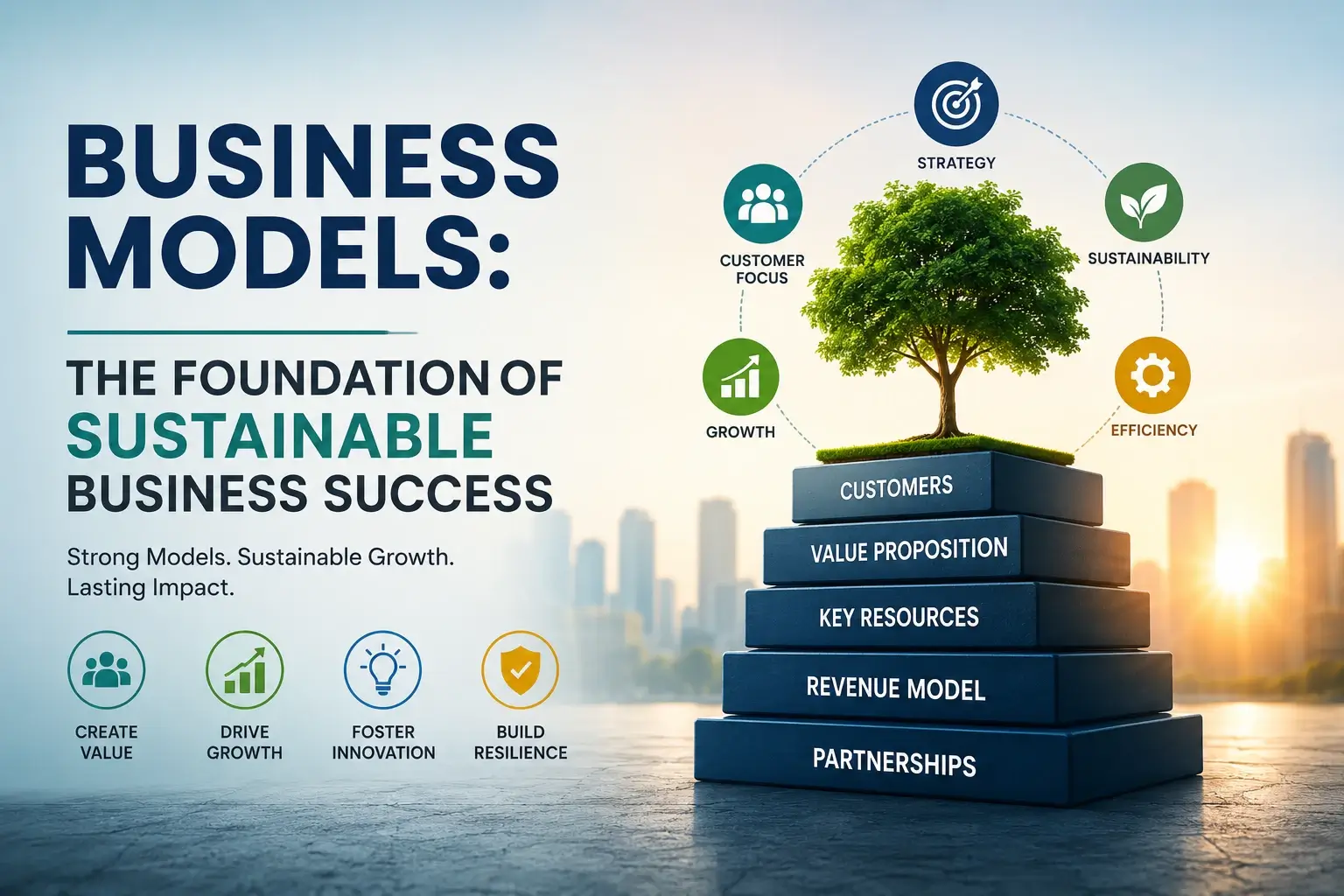
In today’s competitive and rapidly evolving marketplace, understanding Business Models is essential for entrepreneurs, business leaders, investors, and organizations seeking long-term success. A company may have an innovative product, exceptional talent, and significant financial resources, but without a clear and effective business model, sustainable growth can be difficult to achieve.
After you understand what a business is and Types of Businesses, the next critical concept is how it works financially. A business model defines how an organization creates, delivers, and captures value. It serves as the blueprint that explains how a company operates, generates revenue, serves customers, and maintains profitability. Whether a startup is disrupting an industry or an established enterprise is adapting to market changes, selecting the right business model can significantly influence success.
This article explores the concept of Business Models, their importance, key components, popular types, benefits, challenges, and best practices for developing an effective model that drives growth and competitive advantage.
Table of Contents
📌 What Are Business Models?
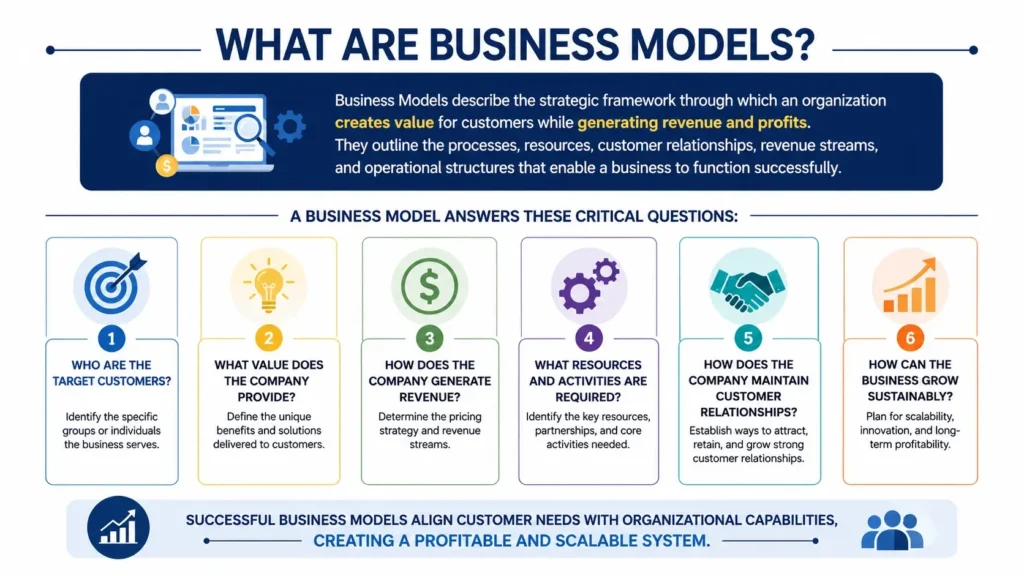
Business Models describe the strategic framework through which an organization creates value for customers while generating revenue and profits. They outline the processes, resources, customer relationships, revenue streams, and operational structures that enable a business to function successfully.
Simply put, a business model answers several critical questions:
- 🎯 Who are the target customers?
- 💡 What value does the company provide?
- 💰 How does the company generate revenue?
- ⚙️ What resources and activities are required?
- 🤝 How does the company maintain customer relationships?
- 📈 How can the business grow sustainably?
Successful Business Models align customer needs with organizational capabilities, creating a profitable and scalable system.
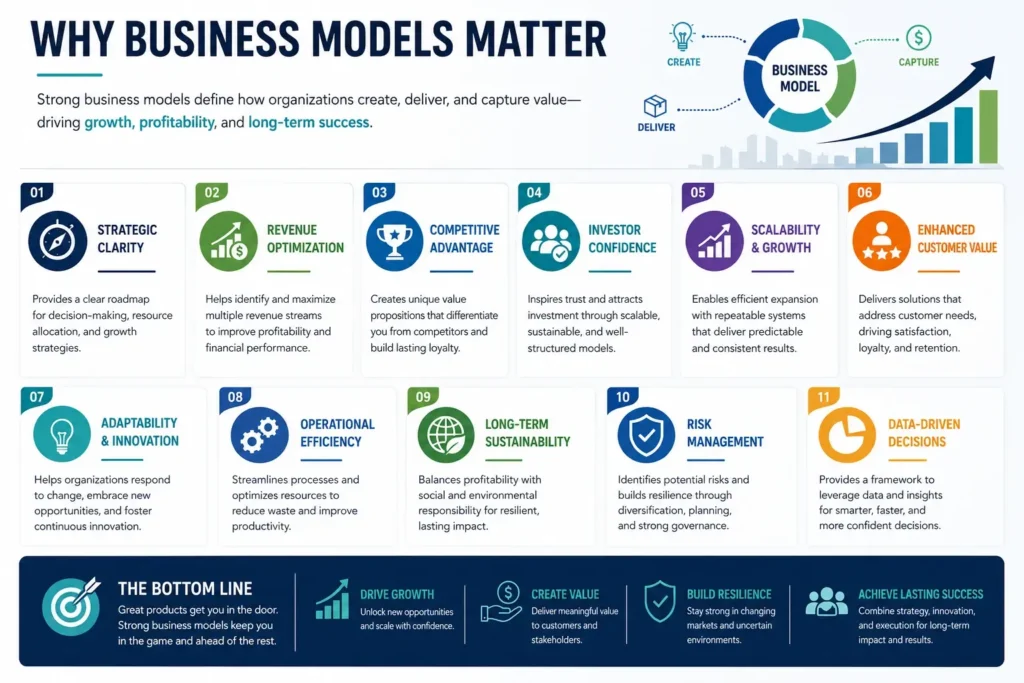
🌟 Why Business Models Matter
The importance of Business Models extends far beyond revenue generation. They provide strategic direction and help organizations remain competitive in dynamic markets.
Key Benefits Include:
🧭 Strategic Clarity
Well-defined Business Models provide a clear roadmap for decision-making, resource allocation, and growth strategies. They help organizations align their goals, operations, and resources toward a common vision while reducing uncertainty in business planning.
💰 Revenue Optimization
Organizations can identify multiple revenue streams and maximize profitability through effective business model design. By understanding how value is created and monetized, businesses can improve pricing strategies, reduce costs, and increase overall financial performance.
🏆 Competitive Advantage
Innovative Business Models often create differentiation that competitors struggle to replicate. Companies that develop unique ways of delivering value can strengthen their market position, enhance customer loyalty, and maintain a sustainable edge over rivals.
📊 Investor Confidence
Investors are more likely to support businesses with clear, scalable, and sustainable business models. A strong model demonstrates growth potential, financial viability, and risk management, making it easier to attract funding and strategic partnerships.
🚀 Scalability
Strong Business Models facilitate growth by providing repeatable systems and predictable outcomes. As demand increases, organizations can expand operations more efficiently without significantly increasing costs or complexity.
🤝 Enhanced Customer Value
A well-structured business model ensures that products and services effectively address customer needs and pain points. This leads to higher customer satisfaction, stronger relationships, and improved retention rates.
🔄 Adaptability and Innovation
Business Models help organizations respond to market changes, technological advancements, and evolving customer preferences. Companies with flexible models can innovate more quickly and seize new opportunities as they emerge.
⚙️ Operational Efficiency
Clearly defined processes, resources, and value chains enable organizations to operate more efficiently. This reduces waste, improves productivity, and supports consistent delivery of products and services.
🌍 Long-Term Sustainability
Successful Business Models balance profitability with environmental, social, and economic considerations. This helps businesses build resilience, maintain stakeholder trust, and achieve sustainable growth over time.
📈 Risk Management
A robust business model allows organizations to identify potential risks, evaluate vulnerabilities, and develop contingency plans. Diversified revenue streams and clear operational structures can reduce exposure to market uncertainties.
🔑 Core Components of Business Models
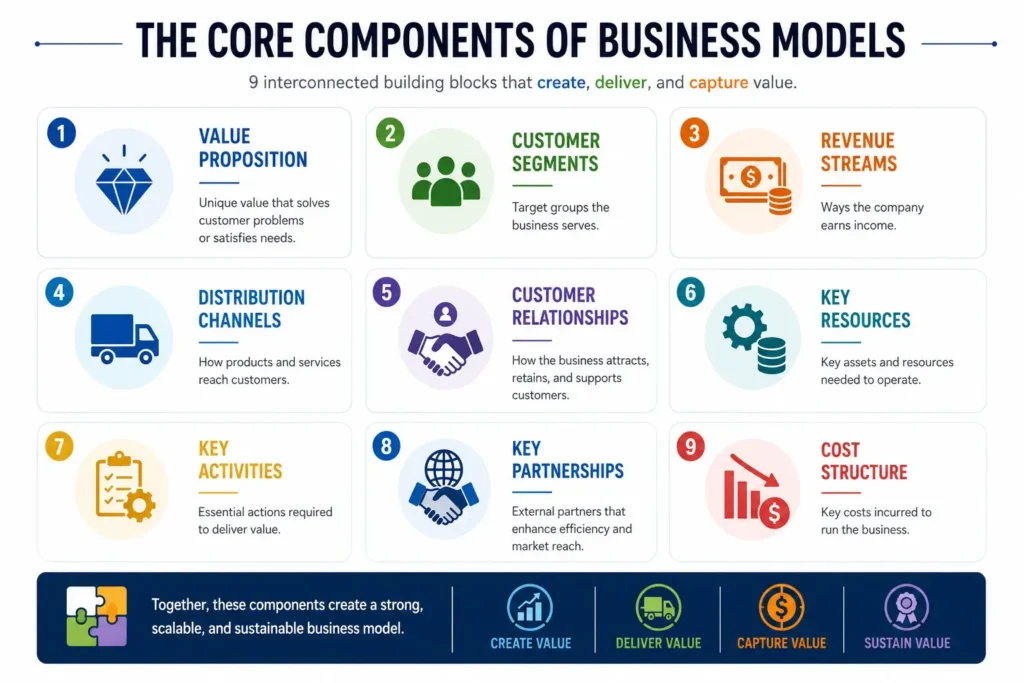
Most successful Business Models consist of several interconnected components.
💡 Value Proposition
The value proposition explains why customers choose a company’s products or services. It identifies the unique benefits offered to solve customer problems or satisfy needs.
Examples include:
- Lower costs
- Superior quality
- Convenience
- Innovation
- Exceptional customer service
👥 Customer Segments
Businesses must identify and understand their target audience. Different customer groups often require distinct approaches and solutions.
Customer segments may include:
- Consumers
- Small businesses
- Enterprises
- Government organizations
- Niche markets
💵 Revenue Streams
Revenue streams define how a company earns income.
Common revenue sources include:
- Product sales
- Subscription fees
- Licensing
- Advertising
- Service fees
- Commission-based earnings
📦 Distribution Channels
These are the methods through which products and services reach customers.
Examples include:
- Online stores
- Retail outlets
- Direct sales teams
- Mobile applications
- Distribution partners
🤝 Customer Relationships
Organizations must determine how they attract, retain, and support customers.
Approaches may include:
- Personalized support
- Self-service platforms
- Community engagement
- Loyalty programs
- Automated services
⚙️ Key Resources
Resources required to operate include:
- Human talent
- Technology
- Intellectual property
- Financial capital
- Physical assets
🔄 Key Activities
These are the essential actions necessary to deliver value.
Examples include:
- Product development
- Marketing
- Manufacturing
- Customer support
- Research and innovation
🌐 Key Partnerships
Partnerships often enhance efficiency and market reach.
Potential partners include:
- Suppliers
- Technology providers
- Distributors
- Strategic alliances
- Outsourcing vendors
📉 Cost Structure
Understanding costs is vital for maintaining profitability.
Major cost categories include:
- Operations
- Labor
- Marketing
- Infrastructure
- Research and development
🏢 Common Types of Business Models
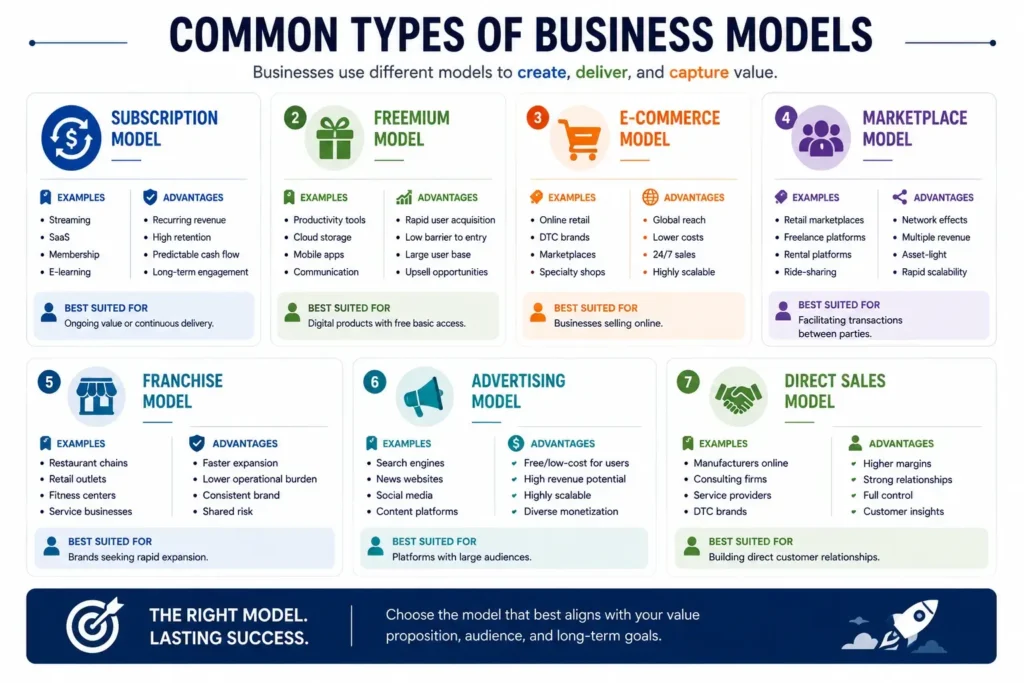
Business models define how an organization creates, delivers, and captures value. Across industries, companies adopt different business models based on their target market, customer needs, competitive environment, and revenue objectives. Understanding these models helps businesses identify sustainable growth opportunities and optimize profitability.
Selecting the right business model is a critical strategic decision that influences a company’s growth, profitability, customer relationships, and competitive advantage. While some organizations rely on a single model, many successful businesses combine multiple approaches—for example, using a Freemium + Subscription strategy or an E-Commerce + Advertising model—to diversify revenue streams and strengthen market position.
The most successful business model is not necessarily the most popular one—it is the one that best aligns with the company’s value proposition, target audience, and long-term business objectives. 🚀
🔄 Subscription Model
The Subscription Model generates recurring revenue by charging customers a regular fee—monthly, quarterly, or annually—for continued access to a product or service.
Examples
- Streaming platforms
- Software-as-a-Service (SaaS) solutions
- Membership-based services
- Online learning platforms
Key Advantages
✅ Predictable and recurring revenue streams
✅ Higher customer retention and loyalty
✅ Improved cash flow forecasting
✅ Opportunities for long-term customer engagement
Best Suited For
Businesses offering ongoing value, continuous updates, or regular content delivery.
🎁 Freemium Model
Under the Freemium Model, companies provide basic features at no cost while charging users for advanced functionalities, premium services, or enhanced experiences.
Examples
- Productivity and collaboration tools
- Cloud storage platforms
- Mobile applications
- Digital communication services
Key Advantages
✅ Rapid customer acquisition
✅ Low barrier to entry for users
✅ Large user base creation
✅ Strong upselling and conversion opportunities
Best Suited For
Digital products where users can experience value before committing to a paid plan.
🛒 E-Commerce Model
The E-Commerce Model enables businesses to sell products or services directly through online channels, eliminating the need for physical storefronts.
Examples
- Online retail stores
- Direct-to-consumer (DTC) brands
- Digital product marketplaces
- Specialty online shops
Key Advantages
✅ Access to global markets
✅ Lower operational and infrastructure costs
✅ 24/7 sales capability
✅ High scalability and growth potential
Best Suited For
Businesses seeking broad market reach with digital sales and distribution capabilities.
🌍 Marketplace Model
Marketplace businesses act as intermediaries by connecting buyers and sellers while earning revenue through commissions, transaction fees, subscriptions, or advertising.
Examples
- Online retail marketplaces
- Freelance service platforms
- Property rental platforms
- Ride-sharing applications
Key Advantages
✅ Strong network effects as users grow
✅ Multiple revenue generation opportunities
✅ Asset-light business structure
✅ Rapid scalability
Best Suited For
Businesses focused on facilitating transactions between independent parties.
🏪 Franchise Model
The Franchise Model allows entrepreneurs (franchisees) to operate under an established brand by paying licensing fees and following standardized business processes.
Examples
- Restaurant chains
- Retail outlets
- Fitness centers
- Service-based businesses
Key Advantages
✅ Faster market expansion
✅ Reduced operational burden for the franchisor
✅ Consistent brand experience
✅ Shared business risk
Best Suited For
Established brands seeking rapid expansion while maintaining operational standards.
📢 Advertising Model
In the Advertising Model, businesses generate revenue by selling advertising space, promotional opportunities, or audience access to advertisers.
Examples
- Search engines
- News and media websites
- Social media platforms
- Content-sharing platforms
Key Advantages
✅ Free or low-cost access for users
✅ Significant revenue potential with large audiences
✅ Highly scalable business model
✅ Diverse monetization opportunities
Best Suited For
Platforms with substantial user traffic, engagement, and content consumption.
🤝 Direct Sales Model
The Direct Sales Model involves selling products or services directly to end customers without relying on intermediaries, wholesalers, or retailers.
Examples
- Manufacturers selling online
- Consulting firms
- Professional service providers
- Direct-to-consumer brands
Key Advantages
✅ Higher profit margins
✅ Stronger customer relationships
✅ Greater control over customer experience
✅ Valuable customer insights and feedback
Best Suited For
Businesses aiming to build direct customer connections and maximize revenue per sale.
🚀 Innovative Business Models Transforming Industries
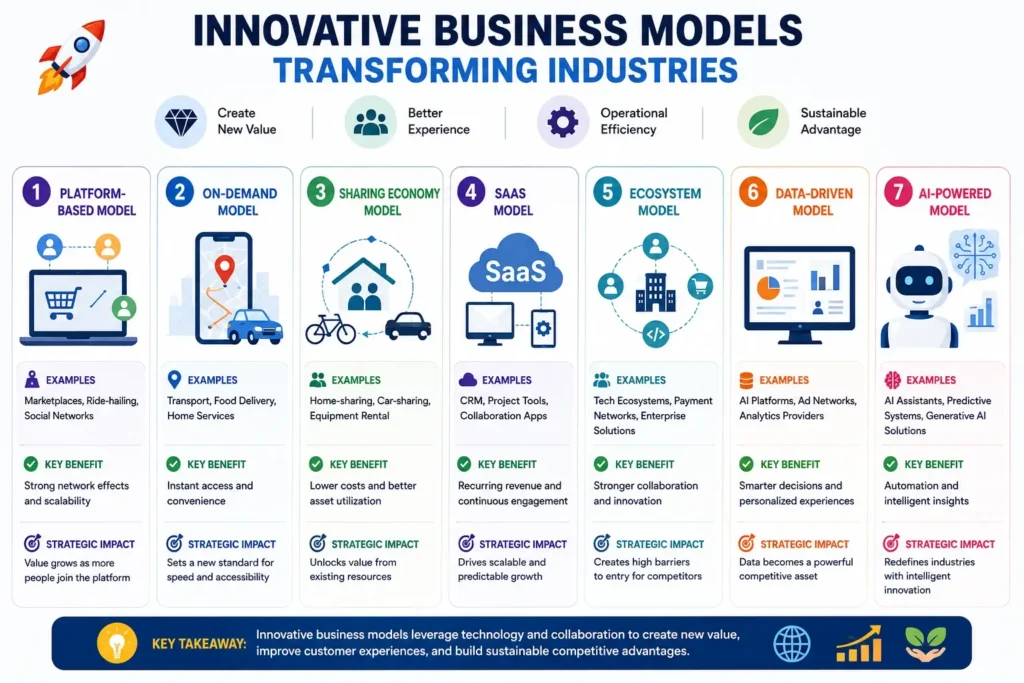
In today’s digital economy, traditional business approaches are rapidly evolving. Organizations are increasingly adopting innovative business models to respond to technological advancements, changing consumer behaviors, globalization, and increasing market competition. These models enable businesses to create new sources of value, improve customer experiences, enhance operational efficiency, and establish sustainable competitive advantages.
As digital transformation accelerates across industries, innovative business models are becoming critical drivers of long-term growth, profitability, and resilience.
🌐 Platform-Based Business Model
A platform-based business model creates value by connecting multiple groups of users—such as buyers, sellers, service providers, advertisers, and consumers—through a centralized digital platform. Instead of producing products directly, the platform facilitates interactions and transactions between participants.
📌 Examples
- 🛍️ Online marketplaces
- 🚖 Ride-hailing services
- 💼 Freelance and gig-work platforms
- 📱 Social networking platforms
⭐ Key Characteristics
- Multi-sided market structure
- Digital ecosystem management
- User-generated value creation
- Data-driven decision making
- Scalable technology infrastructure
✅ Benefits
- 🚀 Rapid scalability with minimal physical assets
- 🌍 Strong network effects that increase platform value
- 📊 Rich customer and transaction data
- 💰 Multiple monetization channels
- 🔄 Continuous user engagement
⚠️ Challenges
- Achieving critical mass of users
- Maintaining trust and platform security
- Regulatory compliance across markets
- Managing platform governance
🎯 Strategic Impact
Platform businesses often become industry leaders because their value grows as more participants join the ecosystem, creating a powerful competitive advantage.
⚡ On-Demand Business Model
The on-demand model delivers products or services instantly whenever customers require them. Driven by mobile applications, real-time tracking, and digital payments, this model focuses on speed, convenience, and customer accessibility.
📌 Examples
- 🚗 Transportation services
- 🍔 Food and grocery delivery
- 🏠 Home maintenance services
- 🏥 Telemedicine and healthcare consultations
⭐ Key Characteristics
- Real-time service fulfillment
- Mobile-first customer experience
- Flexible workforce management
- Dynamic pricing capabilities
✅ Benefits
- ⏱️ Immediate customer satisfaction
- 📈 Increased customer loyalty
- 🎯 Improved service accessibility
- 📱 Enhanced digital customer experience
⚠️ Challenges
- High logistics and operational costs
- Demand fluctuation management
- Service quality consistency
- Workforce availability
🎯 Strategic Impact
On-demand models have reshaped customer expectations by making instant access and convenience standard across industries.
🤝 Sharing Economy Model
The sharing economy model enables individuals and organizations to share underutilized assets, resources, or services through digital platforms. Instead of ownership, customers pay for temporary access, promoting efficiency and sustainability.
📌 Examples
- 🚘 Vehicle-sharing services
- 🏢 Shared office spaces
- 🏠 Home-sharing platforms
- 🔧 Equipment rental services
⭐ Key Characteristics
- Peer-to-peer transactions
- Asset utilization optimization
- Community-based participation
- Digital trust mechanisms
✅ Benefits
- 💰 Lower costs for consumers
- 💵 Additional income for asset owners
- 🌱 Sustainable resource utilization
- 🔓 Greater access to products and services
⚠️ Challenges
- Regulatory uncertainty
- User trust and safety concerns
- Quality assurance
- Insurance and liability management
🎯 Strategic Impact
The sharing economy supports sustainable business practices while unlocking economic value from existing resources.
☁️ Software-as-a-Service (SaaS) Model
Software-as-a-Service (SaaS) delivers software applications through cloud-based subscriptions rather than traditional one-time purchases. Customers access applications online while providers manage updates, security, and infrastructure.
📌 Examples
- 👥 Customer Relationship Management (CRM) systems
- 📅 Project management tools
- 💬 Communication and collaboration platforms
- 📊 Business intelligence software
⭐ Key Characteristics
- Cloud-based deployment
- Subscription pricing structure
- Continuous software updates
- Centralized data storage
✅ Benefits
- 💰 Predictable recurring revenue
- 🔄 Continuous customer engagement
- 📉 Lower customer acquisition costs over time
- 🌍 Global market accessibility
- ⚙️ Reduced maintenance requirements
⚠️ Challenges
- Customer churn
- Data security concerns
- Intense market competition
- Infrastructure reliability
🎯 Strategic Impact
SaaS has become one of the fastest-growing business models due to its scalability, flexibility, and recurring revenue potential.
🌱 Ecosystem Business Model
The ecosystem model creates value through interconnected networks of organizations, partners, developers, suppliers, and customers who collaborate to deliver integrated solutions.
📌 Examples
- 💻 Technology ecosystems
- 📱 Smart device ecosystems
- 💳 Digital payment ecosystems
- 🏢 Enterprise software ecosystems
⭐ Key Characteristics
- Collaborative innovation
- Integrated customer experiences
- Partner-driven growth
- Shared value creation
✅ Benefits
- ❤️ Increased customer retention
- 💡 Accelerated innovation
- 📈 Expanded market reach
- 🔗 Strong competitive positioning
⚠️ Challenges
- Ecosystem coordination
- Stakeholder alignment
- Governance complexity
- Revenue-sharing management
🎯 Strategic Impact
Organizations that build successful ecosystems often create significant barriers to entry for competitors.
📊 Data-Driven Business Model
A data-driven model uses data as a strategic asset to improve decision-making, personalize customer experiences, optimize operations, and generate revenue.
📌 Examples
- 🤖 Artificial intelligence platforms
- 📢 Digital advertising networks
- 🎯 Recommendation engines
- 📈 Business analytics providers
⭐ Key Characteristics
- Continuous data collection
- Predictive analytics capabilities
- AI and machine learning integration
- Personalized service delivery
✅ Benefits
- 📊 Better business intelligence
- 🎯 Improved customer targeting
- ⚙️ Enhanced operational efficiency
- 💰 New monetization opportunities
⚠️ Challenges
- Data privacy regulations
- Cybersecurity threats
- Ethical use of data
- Data quality management
🎯 Strategic Impact
Data has become one of the world’s most valuable business assets, enabling organizations to gain deeper customer insights and make more informed decisions.
🤖 AI-Powered Business Model
Artificial Intelligence is creating entirely new business models by automating processes, enhancing decision-making, and delivering highly personalized customer experiences.
📌 Examples
- AI virtual assistants
- Intelligent customer support systems
- Predictive maintenance platforms
- Generative AI solutions
✅ Benefits
- 🚀 Increased productivity
- 💸 Lower operational costs
- 🎯 Enhanced customer experiences
- 📈 Improved business forecasting
🎯 Future Potential
AI-powered models are expected to redefine industries by enabling autonomous operations, intelligent automation, and data-driven innovation.
🌍 Emerging Trends Shaping Future Business Models
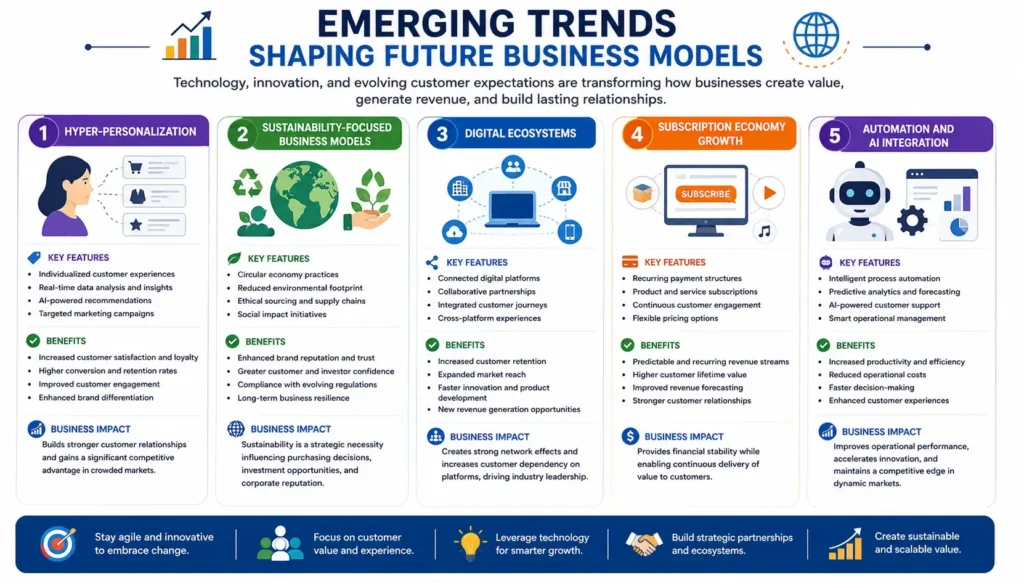
As technology advances and customer expectations evolve, businesses must continuously adapt their strategies to remain competitive. Several emerging trends are redefining how organizations create value, generate revenue, and build lasting customer relationships. These trends are expected to play a critical role in shaping the future of global business.
🎯 Hyper-Personalization
Hyper-personalization leverages Artificial Intelligence (AI), Machine Learning (ML), big data, and advanced analytics to deliver highly customized products, services, and customer experiences tailored to individual preferences, behaviors, and needs.
📌 Key Features
- 👤 Individualized customer experiences
- 📊 Real-time data analysis and insights
- 🤖 AI-powered recommendations
- 🎯 Targeted marketing campaigns
✅ Benefits
- Increased customer satisfaction and loyalty
- Higher conversion and retention rates
- Improved customer engagement
- Enhanced brand differentiation
💡 Business Impact
Organizations that successfully implement hyper-personalization can build stronger customer relationships and gain a significant competitive advantage in crowded markets.
🌱 Sustainability-Focused Business Models
Sustainability-focused models integrate environmental, social, and governance (ESG) principles into business operations and value creation strategies. Companies are increasingly balancing profitability with social responsibility and environmental stewardship.
📌 Key Features
- ♻️ Circular economy practices
- 🌍 Reduced environmental footprint
- 🤝 Ethical sourcing and supply chains
- 💚 Social impact initiatives
✅ Benefits
- Enhanced brand reputation and trust
- Greater customer and investor confidence
- Compliance with evolving regulations
- Long-term business resilience
💡 Business Impact
Sustainability is becoming a strategic necessity rather than a competitive advantage, influencing purchasing decisions, investment opportunities, and corporate reputation.
🔗 Digital Ecosystems
Digital ecosystems bring together multiple organizations, partners, suppliers, and customers through interconnected platforms that deliver integrated products and services. These ecosystems create seamless experiences and increase value for all participants.
📌 Key Features
- 🌐 Connected digital platforms
- 🤝 Collaborative partnerships
- 🔄 Integrated customer journeys
- 📱 Cross-platform experiences
✅ Benefits
- Increased customer retention
- Expanded market reach
- Faster innovation and product development
- New revenue generation opportunities
💡 Business Impact
Companies that build successful ecosystems often become industry leaders by creating strong network effects and increasing customer dependency on their platforms.
🔄 Subscription Economy Growth
The subscription economy continues to expand beyond software and entertainment into industries such as healthcare, education, retail, transportation, and manufacturing. Customers increasingly prefer access and convenience over ownership.
📌 Key Features
- 💳 Recurring payment structures
- 📦 Product and service subscriptions
- 🔄 Continuous customer engagement
- 🎯 Flexible pricing options
✅ Benefits
- Predictable and recurring revenue streams
- Higher customer lifetime value
- Improved revenue forecasting
- Stronger customer relationships
💡 Business Impact
Subscription-based models provide businesses with financial stability while enabling continuous delivery of value to customers.
🤖 Automation and AI Integration
Automation and Artificial Intelligence are transforming business operations by streamlining processes, reducing manual work, and enabling data-driven decision-making. AI-powered systems are increasingly becoming essential components of modern business strategies.
📌 Key Features
- 🤖 Intelligent process automation
- 📊 Predictive analytics and forecasting
- 💬 AI-powered customer support
- ⚙️ Smart operational management
✅ Benefits
- Increased productivity and efficiency
- Reduced operational costs
- Faster decision-making
- Enhanced customer experiences
💡 Business Impact
Organizations that effectively integrate AI and automation can improve operational performance, accelerate innovation, and maintain a competitive edge in rapidly changing markets.
⚠️ Challenges in Developing Effective Business Models
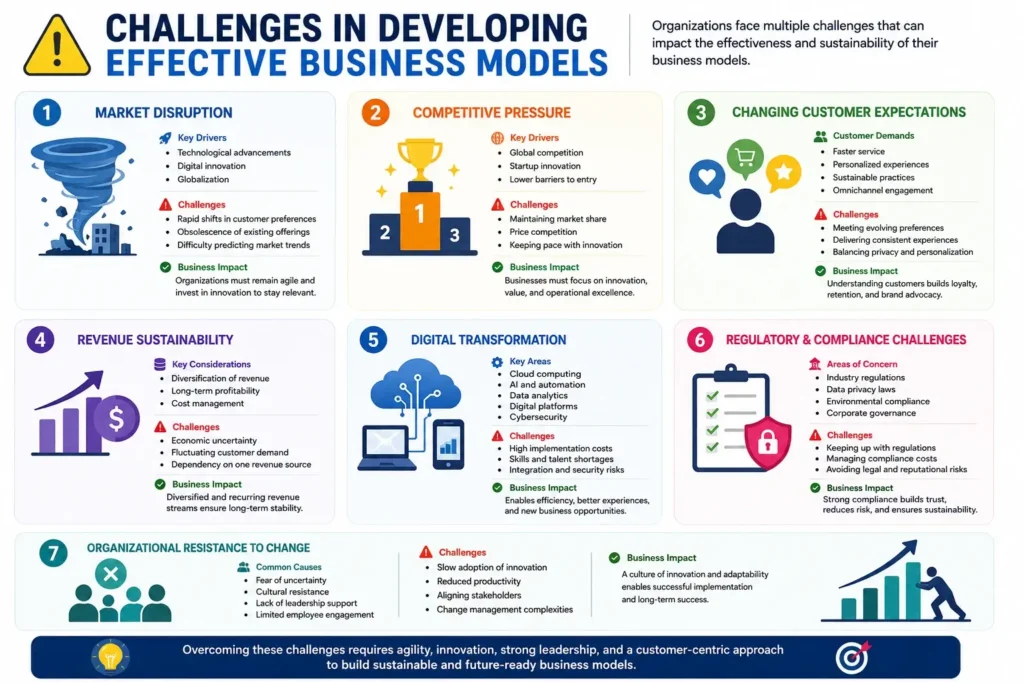
While a well-designed business model can drive growth, profitability, and competitive advantage, organizations often face significant challenges in developing and sustaining effective business models. Rapid technological advancements, evolving customer expectations, and increasing market competition require businesses to continuously adapt and innovate to remain relevant.
Understanding these challenges is essential for organizations seeking long-term success in an increasingly dynamic and digital business environment.
🌪️ Market Disruption
Market disruption occurs when technological innovations, emerging business models, or changing consumer behaviors fundamentally alter industry dynamics. Companies that fail to adapt may quickly lose market share and relevance.
📌 Key Drivers
- 🚀 Technological advancements
- 📱 Digital innovation
- 🤖 Artificial Intelligence and automation
- 🌐 Globalization and digital connectivity
⚠️ Challenges
- Rapid shifts in customer preferences
- Obsolescence of existing products and services
- Increased pressure to innovate continuously
- Difficulty predicting future market trends
✅ Business Impact
Organizations must remain agile and continuously invest in innovation to respond effectively to disruptive market forces.
🏆 Competitive Pressure
The business landscape has become increasingly competitive as new entrants, startups, and digital-first organizations challenge established companies with innovative products, services, and business models.
📌 Key Drivers
- 🌍 Global competition
- 💡 Startup innovation
- 📱 Digital platforms
- ⚡ Lower barriers to market entry
⚠️ Challenges
- Maintaining market share
- Price competition and margin pressure
- Differentiating products and services
- Keeping pace with industry innovation
✅ Business Impact
Businesses must focus on innovation, customer value, and operational excellence to sustain a competitive advantage.
👥 3. Changing Customer Expectations
Modern customers are more informed, connected, and demanding than ever before. They expect seamless experiences, personalized interactions, and socially responsible business practices.
📌 Customer Demands
- ⚡ Faster service delivery
- 📱 Greater convenience and accessibility
- 🎯 Personalized products and experiences
- 🌱 Sustainable and ethical business practices
- 💬 Omnichannel customer engagement
⚠️ Challenges
- Meeting evolving customer preferences
- Delivering consistent experiences across channels
- Balancing personalization with data privacy concerns
- Continuously enhancing customer satisfaction
✅ Business Impact
Organizations that successfully understand and respond to customer expectations can build stronger loyalty, retention, and brand advocacy.
💰 Revenue Sustainability
Generating revenue is not enough; businesses must ensure that their revenue streams remain stable and resilient during economic downturns, market fluctuations, and unexpected disruptions.
📌 Key Considerations
- Diversification of revenue sources
- Long-term profitability
- Customer retention strategies
- Cost management and efficiency
⚠️ Challenges
- Economic uncertainty
- Inflation and rising operational costs
- Fluctuating customer demand
- Dependency on a single revenue source
✅ Business Impact
Organizations with diversified and recurring revenue streams are generally better positioned to withstand financial and economic challenges.
💻 Digital Transformation
Digital transformation is reshaping industries and forcing organizations to rethink traditional business models. Businesses must integrate digital technologies into operations, products, services, and customer interactions to remain competitive.
📌 Key Areas of Transformation
- ☁️ Cloud computing
- 🤖 Artificial Intelligence (AI)
- 📊 Data analytics
- 📱 Mobile and digital platforms
- 🔐 Cybersecurity technologies
⚠️ Challenges
- High implementation costs
- Resistance to organizational change
- Technology integration complexity
- Skills and talent shortages
- Cybersecurity and data privacy risks
✅ Business Impact
Successful digital transformation enables organizations to improve efficiency, enhance customer experiences, and create new business opportunities.
🌍 Regulatory and Compliance Challenges
As industries become more interconnected and data-driven, organizations must comply with an increasing number of legal, regulatory, and ethical requirements.
📌 Areas of Concern
- 📜 Industry regulations
- 🔒 Data protection and privacy laws
- 🌱 Environmental compliance
- ⚖️ Corporate governance requirements
⚠️ Challenges
- Keeping pace with changing regulations
- Managing compliance costs
- Avoiding legal and reputational risks
- Ensuring transparency and accountability
✅ Business Impact
Strong compliance practices help organizations build trust, reduce risk, and maintain sustainable operations.
👨💼 Organizational Resistance to Change
Even when a new business model offers clear advantages, internal resistance can slow or prevent successful implementation.
📌 Common Causes
- Fear of uncertainty
- Cultural resistance
- Lack of leadership support
- Limited employee engagement
⚠️ Challenges
- Slow adoption of innovation
- Reduced productivity during transitions
- Difficulty aligning stakeholders
- Change management complexities
✅ Business Impact
Organizations that foster a culture of innovation and adaptability are more likely to successfully implement and sustain new business models.
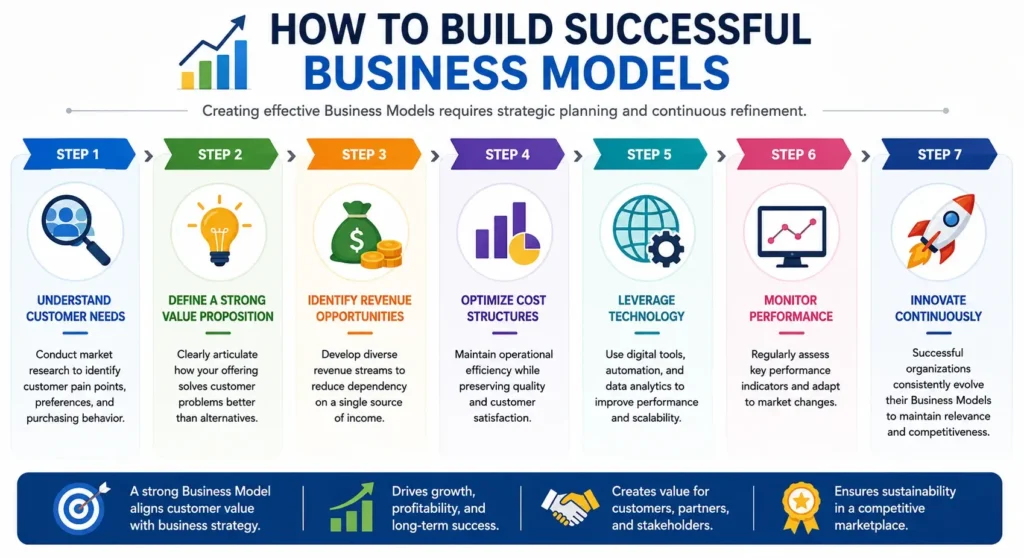
📈 How to Build Successful Business Models
Developing a successful business model is one of the most important factors in achieving sustainable growth and long-term profitability. A strong business model not only defines how an organization creates, delivers, and captures value but also provides a roadmap for adapting to market changes and maintaining a competitive advantage.
Successful business models are built through strategic planning, customer understanding, continuous innovation, and effective execution.
🔍 Step 1: Understand Customer Needs
Every successful business model begins with a deep understanding of the target market. Organizations must identify customer pain points, preferences, expectations, and purchasing behaviors to develop products and services that create meaningful value.
📌 Key Activities
- Conduct market research and customer surveys
- Analyze consumer behavior and purchasing patterns
- Gather customer feedback and insights
- Study industry trends and market demands
- Develop detailed customer personas
✅ Benefits
- Improved product-market fit
- Better customer satisfaction
- Stronger customer loyalty
- Reduced market uncertainty
🎯 Success Tip
Focus on solving real customer problems rather than simply offering products or services.
💡 Step 2: Define a Strong Value Proposition
A value proposition clearly explains why customers should choose your product or service over competing alternatives. It represents the unique benefits and solutions your organization provides.
📌 Key Questions
- What problem are we solving?
- What value do we create?
- Why are we different from competitors?
- What makes our solution unique?
⭐ Elements of a Strong Value Proposition
- Clear customer benefits
- Unique selling points (USPs)
- Measurable outcomes
- Competitive differentiation
✅ Benefits
- Stronger brand positioning
- Increased customer acquisition
- Higher conversion rates
- Improved market competitiveness
🎯 Success Tip
Keep your value proposition simple, compelling, and customer-focused.
💰 Step 3: Identify Revenue Opportunities
Organizations should establish sustainable and diversified revenue streams to minimize risk and ensure financial stability.
📌 Common Revenue Streams
- Subscription fees
- Product sales
- Service contracts
- Licensing and royalties
- Advertising revenue
- Commission-based income
- Affiliate partnerships
✅ Benefits
- Reduced dependence on a single income source
- Greater financial resilience
- Improved cash flow management
- Enhanced growth opportunities
🎯 Success Tip
Diversify revenue streams whenever possible to strengthen long-term sustainability.
📊 Step 4: Optimize Cost Structures
An effective business model balances value creation with operational efficiency. Businesses must carefully manage costs while maintaining product quality and customer satisfaction.
📌 Key Cost Areas
- Operations and production
- Marketing and sales
- Technology infrastructure
- Human resources
- Customer support
✅ Benefits
- Improved profitability
- Greater operational efficiency
- Better resource utilization
- Increased competitiveness
🎯 Success Tip
Regularly evaluate costs and eliminate activities that do not contribute significant value.
🌐 Step 5: Leverage Technology
Technology plays a critical role in modern business models by improving efficiency, enhancing customer experiences, and enabling scalability.
📌 Technologies to Consider
- ☁️ Cloud Computing
- 🤖 Artificial Intelligence (AI)
- 📊 Data Analytics
- 🔄 Business Process Automation
- 📱 Mobile Applications
- 🛒 E-commerce Platforms
- 🔐 Cybersecurity Solutions
✅ Benefits
- Increased productivity
- Faster decision-making
- Improved customer engagement
- Enhanced scalability
- Reduced operational costs
🎯 Success Tip
Invest in technologies that align with your strategic objectives and customer needs.
📈 Step 6: Monitor Performance
Continuous performance monitoring helps organizations evaluate the effectiveness of their business model and identify opportunities for improvement.
📌 Key Performance Indicators (KPIs)
- Revenue growth
- Customer acquisition cost (CAC)
- Customer lifetime value (CLV)
- Profit margins
- Customer retention rate
- Market share
- Return on investment (ROI)
✅ Benefits
- Data-driven decision-making
- Early identification of challenges
- Improved strategic planning
- Enhanced organizational performance
🎯 Success Tip
Use dashboards and analytics tools to track performance in real time.
🚀 Step 7: Innovate Continuously
Markets, technologies, and customer expectations are constantly evolving. Successful organizations continuously refine and adapt their business models to maintain relevance and competitiveness.
📌 Innovation Strategies
- Invest in research and development (R&D)
- Monitor emerging market trends
- Explore new revenue opportunities
- Test new products and services
- Encourage a culture of innovation
✅ Benefits
- Long-term sustainability
- Competitive advantage
- Increased market adaptability
- Greater growth potential
🎯 Success Tip
Treat innovation as an ongoing process rather than a one-time initiative.
🏗️ Additional Success Factors
Beyond the seven core steps, successful business models often incorporate the following elements:
🤝 Strategic Partnerships
Collaborate with suppliers, distributors, technology providers, and industry partners to expand capabilities and create additional value.
🌍 Market Adaptability
Remain flexible and responsive to economic, technological, and social changes.
❤️ Customer-Centric Culture
Place customer needs at the center of decision-making processes.
📚 Continuous Learning
Encourage ongoing learning, skill development, and knowledge sharing across the organization.
⚖️ Risk Management
Identify potential risks and develop contingency plans to ensure business continuity.
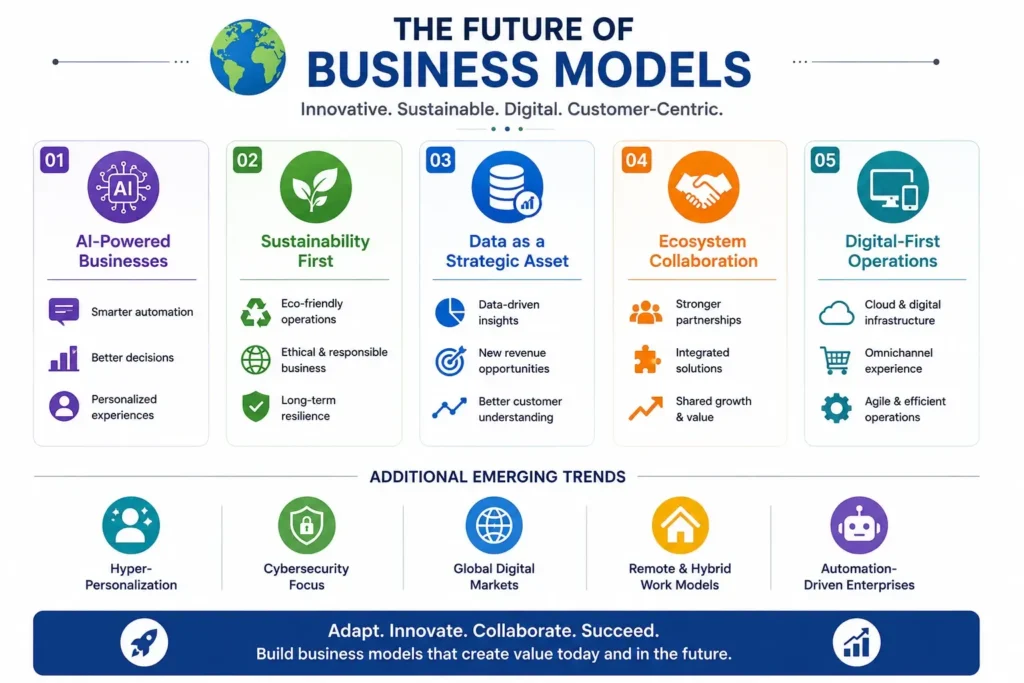
🌍 The Future of Business Models
The business landscape is undergoing a profound transformation driven by technological innovation, evolving customer expectations, globalization, and increasing market complexity. Traditional business models are being reshaped as organizations seek new ways to create value, improve efficiency, and maintain competitive advantage in an increasingly digital world.
The future of business models will be defined by agility, innovation, sustainability, and technology-driven decision-making. Organizations that proactively adapt to emerging trends will be better positioned to achieve sustainable growth, enhance customer experiences, and thrive in the next generation of business.
🤖 Artificial Intelligence (AI)
Artificial Intelligence is rapidly becoming a core component of modern business models. AI enables organizations to automate processes, analyze vast amounts of data, personalize customer experiences, and make more accurate strategic decisions.
📌 Key Applications
- 💬 AI-powered customer service and chatbots
- 📊 Predictive analytics and forecasting
- 🎯 Personalized marketing and recommendations
- ⚙️ Process automation and workflow optimization
- 🧠 Intelligent decision support systems
✅ Benefits
- Increased operational efficiency
- Reduced costs and manual effort
- Faster and more informed decision-making
- Enhanced customer satisfaction
- Greater business scalability
🎯 Future Impact
AI will increasingly transform entire industries by enabling autonomous operations, hyper-personalization, and data-driven innovation.
🌱 Sustainability and Green Business Models
Environmental sustainability is no longer a secondary consideration—it has become a strategic priority. Consumers, investors, and regulators increasingly expect businesses to operate responsibly and contribute positively to society and the environment.
📌 Key Trends
- ♻️ Circular economy initiatives
- 🌍 Carbon reduction strategies
- 🔋 Renewable energy adoption
- 🤝 Ethical sourcing and supply chains
- 📈 ESG (Environmental, Social, and Governance) reporting
✅ Benefits
- Enhanced brand reputation
- Increased customer trust and loyalty
- Improved investor confidence
- Regulatory compliance
- Long-term business resilience
🎯 Future Impact
Organizations that integrate sustainability into their business models will gain stronger market positioning and attract environmentally conscious customers and investors.
📊 Data Monetization
Data has become one of the most valuable business assets in the digital economy. Organizations are increasingly leveraging customer, operational, and market data to generate new revenue streams and create strategic advantages.
📌 Key Approaches
- 📈 Selling data-driven insights and analytics
- 🎯 Personalized products and services
- 📢 Targeted advertising and marketing
- 🤖 AI model development and optimization
- 📋 Business intelligence solutions
✅ Benefits
- New revenue generation opportunities
- Better customer understanding
- Improved strategic planning
- Enhanced operational efficiency
🎯 Future Impact
Companies that effectively collect, analyze, and monetize data will be able to unlock significant value and strengthen their competitive advantage.
🤝 Ecosystem Collaboration
Future business success will increasingly depend on collaboration rather than competition alone. Organizations are building interconnected ecosystems that bring together partners, suppliers, developers, and customers to create integrated solutions.
📌 Key Characteristics
- 🌐 Shared digital platforms
- 🤝 Strategic partnerships
- 🔗 Integrated products and services
- 💡 Collaborative innovation
✅ Benefits
- Faster innovation cycles
- Expanded market reach
- Increased customer value
- Shared resources and expertise
🎯 Future Impact
Business ecosystems will become powerful growth engines, enabling organizations to deliver seamless experiences while creating barriers to entry for competitors.
💻 Digital-First Operations
Digital transformation continues to redefine how businesses operate, engage customers, and generate revenue. Organizations are increasingly adopting digital-first strategies that prioritize online interactions, automation, and data-driven operations.
📌 Key Components
- 📱 Mobile and web-based platforms
- ☁️ Cloud computing infrastructure
- 🛒 E-commerce and digital marketplaces
- 🔄 Automated business processes
- 📊 Real-time analytics and reporting
✅ Benefits
- Greater operational efficiency
- Enhanced customer accessibility
- Reduced operating costs
- Improved scalability and flexibility
🎯 Future Impact
Digital channels will continue to become the primary drivers of customer engagement, business growth, and competitive differentiation.
🚀 Additional Emerging Trends
🧬 Hyper-Personalization
Businesses will increasingly use AI, analytics, and behavioral data to deliver highly customized products, services, and experiences tailored to individual customer needs.
🔐 Cybersecurity-Centric Models
As digital operations expand, cybersecurity will become a strategic business priority, influencing customer trust and organizational resilience.
🌎 Global Digital Markets
Digital platforms will allow businesses of all sizes to access international customers and expand beyond traditional geographic boundaries.
🏠 Remote and Hybrid Business Models
Flexible work environments and distributed teams will continue reshaping organizational structures and operating models.
⚡ Automation-Driven Enterprises
Organizations will increasingly automate routine tasks, enabling employees to focus on higher-value strategic activities.
📈 Strategic Implications for Organizations
To remain competitive in the future, organizations should:
- ✅ Invest in digital transformation initiatives
- ✅ Leverage Artificial Intelligence and automation technologies
- ✅ Build sustainable and socially responsible business practices
- ✅ Develop data-driven decision-making capabilities
- ✅ Foster innovation and organizational agility
- ✅ Establish strategic partnerships and ecosystems
- ✅ Continuously adapt to changing customer expectations
- ✅ Strengthen cybersecurity and digital resilience
🎯 Key Success Factors for Future Business Models
| Success Factor | Strategic Importance |
|---|---|
| 🤖 Artificial Intelligence | Enhances automation, personalization, and decision-making |
| 🌱 Sustainability | Builds trust, compliance, and long-term resilience |
| 📊 Data Utilization | Creates insights and new revenue opportunities |
| 🤝 Collaboration | Accelerates innovation and market expansion |
| 💻 Digital Transformation | Improves efficiency and customer engagement |
| 🚀 Innovation | Ensures adaptability and competitive advantage |
| ❤️ Customer Centricity | Strengthens loyalty and long-term growth |
🎯 Conclusion
Business Models are the foundation upon which successful organizations build value, generate revenue, and achieve sustainable growth. They define how companies serve customers, compete in the marketplace, and create long-term profitability. From subscription services and e-commerce platforms to marketplace ecosystems and SaaS solutions, the variety of available business models provides organizations with numerous opportunities to innovate and differentiate themselves.
As technology, consumer behavior, and global markets continue to evolve, businesses must continuously evaluate and refine their strategies. Organizations that develop customer-centric, scalable, and adaptable Business Models will be better positioned to navigate uncertainty, capitalize on emerging opportunities, and achieve lasting success in an increasingly competitive business landscape.
Ultimately, a strong business model is not merely a revenue-generation mechanism—it is a strategic framework that transforms ideas into sustainable enterprises and enables organizations to create enduring value for customers, stakeholders, and society.
References
- Business Model Generation
Osterwalder, A., & Pigneur, Y. (2010). Business model generation: A handbook for visionaries, game changers, and challengers. John Wiley & Sons. - Alexander Osterwalder
Osterwalder, A. (2004). The business model ontology: A proposition in a design science approach (Doctoral dissertation, University of Lausanne). - Joan Magretta
Magretta, J. (2002). Why business models matter. Harvard Business Review, 80(5), 86–92. - David J. Teece
Teece, D. J. (2010). Business models, business strategy and innovation. Long Range Planning, 43(2–3), 172–194. https://doi.org/10.1016/j.lrp.2009.07.003 - Henry Chesbrough
Chesbrough, H. (2010). Business model innovation: Opportunities and barriers. Long Range Planning, 43(2–3), 354–363. https://doi.org/10.1016/j.lrp.2009.07.010 - Clayton M. Christensen, Mark W. Johnson, & Henning Kagermann
Johnson, M. W., Christensen, C. M., & Kagermann, H. (2008). Reinventing your business model. Harvard Business Review, 86(12), 50–59. - Christoph Zott & Raphael Amit
Zott, C., & Amit, R. (2010). Business model design: An activity system perspective. Long Range Planning, 43(2–3), 216–226. https://doi.org/10.1016/j.lrp.2009.07.004 - Christoph Zott, Raphael Amit, & Lorenzo Massa
Zott, C., Amit, R., & Massa, L. (2011). The business model: Recent developments and future research. Journal of Management, 37(4), 1019–1042. https://doi.org/10.1177/0149206311406265 - Organisation for Economic Co-operation and Development
Organisation for Economic Co-operation and Development (OECD). (2019). The digital transformation of SMEs. OECD Publishing. https://doi.org/10.1787/bdb9256a-en - World Economic Forum
World Economic Forum. (2023). Future of jobs report 2023. World Economic Forum.

 Inar Learn