

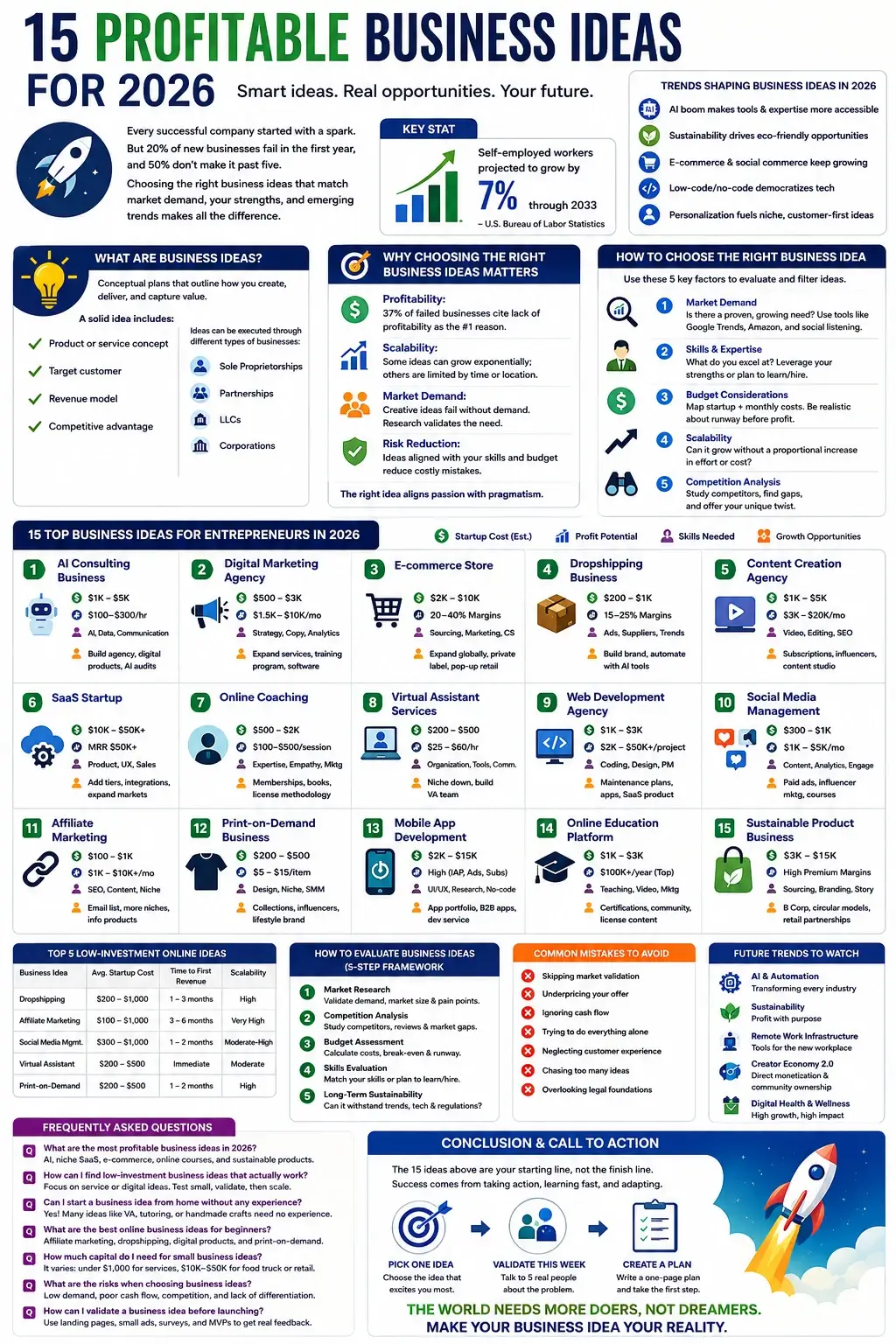
Every successful company—from Airbnb to a neighborhood coffee shop—started with a spark: a set of business ideas that someone dared to turn into reality. Yet, according to the U.S. Bureau of Labor Statistics, about 20% of new businesses fail within the first year, and roughly half don’t make it past five. The difference often isn’t talent or funding; it’s selecting the right business ideas that match market demand, personal strengths, and emerging trends.
In 2026, the entrepreneurial landscape is more dynamic than ever. Artificial intelligence, remote work, and the digital creator economy have unlocked entirely new categories of best business ideas that didn’t exist a decade ago. Whether you’re hunting for low investment business ideas to start as a side hustle, or you’re ready to build the next startup business ideas into a venture-backed unicorn, the opportunity is massive—if you know where to look.
This guide dives deep into 15 profitable business ideas for 2026, complete with startup costs, required skills, and growth potential. You’ll also learn how to validate concepts, avoid common pitfalls, and spot the innovative business ideas that will define the next five years. Let’s turn your entrepreneurial ambition into a tangible plan.
What Are Business Ideas?
Business ideas are conceptual plans that outline how an individual or team can create, deliver, and capture value in the marketplace. More than a fleeting thought, a solid business idea includes a product or service concept, a defined target customer, a revenue model, and a competitive advantage. In entrepreneurship, these ideas form the bedrock of a business plan, guiding decisions from funding to marketing.
Before diving deeper, it helps to clarify what is a business: an entity that provides products or services to customers in exchange for money. Business ideas can be executed through various types of businesses, such as sole proprietorships, partnerships, limited liability companies (LLCs), and corporations—each with distinct legal and tax implications. However, the business idea itself remains the creative seed that launches the venture.
Why are business ideas so crucial? Because they determine your potential to solve real problems. The best business ideas emerge at the intersection of market gaps, personal expertise, and emerging trends. The rise of the gig economy and remote work, for example, has unleashed a wave of home-based and online business ideas that simply didn’t exist a decade ago.
Current market trends shaping business ideas in 2026 include:
- The explosion of artificial intelligence, making AI-powered startup ideas accessible to non‑technical founders.
- Surging consumer demand for sustainability, creating eco‑friendly business opportunities.
- The continued dominance of e‑commerce and social commerce, fueling new online business ideas.
- Low‑code/no‑code platforms that let anyone build technology small business ideas.
- Growing appetite for personalization, giving rise to niche entrepreneurial ideas.
According to the U.S. Bureau of Labor Statistics, the number of self‑employed workers is projected to grow by 7% through 2033, reflecting a thriving ecosystem for innovative business ideas.
Why Choosing the Right Business Ideas Matters
Selecting the right business idea isn’t a gamble—it’s a strategic decision that directly impacts profitability, scalability, and risk. Here’s why due diligence matters:
- Profitability: Not every great business idea translates into profit. A 2024 survey by Guidant Financial found that 37% of failed small businesses cited lack of profitability as the primary reason. High‑margin business ideas, such as digital products or consulting, often outperform capital‑intensive models.
- Scalability: Some business ideas can grow exponentially (software, e‑commerce), while others are constrained by location or time (local services). Evaluating whether a business idea can scale determines your long‑term earning ceiling.
- Market Demand: Even the most creative business ideas fail if nobody wants to buy. Thorough market research validates that your idea solves a genuine pain point.
- Risk Reduction: Entrepreneurial ideas aligned with your expertise and financial capacity reduce the risk of costly mistakes. For instance, low‑investment business ideas let you test the waters before committing significant capital.
Simply put, the right business ideas align passion with pragmatism. The following section provides a curated list of high‑potential business ideas so you can make an informed choice.
How to Choose the Right Business Idea
Not every appealing concept is worth pursuing. Filtering through innovative business ideas requires a structured approach. Here are the five key factors you must evaluate:
- Market Demand: Is there a proven, growing need for your product or service? Use tools like Google Trends, Amazon Best Sellers, and social listening to validate interest. The best entrepreneur business ideas solve urgent problems or fulfil deep desires.
- Skills and Expertise: What do you already excel at? The most successful business ideas often spring from a founder’s unique skill set. If you lack a critical skill, consider how quickly you can learn it or hire for it.
- Budget Considerations: Many low investment business ideas require less than $1,000 to start. Map out your one-time and monthly costs. Be realistic about how long you can sustain operations before turning a profit.
- Scalability: Can the business grow without a proportional increase in effort or cost? Online business ideas like SaaS or digital courses have near-infinite scalability, while a local bakery may hit a ceiling fast. This is where having business models explained clearly helps—subscription models, for instance, scale far more predictably than one-off project fees.
- Competition Analysis: High competition can signal a lucrative market, but you need a clear differentiator. Study competitors’ reviews to find gaps. A fresh twist on profitable business ideas can help you carve out a unique niche.
Combining these criteria drastically improves your odds of choosing a winner.
Top Business Ideas for Entrepreneurs in 2026
Below are 15 of the most promising business ideas for aspiring entrepreneurs this year. Each entry includes an overview, estimated startup costs, potential profitability, required skills, and growth opportunities.
AI Consulting Business
Businesses of all sizes are racing to integrate artificial intelligence, but most lack in-house expertise. As an AI consultant, you’ll help clients automate processes, deploy chatbots, or leverage predictive analytics.
- Startup Cost: $1,000–$5,000 (certifications, marketing)
- Potential Profitability: $100–$300 per hour; high six-figure annual income possible
- Skills Required: Machine learning fundamentals, data analysis, communication
- Growth Opportunities: Package consulting into digital products, build a niche agency, or create AI audit services.
Digital Marketing Agency
With screen time at an all-time high, companies need specialists who can drive traffic and conversions. You can start broad or focus on SEO, paid ads, or email marketing.
- Startup Cost: $500–$3,000 (website, tools)
- Potential Profitability: Retainers of $1,500–$10,000/month per client
- Skills Required: Digital strategy, copywriting, analytics
- Growth Opportunities: Expand into a full-service agency, launch a training program, or develop proprietary software.
E-commerce Store
Selling physical products online remains one of the most popular online business ideas. You can choose a niche—sustainable fashion, pet accessories, smart home devices—and build a brand around it.
- Startup Cost: $2,000–$10,000 (inventory, Shopify store, branding)
- Potential Profitability: Margins of 20–40%; top stores generate seven figures
- Skills Required: Product sourcing, digital marketing, customer service
- Growth Opportunities: Expand to international markets, launch private label lines, or open a pop-up retail experience.
Dropshipping Business
A subset of e-commerce, dropshipping eliminates inventory hassles. You sell products that are shipped directly from suppliers. It’s perfect for testing small business ideas with minimal risk.
- Startup Cost: $200–$1,000 (store setup, ads)
- Potential Profitability: 15–25% margins; highly dependent on ad efficiency
- Skills Required: Facebook/Google Ads, supplier negotiation, trend spotting
- Growth Opportunities: Build a loyal customer base and transition to branded inventory, or automate with AI tools.
Content Creation Agency
Brands are desperate for high-quality videos, blogs, and social content. If you can produce scroll-stopping content, you can build a lucrative agency catering to the creator economy.
- Startup Cost: $1,000–$5,000 (camera, editing software)
- Potential Profitability: $3,000–$20,000/month retainers
- Skills Required: Videography, editing, storytelling, SEO
- Growth Opportunities: Offer done-for-you content subscriptions, manage influencer partnerships, or create a content studio.
SaaS Startup
Software as a Service is the holy grail of startup business ideas due to recurring revenue and high valuations. Even a simple micro-SaaS tool that solves a painful business problem can generate massive returns.
- Startup Cost: $10,000–$50,000 (development, cloud hosting) or lower with no-code
- Potential Profitability: MRR can skyrocket to $50K+ per month; exit multiples are generous
- Skills Required: Product management, UX design, sales (or the ability to hire)
- Growth Opportunities: Add premium tiers, integrate with major platforms, or expand into adjacent markets.
Online Coaching
People invest billions in personal and professional development. If you have deep expertise in fitness, career, relationships, or business, coaching can be a transformative profitable business idea.
- Startup Cost: $500–$2,000 (website, certification if needed)
- Potential Profitability: $100–$500 per session; group programs can generate $10K+ per cohort
- Skills Required: Domain expertise, empathy, marketing
- Growth Opportunities: Launch a membership community, write a book, or license your methodology.
Virtual Assistant Services
Remote work has skyrocketed demand for virtual assistants who handle admin, email, scheduling, and customer support. It’s a flexible low investment business idea that can be scaled into a boutique agency.
- Startup Cost: $200–$500 (basic tech setup)
- Potential Profitability: $25–$60 per hour; niche specialists earn more
- Skills Required: Organization, communication, familiarity with productivity tools
- Growth Opportunities: Specialize in a high-demand industry (e.g., real estate, podcasting) or build a VA team.
Web Development Agency
Every business needs a website, but few owners want to build one. Web development remains one of the most evergreen business opportunities. You can start with no-code platforms or custom coding.
- Startup Cost: $1,000–$3,000 (portfolio site, tools)
- Potential Profitability: Projects range from $2,000 to $50,000+
- Skills Required: Web design, HTML/CSS, WordPress or Shopify, project management
- Growth Opportunities: Expand into app development, offer ongoing maintenance packages, or create a SaaS product.
Social Media Management
Companies understand they must be on Instagram, TikTok, and LinkedIn, but they lack the time or expertise. As a social media manager, you become the voice of brands.
- Startup Cost: $300–$1,000 (scheduling tools, portfolio)
- Potential Profitability: $1,000–$5,000/month per client
- Skills Required: Content creation, copywriting, community engagement, analytics
- Growth Opportunities: Expand into paid social advertising, influencer marketing, or build an educational platform.
Affiliate Marketing
Promote other companies’ products and earn a commission for every sale. This is one of the most accessible online business ideas because you don’t need to create a product or handle customer service.
- Startup Cost: $100–$1,000 (website, content creation)
- Potential Profitability: Top affiliates earn six figures monthly; typical starter income $1K–$10K/month
- Skills Required: SEO, content marketing, persuasive writing, niche selection
- Growth Opportunities: Build an email list, diversify into multiple niches, or create your own info products.
Print-on-Demand Business
Combine creativity with e-commerce by selling custom-designed apparel, mugs, and accessories. A print-on-demand partner handles printing and shipping, keeping your risk minimal.
- Startup Cost: $200–$500 (design software, store setup)
- Potential Profitability: $5–$15 net per item; scalable with volume
- Skills Required: Graphic design (basic), niche research, social media marketing
- Growth Opportunities: Launch seasonal collections, partner with influencers, or build a lifestyle brand.
Mobile App Development
With over 6 billion smartphone users globally, the app market is booming. You don’t need to be a coder—low-code platforms have democratized innovative business ideas in this space.
- Startup Cost: $2,000–$15,000 (development, App Store fees)
- Potential Profitability: Revenue from in-app purchases, ads, or subscriptions; hit apps earn millions
- Skills Required: UI/UX design, market research, basic coding or no-code fluency
- Growth Opportunities: Develop a portfolio of apps, pivot to B2B mobile solutions, or offer app development as a service.
Online Education Platform
The e-learning market is projected to reach $457 billion by 2026. Creating and selling courses on platforms like Teachable or Kajabi can generate passive income while establishing you as an authority.
- Startup Cost: $1,000–$3,000 (equipment, platform subscription)
- Potential Profitability: Top course creators earn $100K+ per year; evergreen courses compound income
- Skills Required: Teaching ability, content structure, video production, marketing
- Growth Opportunities: Bundle courses into certification programs, build a community, or license content to companies.
Sustainable Product Business
Consumers increasingly demand eco-friendly alternatives. From biodegradable packaging to reusable household items, sustainability-focused startup business ideas combine profit with purpose.
- Startup Cost: $3,000–$15,000 (sustainable sourcing, branding)
- Potential Profitability: Premium pricing leads to healthy margins; brand loyalty is very high
- Skills Required: Supply chain management, green marketing, storytelling
- Growth Opportunities: Obtain B Corp certification, expand into circular economy models, or partner with major retailers.
Quick Comparison of the Top 5 Low-Investment Online Ideas:
| Business Idea | Avg. Startup Cost | Time to First Revenue | Scalability |
|---|---|---|---|
| Dropshipping | $200–$1,000 | 1–3 months | High |
| Affiliate Marketing | $100–$1,000 | 3–6 months | Very High |
| Social Media Management | $300–$1,000 | 1–2 months | Moderate-High |
| Virtual Assistant | $200–$500 | Immediate | Moderate |
| Print-on-Demand | $200–$500 | 1–2 months | High |
How to Evaluate Business Ideas
Even the most promising business ideas need rigorous evaluation. Use this five‑step framework:
- Market Research: Analyze target market size, growth rate, and customer pain points using tools like Google Trends, Statista, and U.S. Census Bureau data. Without validating demand, even the best business ideas will fail.
- Competition Analysis: Identify direct and indirect competitors. Assess their strengths, pricing, and reviews to spot gaps where your business ideas can differentiate.
- Budget Assessment: Calculate true startup costs, operating expenses, and break‑even timeline. Low‑investment business ideas are easier to test but still require honest financial planning.
- Skills Evaluation: Honestly assess whether your current skills match the business idea. If not, factor in the time and cost of upskilling or hiring.
- Long‑Term Sustainability: Determine if the business idea can withstand market shifts, regulatory changes, and evolving technology. Scalable business ideas with recurring revenue models tend to be more sustainable.
Additionally, business models explained upfront can prevent costly pivots. A business model defines how you’ll create, deliver, and capture value—common frameworks include subscription, marketplace, e‑commerce, and franchising. Closely tied to this is the question of how businesses generate revenue: through one‑time sales, recurring subscriptions, licensing fees, or commission structures. Nailing this early ensures your business idea is built on a viable economic engine.
Applying this filter dramatically increases your chances of turning entrepreneurial ideas into lasting enterprises.
Common Mistakes to Avoid When Starting a Business
Even the most brilliant business ideas fail due to execution errors. Steer clear of these common pitfalls:
- Skipping Market Validation – Don’t assume people want your product. Survey potential customers, run a small test campaign, or create a minimal viable product before committing fully.
- Underpricing Your Offer – Many new entrepreneurs undercharge to attract clients, then burn out. Price based on value, not fear. Sustainable profits are essential for successful business ideas to thrive.
- Ignoring Cash Flow Management – More businesses die from poor cash flow than lack of profit. Track every dollar and maintain a cash buffer.
- Trying to Do Everything Alone – The “solopreneur” myth can limit growth. Outsource tasks that aren’t your core genius zone—virtual assistants, bookkeepers, and freelancers are affordable force multipliers. Crucially, know the entrepreneur vs business owner distinction: entrepreneurs build systems that run without them, while business owners often remain the indispensable operator. Decide which path you want early on.
- Neglecting Customer Experience – Acquisition is expensive; retention is gold. A staggering 86% of consumers will pay more for a better experience. Every business opportunity must be built around delighting customers.
- Chasing Too Many Ideas at Once – Focus. Master one entrepreneur business idea before expanding. Fragmented attention yields mediocre results.
- Overlooking Legal Foundations – Trademark your brand, use proper contracts, and separate personal and business finances from day one.
Future Trends Shaping Business Ideas
To stay ahead, align your venture with macro trends. These forces are redefining which business ideas will dominate the next decade:
- Artificial Intelligence & Automation – Beyond AI consulting, we’ll see AI-first startups transforming healthcare diagnostics, legal document review, and personalized learning. Embedding AI into any online business idea can dramatically increase efficiency.
- Sustainability & Ethical Consumerism – Circular economy models, carbon-neutral supply chains, and regenerative agriculture are not just buzzwords. Investors and customers reward businesses that prioritize the planet.
- Remote & Hybrid Work Infrastructure – Tools that bridge the physical and digital workspace will continue to explode. Think virtual event platforms, asynchronous collaboration tools, and digital wellness apps.
- Creator Economy 2.0 – The shift from advertiser-funded models to direct fan monetization through NFTs, memberships, and token-gated communities opens up radical new business opportunities for creators and platform builders.
- Digital Health & Wellness – Telehealth, mental wellness apps, and personalized nutrition plans are ripe for innovation. These are some of the most profitable business ideas for purpose-driven founders.
Smart entrepreneurs don’t just react to trends—they anticipate them. Regularly scanning the horizon ensures your catalog of small business ideas stays fresh and future-proof.
Frequently Asked Questions
What are the most profitable business ideas in 2026?
Some of the most profitable business ideas include AI chatbot development, niche SaaS products, e‑commerce stores in high‑margin niches, and online course creation. Profitability depends heavily on execution, market demand, and scalability.
How can I find low‑investment business ideas that actually work?
Focus on service‑based or digital low‑investment business ideas like freelance writing, virtual assistance, social media management, or print on demand. Validate each business idea with a small test before scaling.
Can I start a business idea from home without any experience?
Absolutely. Many home‑based business ideas—such as virtual assistant, online tutoring, or handmade crafts—require no formal experience. Leverage free online resources, start small, and learn as you go.
What are the best online business ideas for beginners?
For beginners, the best online business ideas include affiliate marketing, dropshipping, selling digital products, and print on demand. These models have low barriers to entry and extensive learning communities.
How much capital do I need for small business ideas?
Capital needs vary widely. Some small business ideas like a cleaning service can launch with under $1,000, while a food truck may require $10,000–$50,000. Always build a detailed budget for your chosen business idea.
What are the risks when choosing business ideas?
Common risks include insufficient market demand, poor cash flow management, intense competition, and lack of differentiation. Mitigate these by thoroughly evaluating business ideas before launch and starting with a pilot.
How can I validate a business idea before launching?
Use landing pages to gauge interest, run small‑scale ads, conduct surveys with your target audience, and create a minimum viable product. Real‑world feedback is the gold standard for validating entrepreneurial ideas.
Conclusion
Choosing the right business ideas is equal parts art and science. It demands a clear-eyed look at market data, an honest assessment of your skills, and the courage to start before you feel ready. The 15 best business ideas we’ve explored—from AI consulting to sustainable products—offer a spectrum of entry points, risk levels, and income potentials. What they all share is a pathway to financial independence and professional fulfillment.
Remember, no list of profitable business ideas can guarantee success. The real magic happens when you take one of these business opportunities and inject your unique perspective, work ethic, and adaptability. The entrepreneurs who thrive in 2026 will be those who test assumptions quickly, listen to customers, and pivot when necessary.
So, here’s your call to action: pick one business idea that excites you, validate it this week with five real conversations, and create a simple one-page action plan. The world needs more doers, not dreamers. The most successful business ideas are the ones that leave the whiteboard and hit the market. Your time is now.
References
- U.S. Bureau of Labor Statistics. (2023). Survival rates of establishments, 2021. https://www.bls.gov/bdm/survival.htm
- Statista. (2025). Global retail e-commerce sales 2014–2027. https://www.statista.com/statistics/379046/worldwide-retail-e-commerce-sales/
- Upwork. (2023). Freelance Forward 2023. https://www.upwork.com/research/freelance-forward
- Goldman Sachs. (2023). The creator economy could approach half-a-trillion dollars by 2027. https://www.goldmansachs.com/intelligence/pages/the-creator-economy-could-approach-half-a-trillion-dollars-by-2027.html
- Global Market Insights. (2023). E-Learning market size & share, growth forecast 2023–2032. https://www.gminsights.com/industry-analysis/elearning-market

 Inar Learn