
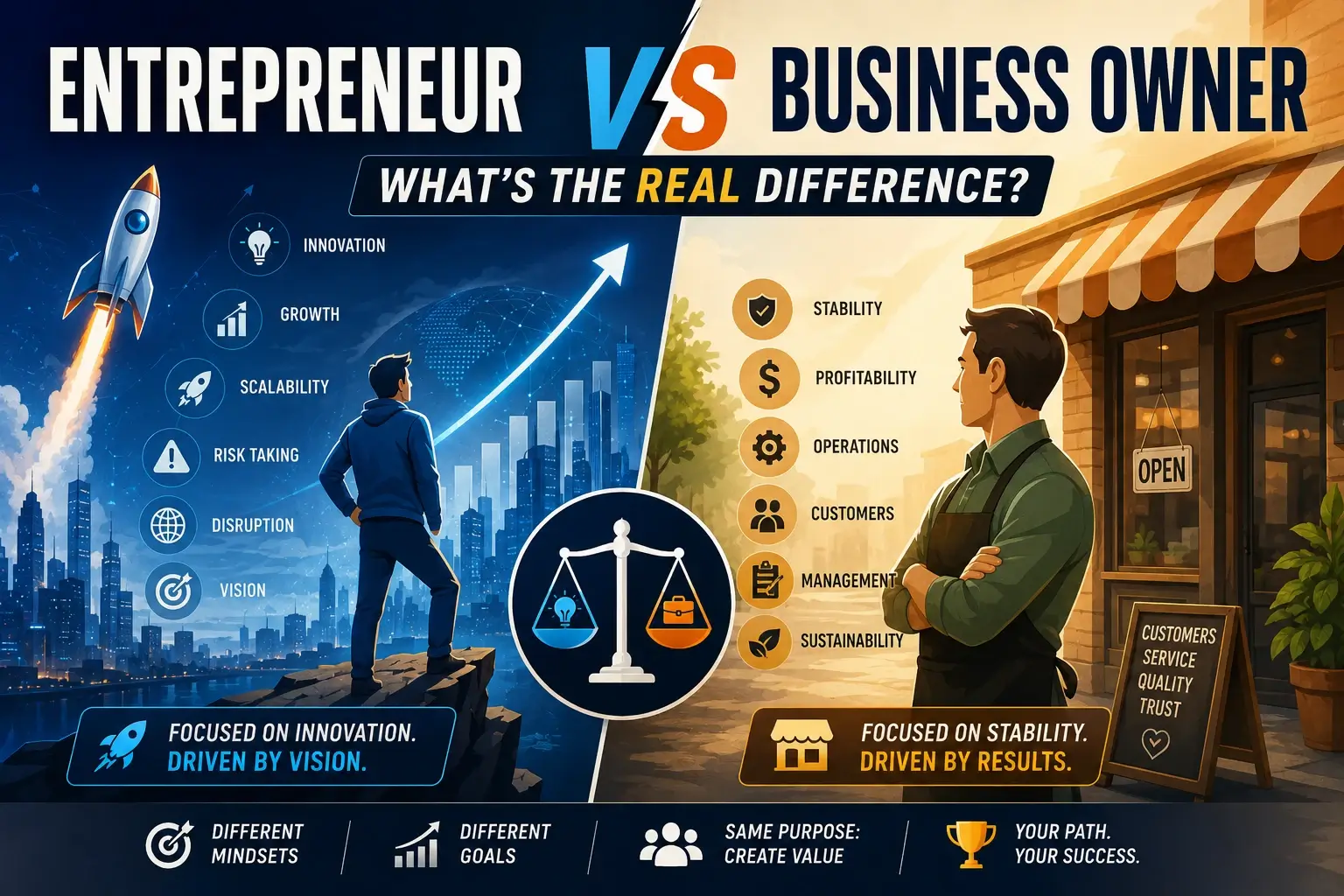
In today’s dynamic business landscape, the terms entrepreneur vs business owner are often used interchangeably. While both involve running and managing a business, they represent distinct approaches to creating value, pursuing growth, and achieving success.
Understanding the differences between Entrepreneur vs Business Owner is essential for aspiring founders, startup enthusiasts, and professionals seeking clarity about their career and business aspirations. Although both roles contribute significantly to economic growth and innovation, their objectives, mindsets, risk tolerance, and long-term visions can differ considerably.
This comprehensive guide explores the similarities and differences between entrepreneur vs business owner, helping you determine which path aligns best with your goals.
Table of Contents
What Is an Entrepreneur? 🚀
An entrepreneur is an individual who identifies opportunities, develops innovative solutions, and creates businesses designed to solve problems or disrupt existing markets.
Entrepreneurs are typically driven by innovation, growth, and the desire to create something new. They often take substantial risks in pursuit of scalable business opportunities.
Key Characteristics of an Entrepreneur
- 💡 Innovation-focused
- 🎯 Vision-driven
- 📈 Growth-oriented
- 🚀 Seeks scalability
- ⚡ Comfortable with uncertainty
- 🌍 Interested in market disruption
Entrepreneurs usually build businesses around unique ideas, technologies, products, or services that have the potential to expand significantly.
Example of an Entrepreneur
Consider a founder who develops an AI-powered software platform to transform customer service across industries. Their goal isn’t simply to earn a living but to create a scalable company capable of serving thousands or millions of customers worldwide.
What Is a Business Owner? 💼
A business owner is someone who owns and operates a business, typically focusing on generating steady income, maintaining operations, and serving customers effectively.
Unlike entrepreneurs, business owners may not necessarily seek disruptive innovation or rapid scaling. Their primary objective is often sustainability, profitability, and long-term stability.
Key Characteristics of a Business Owner
- 💼 Operations-focused
- 📊 Stability-oriented
- 🤝 Customer-focused
- 💰 Profit-driven
- 🏢 Emphasizes sustainability
- 📋 Prioritizes efficient management
Business owners frequently operate local businesses, franchises, agencies, retail stores, restaurants, or service-based companies.
Example of a Business Owner
A person who owns a successful local accounting firm with a loyal client base and consistent revenue is generally considered a business owner. Their focus is on maintaining quality service and profitability rather than disrupting the accounting industry.
Entrepreneur vs Business Owner: Detailed Comparison Table
| Factor | 🚀 Entrepreneur | 💼 Business Owner |
|---|---|---|
| Primary Goal | Innovation and growth | Stability and profitability |
| Risk Tolerance | High | Moderate |
| Business Model | Scalable | Sustainable |
| Focus | Creating new opportunities | Managing existing operations |
| Innovation Level | High | Moderate |
| Growth Strategy | Rapid expansion | Controlled growth |
| Financial Objective | Wealth creation and scaling | Consistent income |
| Market Approach | Disruptive | Competitive |
| Decision-Making | Vision-driven | Practical and operational |
| Exit Strategy | Often plans acquisition or IPO | Often long-term ownership |
| Funding | Investors, venture capital | Personal savings, loans |
| Success Metric | Market impact and scale | Profitability and longevity |
Entrepreneur vs Business Owner: Key Differences
Although entrepreneur and business owner share many responsibilities such as leadership, financial management, and customer service, they differ in several fundamental ways. These differences mainly come from their mindset, goals, approach to risk, and long-term vision for their businesses.
1. Mindset and Vision 💡
One of the clearest distinctions in the Entrepreneur vs Business Owner comparison is how each thinks about opportunity and success.
Entrepreneur Mindset
Entrepreneurs are typically driven by innovation and transformation. They tend to look beyond current market conditions and focus on what could be possible in the future.
They often think about:
- Creating entirely new markets or industries
- Solving large-scale or global problems
- Developing innovative or disruptive products and services
- Transforming how people live, work, or communicate
- Building scalable businesses that can grow rapidly
Their guiding question is often:
“How can I change or reshape the market?”
This mindset pushes entrepreneurs to think big, take bold actions, and pursue ideas that may not yet have proven demand.
Business Owner Mindset
Business owners are usually more focused on stability, consistency, and long-term sustainability. Rather than changing markets, they aim to serve existing demand effectively.
They typically focus on:
- Serving customers reliably and consistently
- Managing day-to-day operations efficiently
- Maintaining steady profitability
- Building strong local or niche reputations
- Ensuring long-term business survival and stability
Their guiding question is often:
“How can I improve, maintain, and sustain my business?”
This mindset prioritizes structure, efficiency, and reliability over disruption.
2. Risk-Taking Behavior ⚡
Risk tolerance is another major difference between entrepreneur and business owner.
Entrepreneurs and Risk
Entrepreneurs are generally more comfortable with uncertainty and ambiguity. They often operate in environments where outcomes are unknown.
They may:
- Launch completely new or untested ideas
- Enter emerging or unpredictable markets
- Invest heavily in research, development, or innovation
- Accept a high probability of failure in exchange for high rewards
For entrepreneurs, failure is often seen as part of the process of innovation and growth.
Business Owners and Risk
Business owners tend to prefer more controlled and predictable environments. Their focus is on reducing uncertainty while maintaining consistent performance.
They usually:
- Rely on proven and established business models
- Focus on stable and repeatable revenue streams
- Prioritize financial security and sustainability
- Avoid unnecessary or high-risk experimentation
Their main goal is to ensure the business remains stable and profitable over time.
3. Innovation and Creativity 🚀
Innovation is often what separates entrepreneurs from traditional business owners in practice.
Entrepreneurs
Entrepreneurs are typically highly innovation-driven. They aim to introduce new ideas that can reshape industries or create entirely new ones.
They often:
- Develop new technologies or platforms
- Design original products or services
- Disrupt existing markets or industries
- Experiment with new business models
For entrepreneurs, innovation is not optional—it is the foundation of their strategy.
Business Owners
Business owners may still innovate, but usually within the boundaries of an existing and proven model. Their focus is more on execution than invention.
Common business types include:
- Restaurants and cafés
- Retail shops and franchises
- Service-based businesses
- Professional practices (law, accounting, consulting, etc.)
Their innovation is often operational—such as improving efficiency, customer service, or cost management—rather than creating entirely new markets.
4. Growth and Scalability 📈
Growth expectations differ significantly between entrepreneur and business owner.
Entrepreneurial Growth
Entrepreneurs typically aim for fast and large-scale expansion. Their businesses are often designed to scale beyond local markets.
They pursue:
- National or global expansion
- Rapid customer acquisition
- High-growth startup models
- Exponential revenue growth
Scalability is a core objective from the beginning, often influencing product design and business structure.
Business Owner Growth
Business owners usually prefer steady and manageable growth. Their focus is on maintaining quality and stability rather than rapid expansion.
They prioritize:
- Consistent and sustainable revenue growth
- Strong local or regional market presence
- Operational efficiency and cost control
- Gradual and controlled expansion
Growth is important, but it is balanced with stability and long-term control.
5. Financial Goals 💰
Financial priorities also differ significantly between entrepreneur and business owner.
Entrepreneur Financial Goals
Entrepreneurs often focus on long-term, high-scale financial outcomes. Profit is important, but growth potential often comes first in early stages.
They may aim for:
- Large-scale wealth creation
- Attracting investors and venture capital
- Increasing business valuation
- Selling or exiting the business through acquisition or IPO
In many cases, short-term profit is secondary to long-term value creation.
Business Owner Financial Goals
Business owners generally prioritize financial stability and consistent income. Their goal is often to maintain a dependable livelihood from the business.
They focus on:
- Stable and predictable cash flow
- Regular personal income
- Long-term profitability
- Financial independence and security
For many business owners, the business is a long-term source of income rather than a high-growth investment vehicle.
6. Time Horizon ⏳
A major difference between entrepreneurs and business owners is how they view time and long-term planning.
Entrepreneurs
Entrepreneurs usually think in the long-term future, often planning 5–10 years ahead or more. They are willing to endure short-term losses or instability if it leads to major future gains.
They often prioritize:
- Long-term scalability
- Future market dominance
- Building lasting systems or platforms
- Delayed profitability in exchange for growth
Business Owners
Business owners typically focus more on the short-to-medium term, aiming for steady results and immediate sustainability.
They prioritize:
- Monthly and yearly stability
- Consistent revenue cycles
- Maintaining current operations
- Immediate profitability and cash flow
7. Business Structure and Ownership Model 🏢
The way businesses are structured and controlled also differs significantly.
Entrepreneurs
Entrepreneurs often build businesses with flexibility and external investment in mind. Their structures are designed to scale quickly.
They commonly:
- Seek investors (angel investors, venture capital)
- Give up partial ownership for funding
- Build corporations or scalable startups
- Design systems that can operate globally
Business Owners
Business owners usually prefer full control and independence over their business operations.
They often:
- Self-fund or use small loans
- Retain full ownership and decision-making power
- Operate sole proprietorships, partnerships, or small LLCs
- Avoid external investor influence
8. Role in Daily Operations 🧑💼
Another key difference is how involved each is in day-to-day work.
Entrepreneurs
Entrepreneurs often focus on big-picture strategy and may delegate daily operations once the business grows.
They tend to:
- Work on vision, innovation, and expansion
- Build leadership teams to manage operations
- Step away from routine tasks over time
- Focus on scaling systems rather than daily execution
Business Owners
Business owners are usually more involved in daily operations, especially in small and medium-sized businesses.
They often:
- Handle daily management tasks directly
- Interact regularly with customers and staff
- Oversee operations personally
- Ensure smooth day-to-day functioning
9. Exit Strategy 🎯
Entrepreneurs and business owners often differ in how they view the future of the business itself.
Entrepreneurs
Entrepreneurs frequently build businesses with a planned exit strategy in mind.
Common exit goals include:
- Selling the business to a larger company
- Merging with another organization
- Going public (IPO)
- Scaling and then stepping away
The business is often seen as a high-growth asset.
Business Owners
Business owners typically view their business as a long-term or lifelong commitment.
They often:
- Plan to run the business indefinitely
- Pass it down to family members
- Maintain ownership for steady income
- Rarely plan to sell or exit
The business is seen as a permanent source of livelihood.
10. Success Measurement 📊
The definition of success also varies between entrepreneurs and business owners.
Entrepreneurs
Entrepreneurs measure success through growth and impact.
They focus on:
- Market valuation
- User/customer growth
- Innovation impact
- Market disruption
- Investment funding raised
Business Owners
Business owners measure success through stability and sustainability.
They focus on:
- Consistent profit
- Customer retention
- Business longevity
- Operational efficiency
- Work-life balance
Similarities Between Entrepreneur and Business Owner 🤝
Although entrepreneur and business owner are often described differently—entrepreneur as innovator and business owner as operator of established models—they share many fundamental traits. In reality, both roles overlap significantly in the skills they use, the challenges they face, and the value they create.
Both Create Economic Value
At their core, both entrepreneur vs business owner contribute to the economy by building and sustaining productive activity. Whether launching a new idea or running an existing operation, both play an important role in economic development.
They contribute through:
- Job creation: Hiring employees and supporting livelihoods
- Economic growth: Increasing production, trade, and local spending
- Customer satisfaction: Providing goods and services that meet real needs
- Community development: Supporting suppliers, local partnerships, and regional stability
Even small-scale businesses can have a meaningful impact when they consistently operate and grow over time.
Both Require Leadership Skills
Leadership is essential in both entrepreneurship and business ownership, as both roles involve guiding people and making decisions that affect operations and outcomes.
Key leadership responsibilities include:
- Communication: Clearly expressing goals, expectations, and feedback
- Decision-making: Choosing effective solutions under pressure or uncertainty
- Problem-solving: Addressing operational, financial, or customer-related issues
- Team management: Motivating staff, assigning roles, and maintaining productivity
Strong leadership helps ensure that a business runs smoothly and continues improving.
Both Face Ongoing Challenges
No business journey is free from obstacles. Entrepreneurs and business owners regularly deal with internal and external pressures that require quick thinking and resilience.
Common challenges include:
- Competition from similar businesses in the market
- Financial pressure, including managing costs and maintaining cash flow
- Customer expectations, which are constantly evolving
- Operational issues, such as supply chain disruptions or staffing problems
How these challenges are handled often determines long-term success.
Both Need Strategic Thinking
Long-term planning is essential in both roles. Success depends not only on daily operations but also on the ability to anticipate future changes and prepare accordingly.
Strategic thinking involves:
- Setting short-term and long-term goals
- Identifying opportunities in the market
- Planning for growth, sustainability, or expansion
- Managing risks before they become major problems
Without strategy, even a profitable business can struggle to maintain direction.
Both Are Customer-Focused
Customers are the foundation of any business, and both entrepreneurs and business owners must prioritize their needs and experiences.
This includes:
- Understanding customer problems and expectations
- Improving products or services based on feedback
- Building trust and long-term relationships
- Ensuring consistent quality and reliability
Customer satisfaction directly influences reputation and long-term survival.
Both Require Financial Management Skills
Managing money effectively is critical for stability and growth in both roles.
They must handle:
- Budgeting and expense control
- Revenue tracking and profit analysis
- Pricing strategies for products or services
- Cash flow management
- Understanding financial statements and performance
Poor financial management can quickly threaten even a strong business model.
Both Must Be Adaptable and Flexible
Markets, technologies, and customer preferences change constantly, requiring both entrepreneurs and business owners to adjust quickly.
They often adapt to:
- Changing consumer behavior
- New technologies and digital tools
- Economic shifts and inflation
- Unexpected disruptions in supply or demand
Flexibility helps businesses stay competitive and resilient.
Both Depend on Marketing and Branding
Attracting and retaining customers requires effective communication and presentation of value.
This includes:
- Advertising through digital and traditional channels
- Building a recognizable brand identity
- Understanding target audiences
- Differentiating from competitors
Even small businesses benefit from strong branding, while larger ones rely heavily on advanced marketing strategies.
Both Require Resilience and Persistence
Business success rarely happens quickly. Both entrepreneurs and business owners must stay committed through setbacks and uncertainty.
They need to:
- Recover from failures and mistakes
- Stay motivated during slow periods
- Learn from experience and improve strategies
- Maintain focus on long-term goals
Persistence is often what separates success from failure.
Both Rely on Networking and Relationships
Relationships play a major role in growth and opportunity for both groups.
Important connections include:
- Customers and clients
- Suppliers and vendors
- Investors and financial partners
- Mentors and industry peers
Strong networks can lead to partnerships, referrals, and new opportunities.
Both Operate in Competitive Markets
Competition pushes both entrepreneurs and business owners to improve continuously.
They must:
- Monitor competitors’ strategies
- Improve efficiency and quality
- Develop unique selling points
- Innovate or differentiate their offerings
Competition encourages growth and innovation in both cases.
Both Must Make Risk-Based Decisions
Every business involves uncertainty, and both roles require evaluating risks carefully before making decisions.
This includes:
- Investment choices
- Expansion opportunities
- Hiring decisions
- Product or service launches
Success depends on managing risk wisely rather than avoiding it completely.
Both Value Time Management
Time is a limited resource, and both entrepreneurs and business owners must use it efficiently.
They balance:
- Daily operations
- Strategic planning
- Customer interactions
- Administrative responsibilities
Good time management improves productivity and reduces stress.
Advantages and Challenges of Being an Entrepreneur 🚀
Advantages of Being an Entrepreneur 🚀
Entrepreneurship offers a dynamic and opportunity-rich path for individuals who want to build something new, take risks, and create large-scale impact. While it can be demanding, it also provides significant rewards.
1. Unlimited Growth Potential
One of the biggest advantages of entrepreneurship is the possibility of exponential growth. Unlike traditional roles, there are few limits on how large a successful venture can become.
Entrepreneurs can:
- Expand from local to global markets
- Scale operations rapidly through systems and technology
- Attract investors to accelerate growth
- Build brands with international recognition
With the right idea and execution, growth potential is virtually unlimited.
2. Innovation Opportunities 💡
Entrepreneurs have the freedom to think creatively and develop entirely new solutions.
They can:
- Introduce groundbreaking products or services
- Disrupt outdated industries
- Solve problems in unique and efficient ways
- Experiment with new business models and technologies
This creative freedom is one of the most rewarding aspects of entrepreneurship.
3. Wealth Creation 💰
Successful entrepreneurs can generate substantial financial rewards, especially when building scalable businesses.
They benefit from:
- Equity ownership in high-growth companies
- Long-term value appreciation
- Investment opportunities and funding rounds
- Potential exits through acquisitions or IPOs
Unlike fixed-income roles, earnings can grow significantly over time.
4. Industry Impact 🌍
Entrepreneurs often influence how entire industries operate.
They may:
- Introduce new standards or technologies
- Change consumer behavior
- Create entirely new markets
- Inspire competitors to innovate
Their work can have a long-lasting impact beyond their own company.
Challenges of Entrepreneurship ⚠️
Despite the benefits, entrepreneurship comes with significant challenges:
- High risk of failure
- Financial instability in early stages
- Intense pressure and responsibility
- Long and irregular working hours
- Constant need to adapt to market changes
Success often requires resilience, persistence, and strong decision-making under uncertainty.
Advantages and Challenges of Being a Business Owner 💼
Advantages of Being a Business Owner 💼
Business ownership focuses more on stability, control, and consistent operations. It is often considered a more predictable and structured path compared to entrepreneurship.
1. Stable Income 📊
Established businesses often generate reliable and predictable cash flow.
Business owners benefit from:
- Consistent monthly revenue
- Repeat customers and steady demand
- Established pricing structures
- Long-term financial planning
This stability makes it easier to manage personal and business finances.
2. Greater Control 🧑💼
Business owners typically maintain full authority over operations and decisions.
They can:
- Directly manage employees and workflows
- Set business policies and standards
- Make independent financial decisions
- Shape the company culture
This control allows for a more personalized approach to business management.
3. Lower Risk ⚖️
Compared to startups, many business ownership models are based on proven systems.
This means:
- Lower chance of complete failure
- Predictable market demand
- Established customer bases
- Reduced uncertainty in operations
Examples include franchises, retail stores, and service-based businesses.
4. Community Influence 🤝
Local business owners often play an important role in their communities.
They:
- Build strong customer relationships
- Support local economies
- Provide consistent services
- Become trusted and familiar brands
Over time, they often become essential parts of their local area.
Challenges of Business Ownership ⚠️
Even though it is more stable, business ownership still comes with challenges:
- Daily operational responsibilities
- Limited scalability compared to startups
- Strong market competition
- Employee hiring and management issues
- Vulnerability to economic changes
Success requires consistency, discipline, and strong management skills.
Real-World Examples of Entrepreneurs and Business Owners
Understanding the difference between entrepreneur vs business owner becomes clearer when we look at real-world examples. These individuals and groups show how mindset, goals, and business models can vary in practice.
Famous Entrepreneurs 🚀
Entrepreneurs are typically known for innovation, disruption, and building scalable businesses that can grow rapidly and impact global markets.
Elon Musk
Elon Musk is widely recognized for pushing technological boundaries in multiple industries, including electric vehicles, space exploration, and artificial intelligence. His ventures aim to solve large-scale global challenges, such as sustainable energy and interplanetary travel.
Steve Jobs
Steve Jobs helped transform personal computing, mobile phones, and digital media through innovation and design-focused products. His work with Apple revolutionized entire industries and changed how people interact with technology.
Richard Branson
Richard Branson built the Virgin Group into a global brand spanning airlines, music, telecommunications, and more. He is known for his bold approach to business and willingness to enter competitive industries with fresh ideas.
Sara Blakely
Sara Blakely created Spanx, a revolutionary apparel company that changed the shapewear industry. She started with a simple idea and turned it into a globally recognized brand, becoming one of the most successful female entrepreneurs in the world.
Examples of Business Owners 💼
Business owners are more focused on stability, consistent income, and long-term operational success rather than rapid global expansion or disruption.
Restaurant Owners 🍽️
Local restaurant owners run food businesses that serve their communities daily. Their success depends on customer satisfaction, consistent quality, and efficient operations.
Accounting Firm Owners 📊
Accounting professionals who own firms focus on providing reliable financial services such as bookkeeping, auditing, and tax preparation for individuals and businesses.
Retail Store Operators 🛍️
Retail business owners manage physical or online stores that sell everyday goods such as clothing, electronics, or groceries, often relying on repeat customers and steady demand.
Real Estate Agency Owners 🏡
These owners run agencies that help clients buy, sell, or rent properties. Their business success depends on trust, local market knowledge, and strong client relationships.
Local Service Providers 🔧
This includes owners of businesses like cleaning services, repair shops, salons, and consulting firms that operate within specific regions and serve local communities.
How to Determine Whether You Are an Entrepreneur or a Business Owner
You May Be an Entrepreneur If:
✅ You constantly seek new opportunities
✅ You enjoy innovation and disruption
✅ You are comfortable with significant risk
✅ You dream of scaling globally
✅ You prioritize growth over short-term profits
You May Be a Business Owner If:
✅ You value stability and consistency
✅ You prefer proven business models
✅ You focus on operational excellence
✅ You prioritize sustainable profitability
✅ You enjoy managing established systems
Entrepreneur vs Business Owner: Which Path Is Right for You? 🎯
When evaluating Entrepreneur vs Business Owner, consider your priorities:
Choose Entrepreneurship If:
- You love innovation
- You embrace uncertainty
- You seek large-scale impact
- You want rapid growth potential
Choose Business Ownership If:
- You prefer stability
- You value predictable income
- You enjoy operations and management
- You want long-term sustainability
Many successful individuals combine both approaches, starting as entrepreneurs and later evolving into business owners as their companies mature.
Frequently Asked Questions (FAQs)
To further clarify the differences between entrepreneur and business owner, here are answers to some of the most commonly asked questions about the topic.
1. What is the main difference between an Entrepreneur and a Business Owner? 🤔
The primary difference lies in their focus and objectives.
Entrepreneurs are typically driven by innovation, growth, and the desire to create new products, services, or markets. They often seek opportunities to disrupt industries and build scalable businesses with significant growth potential.
Business owners, on the other hand, focus on operating and maintaining a business successfully. Their priorities usually include profitability, customer satisfaction, operational efficiency, and long-term sustainability.
In simple terms:
- Entrepreneurs build something new and scalable.
- Business owners manage and grow established businesses.
2. Can a Business Owner Become an Entrepreneur? 🚀
Yes, absolutely.
Many business owners eventually adopt an entrepreneurial mindset by introducing innovative products, entering new markets, or expanding their operations significantly.
For example:
- A local restaurant owner may develop a unique dining concept and franchise it nationally.
- A retail store owner may launch a new product line that disrupts the market.
- A service provider may create software that transforms how their industry operates.
When business owners begin focusing on innovation, scalability, and market transformation, they often transition into entrepreneurial roles.
3. Are All Entrepreneurs Business Owners? 💼
In most cases, yes.
When entrepreneurs launch and operate a company, they become business owners because they own and manage a business entity.
However, the reverse is not always true.
Many business owners run successful companies based on proven business models without necessarily creating something innovative or disruptive.
Therefore:
- Most entrepreneurs are business owners.
- Not all business owners are entrepreneurs.
This distinction is one of the most important aspects of the Entrepreneur vs Business Owner discussion.
4. Which Is Riskier: Being an Entrepreneur or a Business Owner? ⚡
Generally, entrepreneurship involves greater risk.
Entrepreneurs often:
- Launch untested products or services
- Enter uncertain or emerging markets
- Invest heavily in research and development
- Face higher rates of failure
Business owners typically operate within:
- Established industries
- Proven business models
- Predictable customer demand
- More stable revenue structures
While all businesses involve risk, entrepreneurs usually face a higher degree of uncertainty in pursuit of larger rewards.
5. Who Earns More: Entrepreneurs or Business Owners? 💰
There is no single answer because earnings vary greatly.
Entrepreneurs have the potential to earn significantly more because scalable businesses can generate massive revenues and attract investors. Successful startups may eventually be sold for millions—or even billions—of dollars.
However, entrepreneurship also comes with a higher chance of failure and financial loss.
Business owners often enjoy:
- More predictable income
- Stable cash flow
- Consistent profits
- Lower financial volatility
In general:
- Entrepreneurs may achieve higher financial upside.
- Business owners often experience greater financial stability.
6. Is Entrepreneurship Better Than Business Ownership? 🎯
Neither path is inherently better.
The right choice depends on your:
- Personal goals
- Risk tolerance
- Leadership style
- Financial objectives
- Lifestyle preferences
Entrepreneurship may be ideal for those who enjoy innovation, rapid growth, and uncertainty.
Business ownership may be a better fit for those who value stability, operational management, and sustainable profitability.
Success can be achieved through either path.
7. Can Someone Be Both an Entrepreneur and a Business Owner? 🤝
Yes.
In fact, many successful professionals embody both roles at different stages of their careers.
For example:
- An entrepreneur may launch a startup and later focus on managing and sustaining it as a business owner.
- A business owner may develop innovative products or enter new markets, adopting entrepreneurial characteristics.
The two roles often overlap, and many thriving companies require both entrepreneurial vision and strong business management.
8. Do Entrepreneurs Need Investors to Succeed? 💵
Not necessarily.
While many entrepreneurs seek funding from angel investors, venture capitalists, or crowdfunding platforms, others build successful businesses through self-funding (bootstrapping).
Factors that influence funding needs include:
- Industry type
- Growth objectives
- Startup costs
- Market opportunities
Some of the world’s most successful businesses started with little or no external investment.
9. Can a Small Business Owner Be an Entrepreneur? 🌱
Yes.
Business size does not determine whether someone is an entrepreneur.
A small business owner can be considered an entrepreneur if they:
- Introduce innovative products or services
- Develop unique business models
- Pursue scalable growth opportunities
- Create solutions that differentiate them from competitors
Entrepreneurship is defined more by mindset and innovation than by company size.
10. Which Path Offers Better Work-Life Balance? ⚖️
Business ownership often provides a better opportunity for work-life balance, particularly once systems and processes are established.
Entrepreneurs frequently experience:
- Long work hours
- High stress levels
- Constant uncertainty
- Intense growth pressures
Business owners may still work hard, but their operations are often more predictable and manageable.
That said, work-life balance ultimately depends on the individual, the business model, and the stage of the business.
Conclusion
The discussion around Entrepreneur vs Business Owner is not about superiority—it is about alignment.
Entrepreneurs drive innovation, take risks, and build scalable ventures. Business owners prioritize stability, profitability, and long-term sustainability. Both are essential to economic growth and community development.
Your ideal path depends on your vision, mindset, and comfort with uncertainty. Whether you build a global startup or a thriving local business, success ultimately comes from consistency, strategy, and execution.
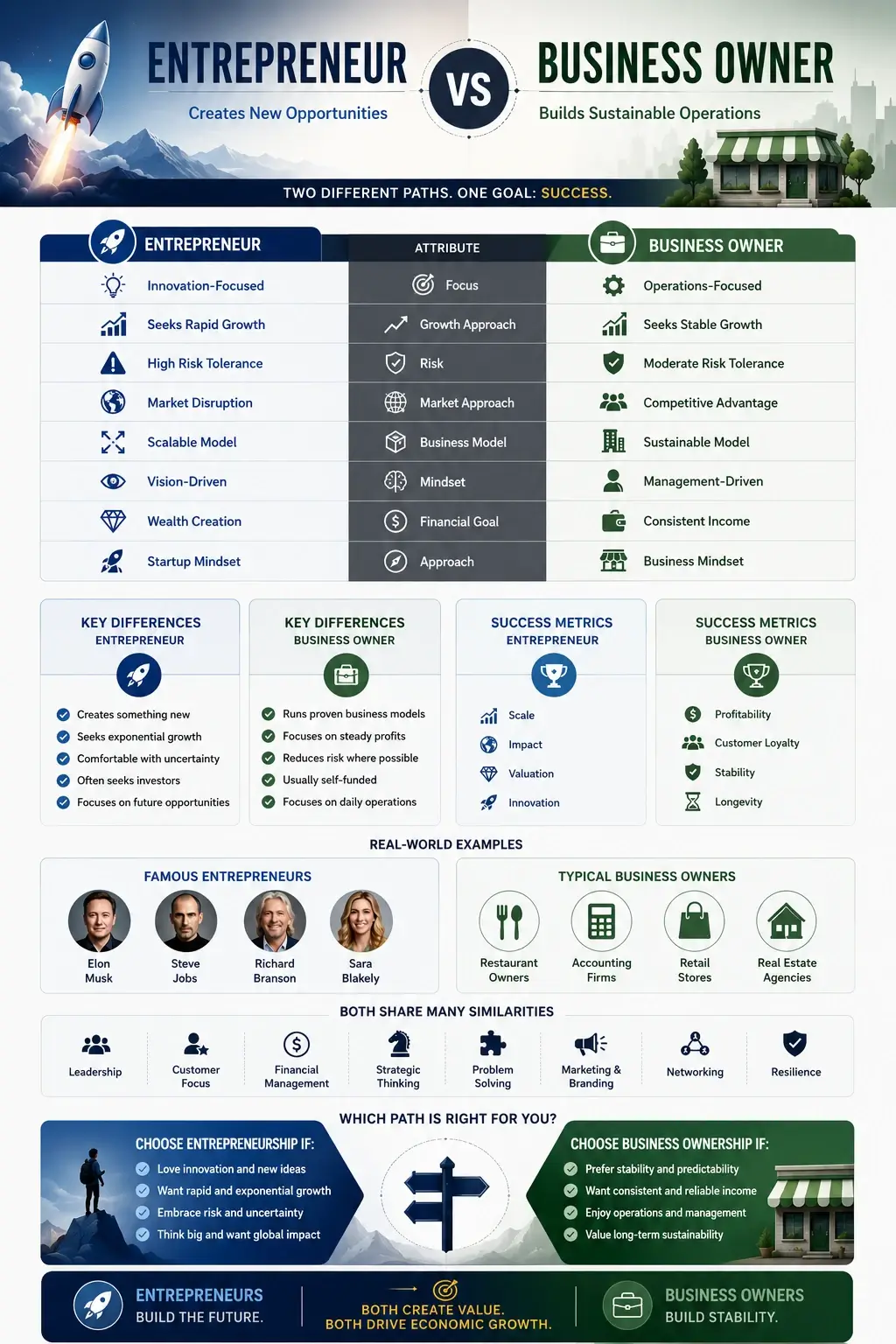
Infographic
References
- Drucker, P. F. (1985). Innovation and Entrepreneurship: Practice and Principles. Harper & Row.
- Gerber, M. E. (1995). The E-Myth Revisited: Why Most Small Businesses Don’t Work and What to Do About It. Harper Business.
- Kuratko, D. F. (2021). Entrepreneurship: Theory, Process, and Practice (11th ed.). Cengage Learning.
- Ries, E. (2011). The Lean Startup: How Today’s Entrepreneurs Use Continuous Innovation to Create Radically Successful Businesses. Crown Business.
- Thiel, P., & Masters, B. (2014). Zero to One: Notes on Startups, or How to Build the Future. Crown Business.
- Zimmerer, T. W., Scarborough, N. M., & Wilson, D. (2008). Essentials of Entrepreneurship and Small Business Management (5th ed.). Pearson Education.
- U.S. Small Business Administration (SBA). Starting and Managing a Business Resources.
- Global Entrepreneurship Monitor (GEM). Global Entrepreneurship Monitor Reports and Research.
- Harvard Business Review (HBR). Entrepreneurship, Innovation, and Business Growth Articles.
- Organisation for Economic Co-operation and Development (OECD) Entrepreneurship Studies. Entrepreneurship at a Glance.

 Inar Learn