
The way people earn a living has changed dramatically. Gone are the days when you needed a physical storefront, a massive inventory, or a team of employees to build a successful business. Today, anyone with an internet connection and a decent idea can launch a venture from their living room. The question is: which online business ideas are actually worth your time and energy in 2026?
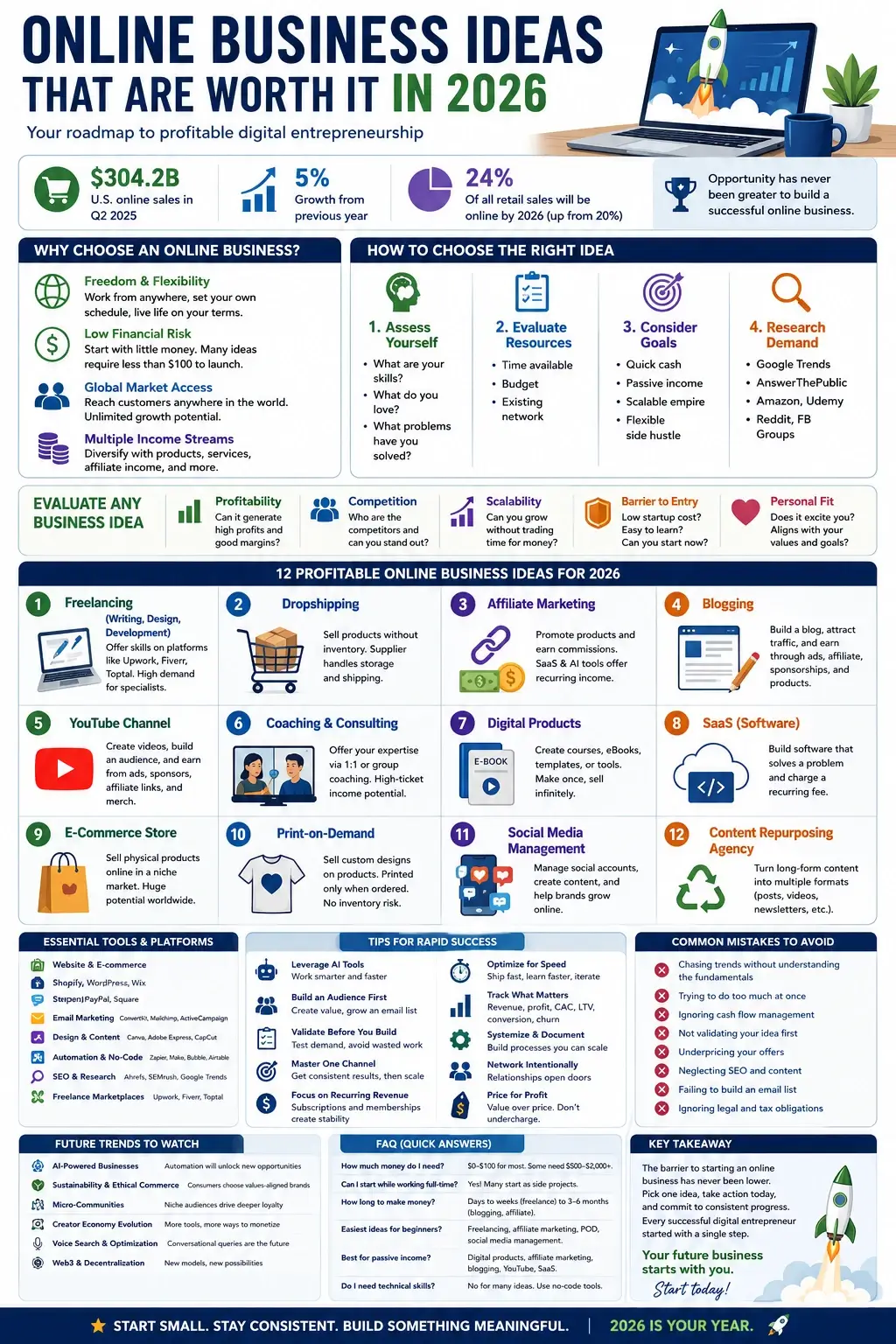
The numbers don’t lie. In the U.S. alone, online sales reached a staggering $304.2 billion in the second quarter of 2025, a 5% jump from the previous year. E-commerce is projected to capture 24% of all retail sales by 2026, up from 20%. Whether you’re looking for a side hustle to supplement your income or a full-time venture that replaces your 9-to-5, the opportunity has never been greater.
This guide explores the most profitable online business ideas for 2026—from low-cost startups you can launch with zero dollars to scalable models that generate passive income. We’ll cover exactly what each idea involves, why it’s profitable, and how you can get started today.
Why Choose an Online Business?
Before diving into specific ideas, let’s explore why starting an online business is one of the smartest career moves you can make in 2026.
The Digital Shift Is Real
The global pandemic permanently changed how people work and shop. Remote work is now mainstream, and consumers have grown comfortable buying everything from groceries to luxury goods online. This shift isn’t temporary—it’s the new normal.
Unprecedented Freedom and Flexibility
Running an online business gives you control over your schedule, location, and lifestyle. Want to work from a beach in Thailand? Go ahead. Prefer to start your workday at 10 AM instead of 8 AM? That’s your call. This flexibility is something traditional employment simply cannot offer.
Lower Financial Risk
Traditional businesses require massive upfront investment—rent, inventory, staff salaries. Many online business ideas can be started with less than $100. You can test, iterate, and scale without risking your life savings.
Global Market Access
When you operate online, your customers aren’t limited to your local area. You can sell to anyone with an internet connection. This global reach means unlimited growth potential.
Multiple Income Streams
One of the beauties of digital entrepreneurship is that you’re not locked into a single revenue source. You can combine affiliate marketing, digital products, coaching, and e-commerce to create diversified income that protects you against market fluctuations.
How to Choose the Right Online Business Idea
With so many online business ideas available, how do you pick the right one? Here’s a framework to help you decide.
1. Assess Your Skills and Interests
The best online business idea for you is one that aligns with what you already know and enjoy. Ask yourself:
- What am I naturally good at?
- What topics could I talk about for hours?
- What problems have I solved in my career or personal life?
If you’re a graphic designer, freelancing or selling digital templates makes sense. If you love teaching, online coaching or course creation might be your path.
2. Evaluate Your Resources
Be honest about what you have available:
- Time: Can you dedicate 5 hours a week or 50?
- Money: Do you have capital to invest, or do you need zero-cost online business ideas?
- Network: Do you have existing connections in a particular industry?
Some businesses, like dropshipping, need upfront capital for ads and website setup. Others, like freelancing, cost virtually nothing to start.
3. Consider Your Lifestyle Goals
Are you looking for:
- Quick cash: Freelancing, social media management, content repurposing
- Passive income: Digital products, affiliate marketing, blogging, YouTube
- Scalable empire: SaaS, e-commerce, coaching programs
- Flexible side hustle: Print-on-demand, dropshipping
Your long-term goals should influence which online business idea you pursue.
4. Research Market Demand
A great idea doesn’t matter if nobody wants what you’re offering. Use tools like:
- Google Trends to check search interest
- AnswerThePublic to find what people are asking
- Amazon and Udemy to see what’s selling
- Reddit and Facebook groups to listen to customer pain points
How to Evaluate Online Business Ideas
Once you have a few online business ideas in mind, use this evaluation framework to choose the best one.
Profitability Potential
- What’s the average price point for products or services in this space?
- Are customers willing to pay premium prices?
- What are the profit margins (revenue minus costs)?
- Can you increase prices as you build authority?
Competition Analysis
- How many competitors exist in this space?
- What are they doing well? What are their weaknesses?
- Can you differentiate yourself?
- Is the market saturated, or is there room for innovation?
Scalability
- Can you grow this business without proportional time investment?
- Does it allow for passive or semi-passive income?
- Can you hire others to handle tasks as you grow?
- Will it generate recurring revenue?
Barrier to Entry
- How much money do you need to start?
- How steep is the learning curve?
- Do you need special skills or certifications?
- Can you start now, or do you need to build something first?
Personal Fit
- Does this idea excite you?
- Will you enjoy the day-to-day work?
- Does it align with your values?
- Can you see yourself doing this long-term?
12 Profitable Online Business Ideas for 2026
Below, you’ll find a curated list of online business ideas that stand out for their low startup costs, high flexibility, and strong earning potential. Each one represents a genuine path to building a meaningful income stream — whether you’re aiming for a side hustle or a full-fledged digital entrepreneurship journey.
1. Freelancing (Writing, Design, Development)
Freelancing remains one of the most accessible online business ideas for beginners. If you have a marketable skill—writing, graphic design, web development, video editing—you can offer your services to clients worldwide.
How it works: Create a profile on platforms like Upwork, Fiverr, or Toptal. Bid on projects, deliver quality work, and build a reputation. As you gain experience, you can raise your rates and attract higher-paying clients.
Why it’s profitable: The global freelance market is booming. Businesses increasingly prefer hiring specialists for specific projects rather than maintaining large in-house teams. Freelance virtual assistants in the U.K., for example, typically earn between £24,000 and £27,000 annually.
How to start: Identify your strongest skill, create a portfolio, and start bidding on small projects. Even dedicating 5-10 hours a week can generate meaningful income.
2. Dropshipping
Dropshipping is one of the most popular online business ideas because it lets you sell products without holding inventory. You set up an online store, partner with suppliers, and when a customer places an order, the supplier ships directly to them.
How it works: You choose products from a supplier, list them on your store at a markup, and handle marketing and customer service. The supplier handles storage, packaging, and shipping.
Why it’s profitable: The global dropshipping market was valued at over $243 billion in 2023. You don’t need to purchase inventory upfront, which means lower financial risk. You can test different products without significant investment.
How to start: Choose a niche (eco-friendly products, AI-powered gadgets, and pet accessories are trending in 2026), set up a Shopify store, and find reliable suppliers through platforms like AliExpress or Spocket.
3. Affiliate Marketing
Affiliate marketing involves promoting other people’s products and earning a commission on every sale you generate. It’s one of the most scalable online business ideas because you can earn money while you sleep.
How it works: You join affiliate programs (Amazon Associates, ShareASale, or individual brand programs), share unique affiliate links through your blog, social media, or email newsletter, and earn commissions when someone purchases through your link.
Why it’s profitable: The highest-paying affiliate niche for 2026 is AI & SaaS Tools, offering generous recurring commissions for the lifetime of the customer. Most AI platforms operate on subscription models, meaning you earn ongoing income as long as users stay subscribed.
How to start: Choose a niche you’re passionate about, create content that provides value, and strategically place affiliate links. Consider starting with curated resource pages or a newsletter that monetizes attention.
4. Blogging
Blogging is one of the oldest online business ideas, and it’s still incredibly effective in 2026. A well-maintained blog can generate income through advertising, affiliate marketing, sponsored content, and digital products.
How it works: You write articles about topics you’re knowledgeable about. Over time, you build an audience, establish authority, and monetize through multiple channels.
Why it’s profitable: Blogs create long-term assets. A single article can generate traffic and income for years. According to research, blogs remain one of the most trusted sources of information online.
How to start: Choose a niche you’re passionate about, set up a WordPress blog (it takes minutes), and consistently publish high-quality content. Monetize through affiliate marketing, sponsored posts, or by selling your own digital products.
5. YouTube Channel
Video content dominates the internet, and YouTube remains the second-largest search engine. Starting a YouTube channel is one of the most engaging online business ideas for creators who enjoy being on camera or producing video content.
How it works: Create videos around a specific niche, build an audience, and monetize through ad revenue, sponsorships, affiliate marketing, and merchandise.
Why it’s profitable: YouTube’s reach is massive. Creators can earn from multiple streams—Google AdSense, brand deals, channel memberships, and super chats. The platform also serves as a funnel for other online business ideas like courses or coaching.
How to start: Identify your niche, invest in basic recording equipment, and commit to a consistent upload schedule. Focus on providing value—entertainment, education, or inspiration.
6. Online Coaching and Consulting
If you have expertise in a specific area, online coaching is one of the most lucrative online business ideas available. People are willing to pay for guidance on everything from career transitions to fitness to business growth.
How it works: You offer one-on-one or group coaching sessions via video calls. Some coaches also create cohort-based courses for larger groups.
Why it’s profitable: Coaching commands premium rates. A single client can pay hundreds or thousands of dollars per month. Plus, you can scale by creating group programs or digital products. Interest in AI coaches has seen a huge 2,801% uplift in demand.
How to start: Define your area of expertise, create a simple website, and start offering free sessions to build testimonials. Use social media and content marketing to attract clients.
7. Digital Products (Courses, eBooks, Templates)
Digital products are arguably the most scalable online business ideas because you create once and sell infinitely. No inventory, no shipping, and global reach.
How it works: You create a digital asset—an online course, eBook, template, or software—and sell it through platforms like Teachable, Gumroad, or your own website.
Why it’s profitable: Digital products have zero physical inventory costs and near-100% profit margins after the initial creation. The global e-learning market continues to expand rapidly. Popular digital products in 2026 include Canva templates, Notion templates, and AI-powered SaaS tools.
How to start: Identify a problem your target audience faces, create a solution in digital format, and sell it. Start with a simple product like an eBook or template to test the market.
8. SaaS (Software as a Service)
Building a SaaS product is one of the most ambitious online business ideas, but it’s also one of the most profitable. You create software that solves a specific problem and charge a recurring subscription fee.
How it works: You identify a pain point, build software that addresses it, and charge users monthly or annually. The global AI consultancy market is projected to reach $347.05 billion in 2026.
Why it’s profitable: SaaS generates predictable, recurring revenue. Once you acquire a customer, they often stay for months or years. Micro-SaaS ideas—small, niche software solutions—are particularly accessible in 2026.
How to start: Start small. Identify a specific problem you understand deeply, build a minimal viable product, and validate with early customers. You don’t need to be a technical founder—AI tools are making it easier for non-technical entrepreneurs to build software.
9. E-Commerce Store
Selling physical products online remains one of the most proven online business ideas. Whether you make products yourself, source from manufacturers, or curate unique items, e-commerce offers endless possibilities.
How it works: You set up an online store (Shopify, WooCommerce, or BigCommerce), list products, handle orders, and manage shipping. Some entrepreneurs focus on niche markets like sustainable fashion, pet accessories, or home office tools.
Why it’s profitable: E-commerce continues to grow globally. Shopify data shows that product categories outside the top 100 now account for significant market share, and niche stores are thriving.
How to start: Choose a niche you understand, source or create products, set up a store, and focus on marketing. Consider starting with a print-on-demand model to test products without inventory risk.
10. Print-on-Demand
Print-on-demand is a variation of e-commerce where you sell custom-designed products—t-shirts, mugs, phone cases—that are printed and shipped only when a customer orders.
How it works: You design products, list them on your store, and when an order comes in, a third-party printer fulfills it. You never touch inventory.
Why it’s profitable: The print-on-demand industry continues to grow, with low startup costs and no inventory risk. It’s particularly appealing for creatives who want to monetize their designs.
How to start: Create designs, set up a Shopify store with a POD app like Printful or Printify, and market your products through social media and paid ads.
11. Social Media Management
Businesses are desperate for social media presence, but most don’t have the time or expertise to manage it effectively. Social media management is one of the most in-demand online business ideas in 2026.
How it works: You manage social media accounts for businesses—creating content, scheduling posts, engaging with followers, and analyzing performance. Some managers also offer TikTok Shop management services.
Why it’s profitable: Companies are willing to pay premium rates for consistent, high-quality social media presence. Live social shopping is a growing niche where hosts sell products through Instagram Live and TikTok Shop.
How to start: Build a portfolio by managing accounts for friends or local businesses, then pitch to larger clients. Focus on a specific platform or industry to stand out.
12. Content Repurposing Agency
With the explosion of content creation, many businesses produce more content than they can effectively distribute. A content repurposing agency transforms long-form content into multiple formats.
How it works: You take a client’s blog post, podcast, or video and repurpose it into social media posts, newsletters, short-form videos, and more.
Why it’s profitable: Businesses need to maximize their content ROI but lack the time to repurpose. Done-for-you content services are exploding in 2026.
How to start: Learn content repurposing tools, create samples, and pitch to content creators and businesses. This is a low-cost, high-value online business idea that requires minimal investment.
Essential Tools and Platforms to Launch Online Business Ideas
Successful online business ideas are built on a foundation of reliable tools. While specific needs vary, certain platforms appear again and again across the most profitable online business ideas:
- Website & e-commerce: Shopify, WordPress, Wix, WooCommerce
- Freelance & service marketplaces: Upwork, Fiverr, Toptal
- Payment processing: Stripe, PayPal, Square
- Email marketing: ConvertKit, Mailchimp, ActiveCampaign
- Design & content: Canva, Adobe Express, CapCut
- Automation & no-code: Zapier, Bubble, Airtable
- Learning & SEO: Ahrefs, SEMrush, Google Trends
Using the right stack from day one makes it far easier to implement your online business ideas without getting bogged down by technical headaches.
Tips for Rapid Success in Digital Entrepreneurship
Starting an online business is exciting, but achieving rapid success requires more than just a good idea. Here are proven strategies to accelerate your growth as a digital entrepreneur.
1. Leverage AI Tools from Day One
In 2026, AI tools are game-changers for digital entrepreneurs. They can handle everything from content creation to customer service.
What to use:
- ChatGPT, Claude, or Perplexity for content drafting and brainstorming
- Canva AI for design work
- Jasper or Copy.ai for copywriting
- Zapier or Make for automation
- Claude or ChatGPT for coding and technical tasks
By using AI, you can accomplish in hours what once took days. This speed advantage lets you launch faster, test more ideas, and scale quicker.
2. Start Before You Feel Ready
The biggest mistake aspiring entrepreneurs make is waiting too long. They want the perfect website, the perfect logo, the perfect product. The problem? Perfect doesn’t exist.
Here’s the truth: Most successful digital entrepreneurs launched with imperfect offerings and improved as they went. Your early customers will give you feedback that no amount of planning can provide.
Action step: Pick one online business idea and launch a simple version of it within 7 days. Don’t wait for perfection.
3. Build an Audience First
Many entrepreneurs build products first and then look for customers. This backward approach leads to wasted time and money.
Better approach: Build an audience first. Create valuable content, grow your email list, and engage with your target market. When you eventually launch a product, you already have a warm audience ready to buy.
Platforms to consider:
- Newsletter (Substack, Beehiiv, ConvertKit)
- Social media (Twitter/X, LinkedIn, Instagram, TikTok)
- YouTube for long-form video content
- Blog for SEO-driven traffic
4. Focus on Distribution Over Creation
Most digital entrepreneurs spend 80% of their time creating content and 20% distributing it. This is backward. The best content in the world is worthless if nobody sees it.
The 80/20 rule: Spend 20% of your time creating and 80% of your time distributing. Share your content on multiple platforms, repurpose it into different formats, and actively promote it.
Distribution tactics:
- Share every piece of content on 3-5 platforms
- Repurpose blog posts into videos, tweets, and newsletters
- Engage with comments and messages
- Collaborate with other creators in your space
5. Validate Before You Build
The most successful online business ideas are validated before any significant investment. Testing demand early prevents you from building something nobody wants.
Validation methods:
- Pre-sales – Offer your product before it exists
- Waitlists – Build a signup page to gauge interest
- Surveys – Ask your audience what they want
- Minimum Viable Product – Launch a simplified version first
If you can get 50 people to express interest before building, you likely have a viable business.
6. Invest in High-Impact Learning
The digital economy moves fast. What worked a year ago might not work today. To succeed rapidly, you need to invest in learning what actually works.
Where to learn:
- Courses from successful entrepreneurs in your space
- Communities like Starter Story, Indie Hackers, or niche Facebook groups
- Mentorship from someone who’s already achieved what you want
- Books and podcasts focused on digital entrepreneurship
Warning: Avoid “get rich quick” content. Focus on proven, implementable strategies from credible sources.
7. Master One Marketing Channel
Many entrepreneurs try to be everywhere at once. This dilutes your efforts and delays results. Instead, pick one marketing channel and master it before expanding.
Which channel to choose:
- SEO/Blogging if you’re good at writing
- YouTube if you’re comfortable on camera
- Twitter/X if you’re good at short-form content
- LinkedIn if you serve professionals
- TikTok/Instagram if you’re targeting younger audiences
Once you’re getting consistent results from one channel, expand to a second.
8. Create Systems and Document Everything
As your online business grows, managing everything manually becomes impossible. Systems and documentation allow you to scale without constant micro-management.
What to systematize:
- Onboarding – Standardize how you bring on new clients or customers
- Content creation – Create a repeatable process for producing content
- Customer support – Build templates and processes for common questions
- Marketing – Document your successful campaigns for replication
Tools: Notion, ClickUp, Asana, Trello
9. Price for Profit, Not Popularity
Beginners often underprice to attract customers. This attracts price-sensitive clients who are more demanding and less loyal. It also leaves money on the table.
Pricing principles:
- Charge more than your competitors if you offer superior value
- Test price increases regularly (you’ll lose some customers but increase revenue)
- Offer multiple pricing tiers to capture different segments
- Remember that pricing is often a signal of quality
10. Build for Recurring Revenue
The most scalable online business ideas incorporate recurring revenue. This stabilizes your income and increases your business valuation.
Recurring revenue models:
- SaaS subscriptions – Monthly/annual software fees
- Membership communities – Paid access to exclusive content
- Retainers – Ongoing services for a flat monthly fee
- Course bundles – Monthly access to new content
Aim to build at least 30-50% of your revenue from recurring sources.
11. Use the “One Thing” Framework
Daily distractions are the enemy of rapid progress. The “One Thing” framework helps you focus on what matters most.
How it works: Each day, ask yourself: “What’s the one thing I can do today that will make everything else easier or unnecessary?”
Examples:
- For an affiliate marketing business: Publishing one high-quality article
- For a coaching business: Recording one YouTube video
- For a SaaS product: Reaching out to five potential users
12. Network Intentionally
The digital entrepreneurship community is surprisingly accessible. Building relationships with other founders can accelerate your growth in ways that solo effort cannot.
Networking opportunities:
- LinkedIn connections in your industry
- Twitter/X conversations with other creators
- Co-working spaces with other digital entrepreneurs
- Online communities (Facebook groups, Slack communities)
- Mastermind groups of 3-5 peer entrepreneurs
13. Track Metrics That Actually Matter
Many new entrepreneurs obsess over vanity metrics like social media followers. These numbers feel good but don’t directly translate to revenue.
Metrics to track:
- Revenue and profit – The bottom line
- Customer acquisition cost – How much to get a customer
- Customer lifetime value – How much each customer is worth over time
- Conversion rates – Traffic to leads, leads to customers
- Churn rate – Percentage of customers who cancel
14. Embrace Public Building
Share your journey publicly. Document your successes, failures, and learnings. This builds trust, attracts customers, and creates accountability for consistent action.
What to share:
- Behind-the-scenes of your business
- Metrics and milestones (good and bad)
- Lessons learned
- Product updates and launches
Public building creates a loyal following that will support your growth.
15. Optimize for Speed of Execution
Speed separates successful digital entrepreneurs from those who stay stuck. In the online world, speed is a competitive advantage.
Speed principles:
- Ship imperfect products quickly
- Respond to customer feedback immediately
- Test ideas rapidly and kill what doesn’t work
- Automate everything that can be automated
Common Mistakes When Pursuing Online Business Ideas
Learning from others’ failures can save you time, money, and frustration. Here are the most common pitfalls in online business ideas.
1. Chasing Trends Without Understanding Fundamentals
Jumping on every new trend without understanding the basics is a recipe for failure. Yes, AI tools are exciting, but they won’t build your business for you. Master the fundamentals first.
2. Trying to Do Too Much at Once
Many entrepreneurs want to be everywhere—Instagram, TikTok, YouTube, newsletters—immediately. This spreads you thin and dilutes your impact. Pick one primary funnel and master it before expanding.
3. Ignoring Cash Flow Management
82% of small businesses fail due to poor cash flow management. Even profitable businesses can fail if they run out of money. Track every dollar, keep expenses low, and reinvest wisely.
4. Neglecting SEO from Day One
Search engine optimization should be built into your business, not added as an afterthought. Every piece of content you create should be optimized for search engines. This is especially critical for online business ideas that rely on organic traffic.
5. Not Validating Your Idea First
Building a product and then hoping people will buy it is backward. Test your idea first—sell a pre-sale, run a survey, or create a waitlist. If nobody wants it, you’ve saved yourself months of wasted effort.
6. Ignoring Legal and Tax Obligations
Many new entrepreneurs overlook the legal side of things. Register your business, understand your tax obligations, and get proper contracts in place. A single legal issue can derail your entire venture.
7. Underpricing Your Products or Services
Beginners often price too low to attract customers. This undervalues your work and attracts the wrong type of client. Charge what you’re worth—you can always adjust later.
8. Failing to Build an Email List
Social media algorithms change constantly. Your email list is the only audience you truly own. Start building it from day one, even if you don’t know exactly what you’ll send yet.
SEO Optimization: How to Make Your Online Business Visible
Starting an online business is only half the battle. The other half is getting found. Here’s how to optimize your venture for search engines:
Benefits of Starting an Online Business
- Flexibility – Work from anywhere, anytime
- Low overhead – No rent, utilities, or massive payroll
- Global reach – Sell to customers worldwide
- Scalability – Grow without proportional cost increases
Essential Tools and Platforms
| Business Type | Recommended Platforms |
|---|---|
| E-commerce | Shopify, WooCommerce, BigCommerce |
| Digital Products | Gumroad, Teachable, Thinkific |
| Freelancing | Upwork, Fiverr, Toptal |
| Affiliate Marketing | Amazon Associates, ShareASale |
| Blogging | WordPress, Medium, Substack |
| Email Marketing | ConvertKit, Mailchimp, ActiveCampaign |
| Social Media Management | Later, Buffer, Hootsuite |
| SEO | Ahrefs, SEMrush, Ubersuggest |
Tips for Success in Online Business
- Start as a side project – Most businesses take 3-6 months to generate consistent income
- Focus on a niche – Targeted markets often have less competition and customers willing to pay premium prices
- Validate your idea first – Test before you invest significant time or money
- Build an email list – Your audience is your most valuable asset
- Consistency beats intensity – Small, consistent actions compound over time
- Invest in learning – The digital landscape evolves rapidly; stay educated
Future Trends in Online Business
Understanding where the market is heading can help you choose online business ideas that will remain relevant for years.
AI-Powered Businesses
Artificial intelligence isn’t just a buzzword—it’s transforming how online businesses operate. From AI writing assistants to customer service chatbots to predictive analytics, AI tools are creating new opportunities for entrepreneurs who know how to leverage them.
Sustainability and Ethical Commerce
Consumers are increasingly choosing businesses that align with their values. Sustainable products, ethical sourcing, and transparent supply chains are becoming differentiators. This applies to everything from dropshipping to digital products.
Micro-Communities and Niche Audiences
Mass market is giving way to micro-communities. Building a business around a specific, passionate audience often outperforms trying to appeal to everyone. These communities are more engaged, more loyal, and more willing to pay premium prices.
Creator Economy Evolution
The creator economy continues to mature. New platforms and monetization tools are emerging constantly. In 2026, we’re seeing more creators transition from pure content creation to full-fledged businesses with diversified revenue streams.
Voice and Search Optimization
Voice search is growing rapidly. Optimizing your content for voice queries—which tend to be longer and more conversational—will become increasingly important for visibility.
Web3 and Decentralization
While still early, Web3 technologies like blockchain, NFTs, and decentralized finance are creating new business models. Entrepreneurs who understand these technologies early can capture significant opportunities.
Frequently Asked Questions
Q: How much money do I need to start an online business?
A: It depends on the business model. Some online business ideas like freelancing, affiliate marketing, and blogging can be started with $0-$100. Others like dropshipping and e-commerce may require $500-$2,000 for website setup, samples, and initial marketing. SaaS can cost more if you’re hiring developers, but no-code tools have significantly lowered this barrier.
Q: Can I start an online business while working full-time?
A: Absolutely. Most successful digital entrepreneurs started their businesses as side projects. Dedicate 5-10 hours a week to your venture. As it grows and generates consistent income, you can transition to full-time.
Q: How long does it take to make money online?
A: It varies widely. Freelancers can make money within days or weeks by winning clients. Affiliate marketing and blogging typically take 3-6 months to generate meaningful income. Digital products and coaching can take 1-3 months if you have an existing audience. The key is consistency and patience.
Q: What are the easiest online business ideas for beginners?
A: The easiest online business ideas for beginners are:
- Freelancing – Leverage existing skills
- Affiliate marketing – No product creation required
- Print-on-demand – Minimal upfront investment
- Social media management – Low barrier to entry
- Digital products – Create once, sell forever
Q: Which online business ideas generate passive income?
A: The best online business ideas for passive income are:
- Digital products – Courses, eBooks, templates
- Affiliate marketing – Earn while you sleep
- Blogging – Content works for you long-term
- YouTube – Videos generate ad revenue indefinitely
- SaaS – Recurring subscription revenue
Q: What online business ideas are most profitable in 2026?
A: The most profitable online business ideas in 2026 include:
- SaaS – High margins, recurring revenue
- Online coaching – Premium pricing, high demand
- Digital products – Near-100% profit margins
- Affiliate marketing for AI/SaaS tools – Recurring commissions
- E-commerce in emerging niches – Less competition, higher margins
Q: Do I need technical skills to start an online business?
A: Not necessarily. Many online business ideas require zero technical skills—freelancing, coaching, social media management, and affiliate marketing can be started with basic computer skills. Even e-commerce and print-on-demand have user-friendly platforms that handle the technical side. For more technical ventures like SaaS, you can partner with developers or use no-code tools.
Q: How do I find my business niche?
A: Finding your niche involves a combination of self-reflection and market research:
- List your skills, passions, and experiences
- Identify problems you’ve solved for others
- Research what people are searching for online
- Look for gaps in existing offerings
- Test your idea with a small audience before committing
Q: What legal structure should I choose for my online business?
A: For most solopreneurs, an LLC or sole proprietorship is common. Consult with a business attorney or accountant to understand the best structure for your specific situation. Key considerations include liability protection and tax implications.
Q: How important is social media for online businesses?
A: Very important, but not mandatory for all online business ideas. For some businesses (blogging, YouTube, social media management), it’s essential. For others (digital products, coaching), social media is a valuable marketing channel but not the only one. SEO, email marketing, and paid advertising are also effective distribution channels.
Conclusion
The world of online business ideas has never been more accessible. In 2026, you don’t need a massive budget, a fancy degree, or years of experience to start making money online. What you need is a solid idea, consistent effort, and the willingness to learn.
From freelancing and dropshipping to digital products and SaaS, there’s an online business idea for every skill set and budget. The key is to choose one that aligns with your strengths, start small, validate your idea, and scale gradually.
Remember, every great online business started with a single step. The most successful digital entrepreneurs didn’t wait for the perfect moment—they started where they were with what they had. The passive income ideas and work from home business opportunities available today are unprecedented.
So here’s your challenge: pick one online business idea from this list, take one action today, and commit to building something meaningful. The internet has democratized entrepreneurship—now it’s your turn to take advantage.
References
- PYMNTS. (2025, August 19). eCommerce Tops 16% of Retail Sales. Retrieved from https://www.pymnts.com/news/ecommerce/2025/ecommerce-now-drives-16-3-of-retail-sales/
- UBS. (2023). Q-Series Redux: eCommerce Migration – More Gradual Shift to Digital Beyond 2022? Retrieved from https://www.ubs.com/global/en/investment-bank/insights-and-data/2023/q-series-redux.html
- Glassdoor. (2024). Freelance Virtual Assistant Salaries in United Kingdom. Retrieved from https://www.glassdoor.co.uk/Salaries/freelance-virtual-assistant-salary-SRCH_KO0,27.htm
- SkyQuest. (2025). Dropshipping Market Size, Share, and Growth Analysis, By Product, By Type, By Destination, By Sales Channel, By Business Model, By Region – Industry Forecast 2025-2032. Retrieved from https://www.giiresearch.com/report/sky1758614-dropshipping-market-size-share-growth-analysis-by.html
- MonetizeMore. (2026, January 15). Highest Paying Affiliate Niches for 2026: Data‑Backed Opportunities for Publishers. Retrieved from https://www.monetizemore.com/blog/high-paying-affiliate-niches/
- Tide. (2026, March 27). Interest in AI and Wellness Businesses Surge According to New Business Opportunities Report. Retrieved from https://www.tide.co/
- Great Place To Work. (2025). AI vs Human Coaching: Finding the Right Balance For A Great Workplace. Retrieved from https://www.greatplacetowork.co.uk/resources/ai-vs-human-coaching-finding-the-right-balance-for-a-great-workplace
- Stratistics MRC. (2026). AI Consulting Services Market Forecasts to 2034 – Global Analysis By Service Type, Deployment Mode, Organization Size, Technology, Application, End User and By Geography. Retrieved from https://www.giiresearch.com/report/smrc2021569-ai-consulting-services-market-forecasts-global.html
- U.S. Chamber of Commerce. (2025). Cited in Busila, A. (2025). Thriving Through Seasonal Cash Flow Challenges: Strategies for Seasonal Small Businesses. Small Business Institute Journal, (2).
- Mailchimp. (2026). 10 Online Business Ideas. Retrieved from https://mailchimp.com/
- Research and Markets. (2026). Ecommerce and Other Non Store Retailers Market Report 2026. Retrieved from https://www.researchandmarkets.com/
- 6Wresearch. (2025). Global E-Learning Market (2025 – 2031) | Trends, Outlook & Forecast. Retrieved from https://www.6wresearch.com/
- Research and Markets. (2025). Print on Demand Market Size, Share & Trends Analysis Report. Retrieved from https://www.researchandmarkets.com/

 Inar Learn