
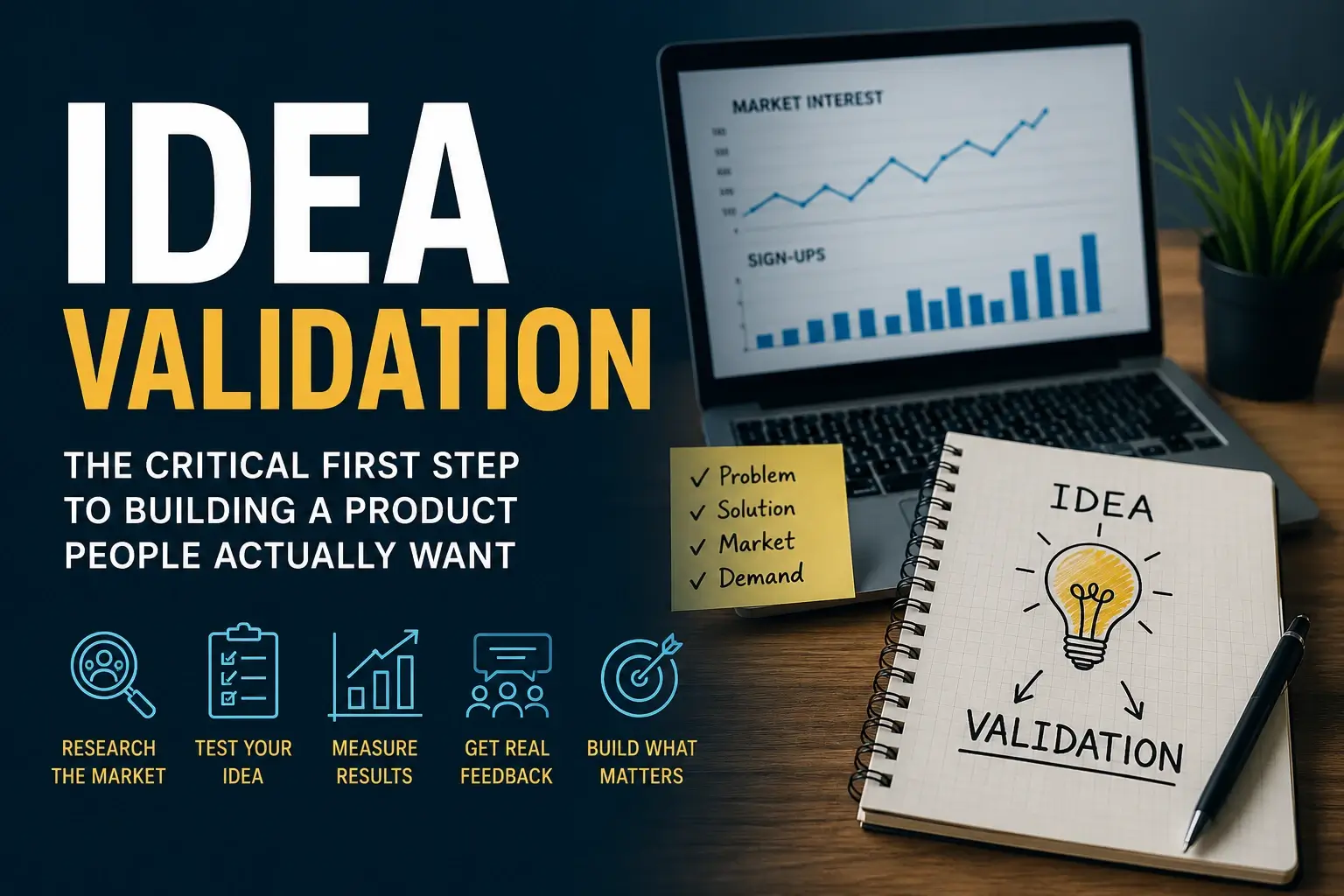
Every transformative enterprise begins with a single, electrifying notion—a promising concept among countless business ideas competing for attention. Yet the sobering statistics tell a different story: roughly 90% of startups collapse within their first few years, and the overwhelming cause is not execution failure, but a fundamental absence of market demand. This is where idea validation emerges not as a mere tactic, but as the strategic linchpin of entrepreneurial resilience.
Idea validation is the disciplined, evidence‑driven process of subjecting your business hypothesis to the harsh light of real‑world scrutiny. It bridges the chasm between a seductive concept and a commercially viable venture. Rather than gambling on intuition, idea validation compels you to test every assumption against the behaviours, pain points, and preferences of actual customers.
For founders, product leaders, and corporate innovators, mastering idea validation is the single most effective lever for improving survival odds. It transforms the development cycle from a costly leap of faith into a series of informed, iterative experiments. This guide will equip you with a comprehensive arsenal—from foundational principles to battle‑tested execution tactics—so you can validate with confidence and build what truly matters.
What Is Idea Validation?
At its essence, idea validation is the systematic attempt to answer one deceptively simple question: Will a sufficient number of people pay real money for this solution? Unlike casual observation or anecdotal encouragement, idea validation relies on structured experimentation and empirical data to confirm or refute your core assumptions.
Beyond the product itself, effective validation also scrutinises the underlying commercial logic—which is where foundational knowledge of business models explained becomes invaluable, as it helps frame how value translates into sustainable operations. Whether you are exploring a subscription model, a transactional marketplace, or a freemium offering, your validation efforts must test not only the solution’s desirability but also its economic feasibility.
The methodology draws heavily from the Lean Startup paradigm, where idea validation operates within the build‑measure‑learn feedback loop. Each cycle yields objective evidence that either strengthens your conviction or signals a necessary pivot. In practice, idea validation might involve customer discovery interviews, smoke tests, landing page conversion audits, or MVP trials—all designed to measure actual behaviour rather than hypothetical interest.
Crucially, idea validation demands intellectual honesty. It forces you to separate emotional attachment from objective reality, treating your business concept as a falsifiable hypothesis. The goal is not to prove you are right, but to discover whether the market agrees with you—and if not, to learn why and adapt accordingly.
Why Idea Validation Matters for Business Success
Skipping idea validation is a luxury few can afford. Consider the cautionary tale of Color Labs, which raised $41 million in venture funding before launching a photo‑sharing app—only to discover that Instagram had already captured the very market they were targeting. Without rigorous idea validation, they built a product that was technically impressive yet commercially irrelevant.
The perils of bypassing idea validation extend beyond such high‑profile failures. They manifest in subtler, equally damaging ways:
- The “Field of Dreams” Fallacy – Assuming that a well‑built product will automatically attract customers. Idea validation introduces a reality check long before development begins.
- The Universal Appeal Illusion – Believing your solution resonates with everyone, when in fact it only serves a narrow segment. Proper idea validation forces you to define and understand your true audience.
- The Confirmation Bias Trap – Subconsciously seeking evidence that supports your beliefs while ignoring contradictory signals. Structured idea validation requires you to actively disconfirm your hypotheses, revealing blind spots early.
Moreover, idea validation delivers a decisive competitive advantage by enabling leaner resource allocation. Every dollar and hour invested in validated concepts yields exponentially higher returns than pouring capital into untested whims. It is the difference between building a product that collects dust and building one that collects customers.
Key Benefits of Idea Validation
Embracing idea validation unlocks a suite of strategic advantages that extend far beyond risk reduction:
- Dramatically Lower Failure Rates: By confirming market demand before committing significant resources, you greatly reduce the risk of building a product that customers do not want.
- Accelerated Time-to-Market: Validated ideas move forward with greater clarity and focus, eliminating unnecessary detours, costly rework, and wasted development effort.
- Increased Investor Confidence: Investors seek evidence of market demand and traction. Effective idea validation provides both quantitative and qualitative proof that your concept has real potential.
- Superior Product-Market Fit: Continuous customer feedback throughout the validation process helps refine your offering, ensuring it aligns closely with user needs and expectations.
- Competitive Differentiation: Deep market validation can reveal underserved customer segments, unmet needs, and unique opportunities that competitors have overlooked.
- Greater Founder Confidence: Validation replaces assumptions with evidence, enabling founders to make decisions with confidence and navigate challenges using data-backed insights.
- Reduced Financial Risk: By identifying what customers truly value, idea validation prevents unnecessary spending on features, products, or services that are unlikely to gain traction.
- Enhanced Product Design: Early customer feedback leads to a more intuitive and user-centered experience, helping teams design solutions that solve real problems.
- Cost Savings: Validating ideas before full-scale development helps avoid costly mistakes and can save thousands of dollars in wasted resources.
- Improved Team Morale: Positive validation results create momentum and enthusiasm, motivating founders, employees, and stakeholders to remain committed to the venture’s success.
Step‑by‑Step Idea Validation Process
Define the Problem
Every viable business addresses a genuine, measurable pain point. Your first validation task is to articulate that problem with surgical precision. Instead of vaguely stating “people need better project management,” specify: “freelance designers struggle to synchronise timelines and deliverables across multiple client engagements.” A crisp problem definition sets the stage for every subsequent validation activity.
Identify the Target Audience
Who experiences this problem most acutely? Effective idea validation requires a granular understanding of your ideal customer profile—covering demographics, psychographics, professional roles, and behavioural patterns. Build detailed personas that differentiate, for example, a solo freelance designer from an enterprise creative team, because their validation criteria will diverge significantly.
Conduct Market Research
This phase combines primary research (direct interviews, surveys, focus groups) with secondary research (industry reports, competitor analysis, search trend data). This includes deep-dive market research to evaluate industry dynamics, customer behaviours, and competitive intensity. Investigate whether your target audience actively seeks solutions, what alternatives they currently use, and where those alternatives fall short. This evidence forms the empirical bedrock of your idea validation efforts.
Build a Minimum Viable Product (MVP)
Create the simplest possible version of your solution that delivers core value. The MVP is not a polished product; it is a test vehicle designed to provoke genuine user reactions. It might be a rudimentary prototype, a feature‑light app, or even a manually delivered service—anything that allows customers to experience your value proposition with minimal development overhead.
Gather Customer Feedback
Deploy your MVP to early adopters and collect structured, candid feedback. Observe actual usage patterns—what features they gravitate toward, where they encounter friction, and whether they would genuinely miss the product if it disappeared. This stage transforms your idea validation from abstract hypothesis into tangible behavioural data.
Analyse Results and Iterate
Interpret the feedback objectively, separating signal from noise. Did customers confirm your core assumptions? What unexpected behaviours or requests emerged? Use these insights to refine your concept, adjust your messaging, or pivot to a more promising direction. A critical component of this analysis involves assessing how businesses generate revenue within this specific context—testing whether your pricing strategy and monetisation channels align with customer willingness to pay. Successful idea validation is rarely linear; each iteration brings you closer to authentic product‑market resonance.
Top Idea Validation Techniques
To truly master Idea Validation, you must deploy the right tactical methods. Here are the absolute best techniques for validating business ideas effectively:
- Surveys: Use tools such as SurveyMonkey or Typeform to collect feedback from a larger audience. Surveys help quantify customer sentiment and provide structured data for informed decision-making.
- In-Depth Interviews: Conduct one-on-one conversations with potential customers to understand the motivations, challenges, and behaviours driving their decisions. This qualitative method uncovers insights that surveys often miss.
- Landing Pages: Create a simple webpage that clearly communicates your value proposition and includes a compelling call-to-action, such as an email sign-up or pre-order. Conversion rates can serve as a strong indicator of market interest.
- Smoke Tests: Run targeted advertising campaigns that direct users to a landing page before building the full product. Measure engagement, click-through rates, and sign-ups to assess demand. Pre-orders or financial commitments provide the strongest validation signals.
- MVP Experiments: Launch a minimum viable product (MVP) with core functionality to a small group of users. Monitor usage patterns, feedback, retention, and engagement to validate whether customers find genuine value in the solution.
- Competitive Analysis: Evaluate existing products and competitors to identify strengths, weaknesses, market gaps, and unmet customer needs. This form of validation helps position your offering more effectively and uncover differentiation opportunities.
Common Idea Validation Mistakes to Avoid
Even highly intelligent founders frequently mess up Idea Validation. You must actively avoid these common traps:
- Asking Leading Questions: Phrasing questions in a way that pushes respondents toward a desired answer distorts results. Instead of asking “Would you pay for this?”, focus on behaviour-based questions like “How do you currently solve this problem?”
- Validating Only with Friends and Family: Feedback from people close to you is often biased and overly supportive. Real validation requires input from neutral, unbiased users with no personal stake in your idea.
- Confirmation Bias: Actively seeking only evidence that supports your assumptions undermines the purpose of validation. Strong idea validation requires objectively considering both positive and negative signals.
- Dismissing Non-Customers: People who are not interested in your solution can provide some of the most valuable insights. Understanding why they decline helps uncover gaps, flaws, or misaligned assumptions.
- Over-Engineering the MVP: Adding unnecessary features defeats the purpose of a Minimum Viable Product. The MVP should test only the core hypothesis with the simplest possible version of the solution.
- Relying on Verbal Commitment: Stated interest is not the same as actual behaviour. Effective validation focuses on real actions—such as sign-ups, pre-orders, or payments—rather than opinions.
Real‑World Example of Successful Idea Validation
Dropbox stands as a masterclass in effective idea validation. Rather than building a fully functional cloud‑storage platform, founder Drew Houston produced a simple explainer video that demonstrated the product’s intended workflow. He then released this video to a tech‑savvy audience and tracked sign‑ups to a waiting list.
The overwhelming response—hundreds of thousands of sign‑ups—provided irrefutable evidence of market demand, all before a single line of production code was written. Houston further validated through a private beta, collecting invaluable usage data that shaped the final product. This methodical, iterative idea validation approach not only saved enormous development costs but also ensured that Dropbox launched with a solution that genuinely resonated. The result: a multibillion‑dollar enterprise that continues to dominate its category.
Best Tools for Idea Validation
Using the right tools streamlines idea validation. Here are the top platforms for modern founders:
- SurveyMonkey / Typeform: Enable rapid survey creation and distribution to collect structured, quantitative feedback from potential users at scale.
- Google Keyword Planner: Helps identify search demand by revealing how often people search for problem-related keywords, indicating real market interest.
- Unbounce / Leadpages: Allow fast creation of landing pages without coding, making it easy to test value propositions and measure conversion rates.
- Hotjar: Provides heatmaps, session recordings, and behavioural analytics to understand how users interact with landing pages or MVPs.
- Intercom / Mailchimp: Support ongoing communication with users, enabling feedback collection, onboarding flows, and validation of engagement over time.
- Ahrefs / SEMrush: Offer competitive and market intelligence, helping identify gaps, keyword opportunities, and existing demand in a niche.
Future Trends in Idea Validation
The field of idea validation is evolving rapidly. Artificial intelligence is changing how we test concepts.
- AI-Driven Predictive Analytics: Machine learning models will increasingly forecast market response using early behavioural signals, speeding up validation cycles and improving accuracy.
- Validation-as-a-Service Platforms: Integrated ecosystems will combine surveys, landing pages, analytics, and user testing into unified workflows, reducing setup complexity.
- Virtual Reality Prototyping: Immersive simulations will allow physical or spatial products to be tested before manufacturing, lowering prototyping costs.
- Continuous, Always-On Validation: Products will increasingly embed real-time feedback loops, turning validation into an ongoing process rather than a one-time phase.
- Blockchain-Verified Feedback: Immutable records of customer behaviour and reviews may improve transparency and trust for investors and stakeholders.
Conclusion
Idea validation is not an optional precursor to entrepreneurship—it is the intellectual discipline that separates enduring success from preventable failure. By systematically interrogating your assumptions against market reality, you transform uncertainty into actionable intelligence, and guesswork into strategic clarity.
The frameworks and techniques outlined above provide a robust toolkit, but their efficacy hinges on execution and mindset. Embrace idea validation as a continuous, iterative practice—not a checkbox to be ticked. Remain humble before the data, willing to pivot when evidence demands, and relentlessly curious about your customers’ true needs. When you build on a foundation of validated learning, you don’t just launch a product; you launch one that is destined to thrive.
FAQ
What is idea validation in simple terms?
Idea validation is the process of testing your business concept with real customers to determine whether there is genuine market demand, before you commit substantial time and capital. It essentially answers: “Will people actually buy this?”
How do you validate a business idea quickly?
Create a landing page that describes your offering and includes a clear call‑to‑action—such as an email sign‑up or pre‑order button. Drive targeted traffic via ads and measure conversion rates. This can yield actionable data within days.
Why is idea validation critical for startups?
It prevents startups from building products that lack market fit, conserves limited resources, attracts investor confidence, and substantially reduces the risk of early‑stage failure.
What are the most widely used idea validation methods?
The most common methods include customer interviews, surveys, landing page tests, smoke tests, MVP experiments, and competitive analysis. Each offers unique insights depending on your context.
When should you begin validating your idea?
Immediately—before drafting a business plan or writing any code. Early validation prevents costly investments in unproven directions.
How long does a typical validation process take?
Simple tests (like landing pages) can yield results in days; more comprehensive MVP studies may require weeks or months. The timeline depends on your product complexity and target audience.
Can you validate without building any product?
Absolutely. Landing pages, explainer videos, customer interviews, and smoke tests all generate meaningful validation data without any development effort.
What is product‑market fit, and how does it connect to validation?
Product‑market fit occurs when your offering meets a strong, sustained market demand. Idea validation is the systematic search for evidence that such fit is achievable—essentially stress‑testing your route to that milestone.
References
- CB Insights. The Top 20 Reasons Startups Fail. Analysis of 101 startup failure post-mortems.
- CB Insights. Analysis of over 400 startup failures identifying no market need as the primary cause (42% of failures).
- Harvard Business Review. “Why Startups Benefit When Big Investments Come Later.” September–October 2025 issue. Details the Color Labs case—$41 million raised pre-launch, subsequent failure.
- Silicon Valley Business Journal. “Color Labs, the $41 million startup, reportedly shutting down.” October 17, 2012.
- Ries, Eric. The Lean Startup: How Today’s Entrepreneurs Use Continuous Innovation to Create Radically Successful Businesses. Crown Business, New York, 2011.
- YourStory. “Dropbox’s fake demo video that got 75,000 signups overnight.” February 18, 2026. Documents Dropbox’s 4-minute validation video and its impact.
- Multiple sources confirm Dropbox’s waitlist grew from 5,000 to 75,000 overnight following the explainer video.
- MIT Orbit Knowledge Base. Guidance on MVP testing, landing page experiments, and validation techniques.

 Inar Learn