

Entering the world of entrepreneurship is an exciting endeavor, but before you can start selling products or offering services, you must establish a legal foundation. Business Registration is the formal, legal process of officially declaring your commercial enterprise to government authorities, tax departments, and regulatory bodies. It transitions your conceptual idea into a recognized, legally binding corporate entity.
Understanding this process is absolutely critical because proper registration dictates your personal liability, taxation rates, funding opportunities, and long-term scalable growth. Every entrepreneur should understand that skipping or mishandling this foundational step can lead to severe financial penalties, operational shutdowns, and legal disputes. In this comprehensive guide, you will learn exactly how to navigate the complex landscape of Business Registration, allowing you to protect your assets, establish market credibility, and position your startup for international success.
What Is Business Registration?
Business Registration is the formal process of recording your company with a government authority so that it exists as a legal business entity separate from you as a person. Depending on your country and chosen company legal structure, that authority may be a Secretary of State, Companies House, a commercial registry, or a free-zone regulator. The purpose is straightforward: legal meaning. A registered company signs contracts, owns property, sues, is sued, and pays taxes under its own name. That is why company registration is the foundation of business legitimacy—unregistered ventures remain legally invisible, exposed, and limited.
Why Business Registration Is Important
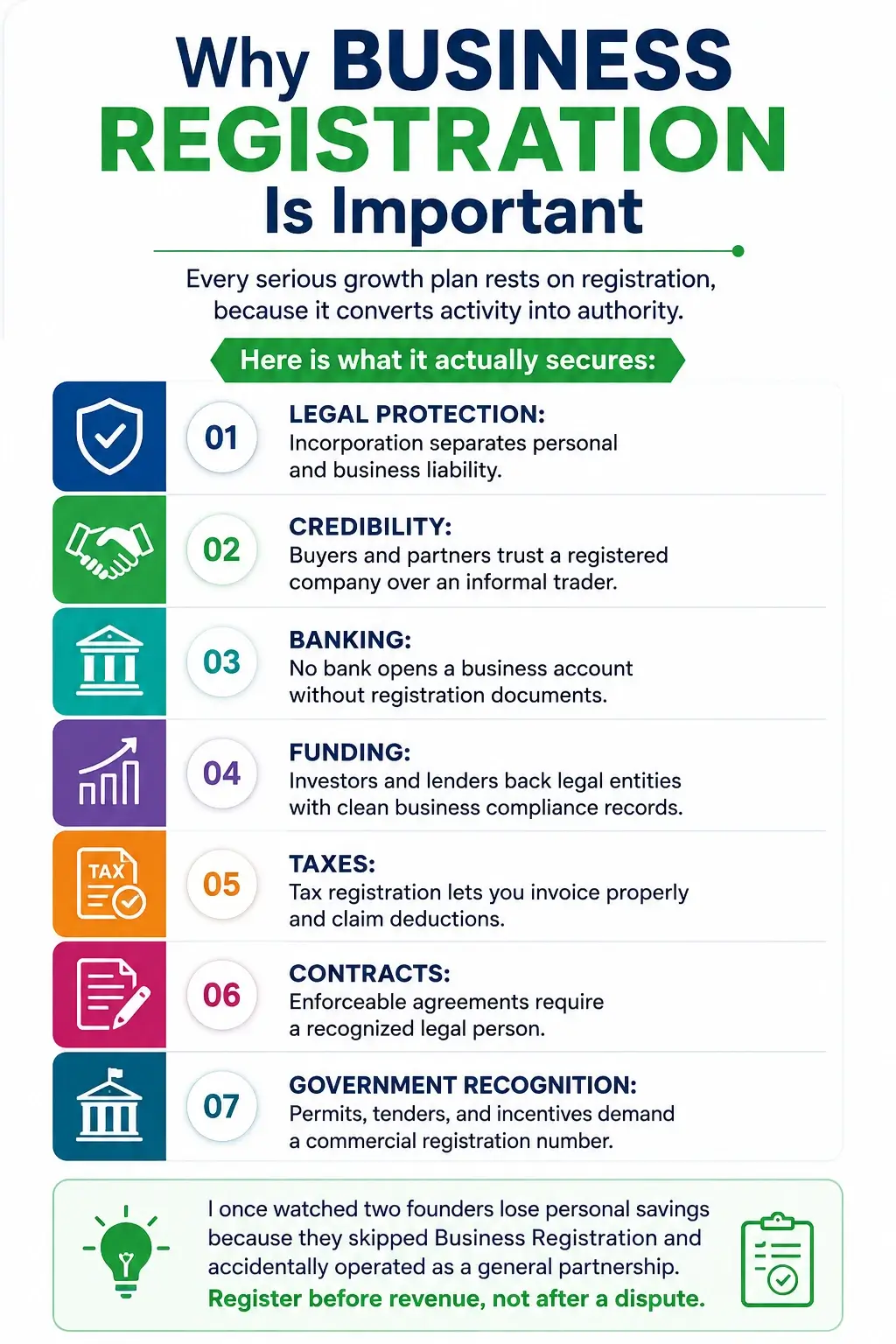
Every serious growth plan rests on registration, because it converts activity into authority. Here is what it actually secures:
- Legal protection: incorporation separates personal and business liability.
- Credibility: buyers and partners trust a registered company over an informal trader.
- Banking: no bank opens a business account without registration documents.
- Funding: investors and lenders back legal entities with clean business compliance records.
- Taxes: tax registration lets you invoice properly and claim deductions.
- Contracts: enforceable agreements require a recognized legal person.
- Government recognition: permits, tenders, and incentives demand a commercial registration number.
I once watched two founders lose personal savings because they skipped Business Registration and accidentally operated as a general partnership. Register before revenue, not after a dispute.
Benefits of Business Registration
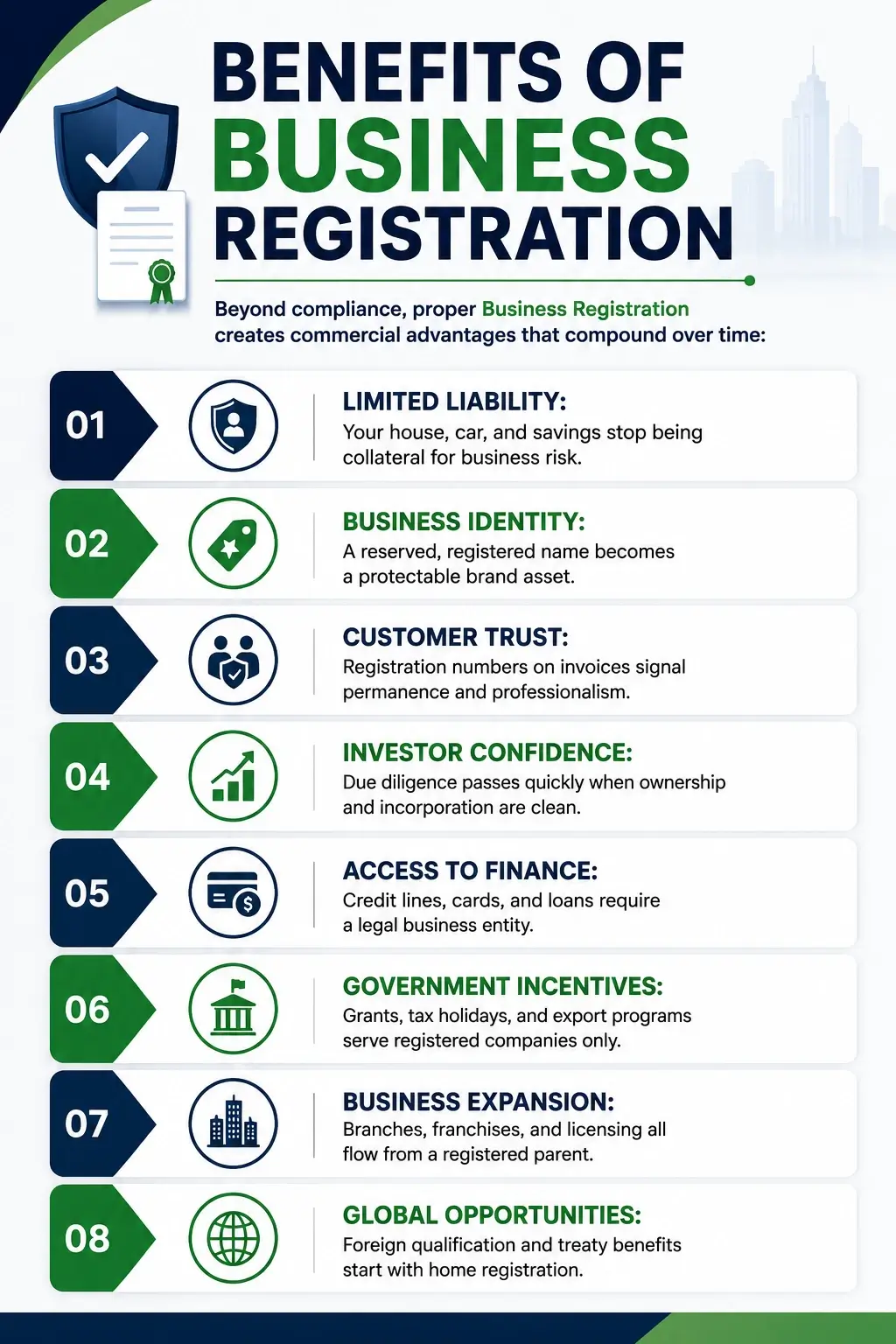
Beyond compliance, proper Business Registration creates commercial advantages that compound over time:
- Limited liability: your house, car, and savings stop being collateral for business risk.
- Business identity: a reserved, registered name becomes a protectable brand asset.
- Customer trust: registration numbers on invoices signal permanence and professionalism.
- Investor confidence: due diligence passes quickly when ownership and incorporation are clean.
- Access to finance: credit lines, cards, and loans require a legal business entity.
- Government incentives: grants, tax holidays, and export programs serve registered companies only.
- Business expansion: branches, franchises, and licensing all flow from a registered parent.
- Global opportunities: foreign qualification and treaty benefits start with home registration.
Types of Business Registration
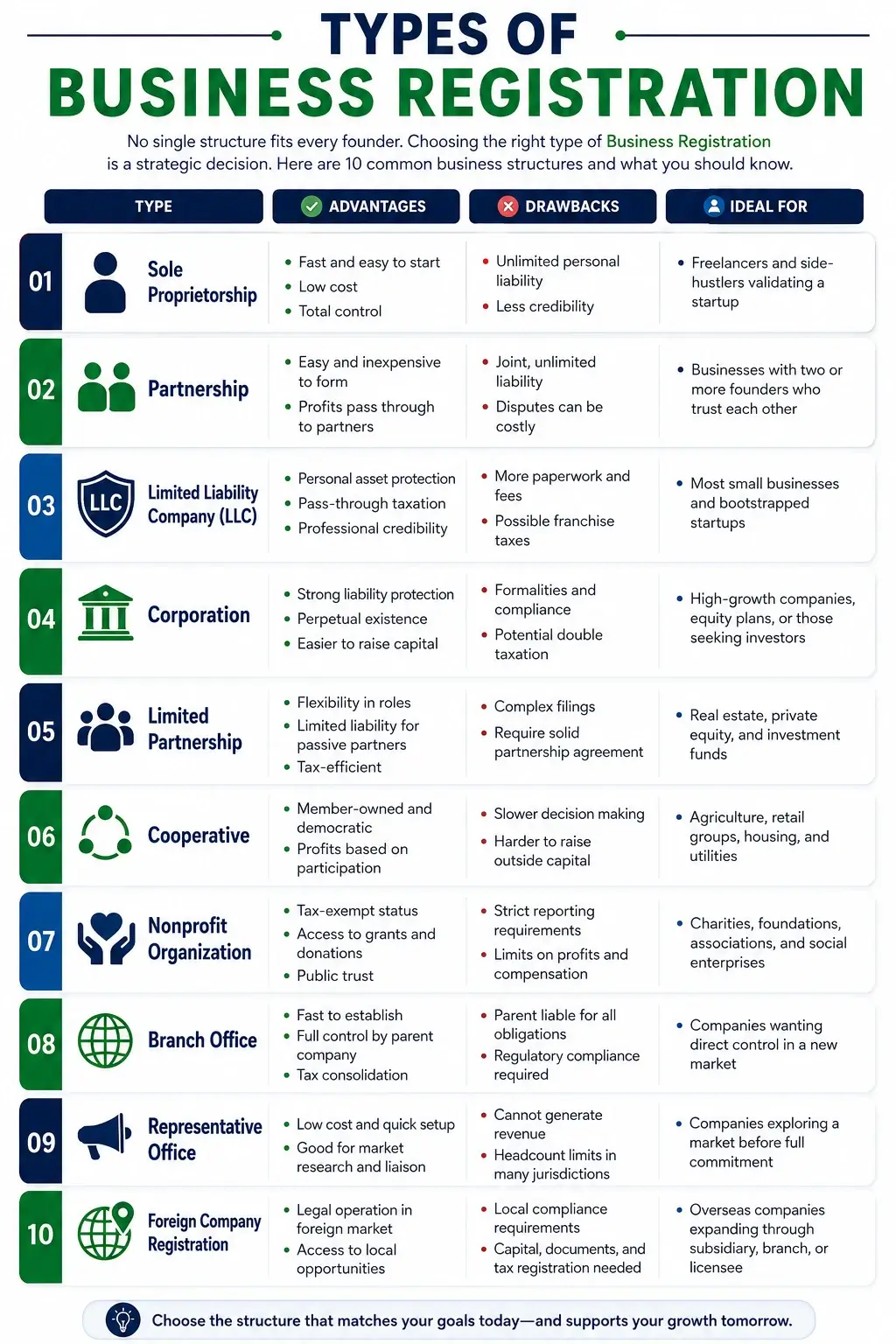
No single structure fits every founder, which is why choosing among the forms of Business Registration is a strategic decision, not a clerical one. Below are the ten vehicles I evaluate with clients, each with advantages, drawbacks, and ideal use cases.
Sole Proprietorship
The sole proprietorship is the simplest form of business ownership: one person, no separate legal entity, profits taxed on the personal return. Advantages are speed, low cost, and total control; the disadvantage is unlimited personal liability for every debt. It suits freelancers and side-hustlers validating a startup business before committing to formal company incorporation.
Partnership
A general partnership lets two or more founders share capital, skills, and profits through a relatively informal startup registration. Formation is cheap and tax passes through to partners, but each partner bears joint, unlimited liability—including for a partner’s mistakes. Ideal only with a written partnership agreement and deep mutual trust; otherwise disputes become expensive.
Limited Liability Company (LLC)
The limited liability company balances protection with simplicity: members’ personal assets are shielded, profits pass through by default, and the structure reads professionally on contracts and invoices. Paperwork and renewal fees exceed a sole proprietorship, and some jurisdictions impose franchise taxes. For most small businesses and bootstrapped startups, LLC registration is the sweet spot.
Corporation
A corporation is a fully separate legal person issuing shares, offering the strongest liability shield, perpetual existence, and the cleanest path to venture capital or public markets. In exchange, accept formalities—directors, minutes, annual reports—and potential double taxation unless electing S-status where available. Choose corporate registration when you plan to scale aggressively, grant equity, or list.
Limited Partnership
A limited partnership combines at least one general partner with unlimited liability and management control, plus limited partners whose risk caps at their investment. It is a favorite for real estate syndications and investment funds where passive capital meets active operators. The structure demands precise filings and a robust partnership agreement; legal advice is prudent.
Cooperative
A cooperative is owned and democratically controlled by its members—customers, employees, or producers—who share profits according to participation, not capital. Formation paperwork resembles a corporation, decisions move slowly, and raising outside capital is harder. Cooperatives shine for agricultural marketing, retail buying groups, housing, and utilities where mutual benefit outweighs speed.
Nonprofit Organization
A nonprofit organization pursues a public-benefit mission; profits must be reinvested, never distributed. Registration usually adds tax-exempt approval (such as 501(c)(3) in the United States), unlocking grants and donor incentives, but brings strict reporting, compensation rules, and dissolution clauses. Ideal for charities, foundations, trade associations, and social enterprises with funding models beyond donations.
Branch Office
A branch office extends a foreign parent into a new market without creating a separate subsidiary: fast to establish and fully controlled, but the parent answers for every liability the branch creates. Regulators typically require certified parent documents, a local manager, and a commercial registration. Use a branch when you want direct operational control and predictable tax consolidation.
Representative Office
A representative office gives a foreign company a legal presence for market research, liaison, and promotion—yet it cannot invoice clients or earn revenue. Costs stay low and setup is quick, making it a sensible scouting vehicle before committing to full foreign company registration. Many jurisdictions cap headcount and demand renewal, so plan an upgrade path early.
Foreign Company Registration
Foreign company registration lets an overseas entity operate legally in another country, either as a subsidiary, branch, or local licensee. Expect local sponsor or agent rules (notably in the Gulf), minimum capital in some markets, translated and notarized documents, and separate tax registration. Done well, it converts international ambition into compliant, bankable local operations.
Step-by-Step Business Registration Process
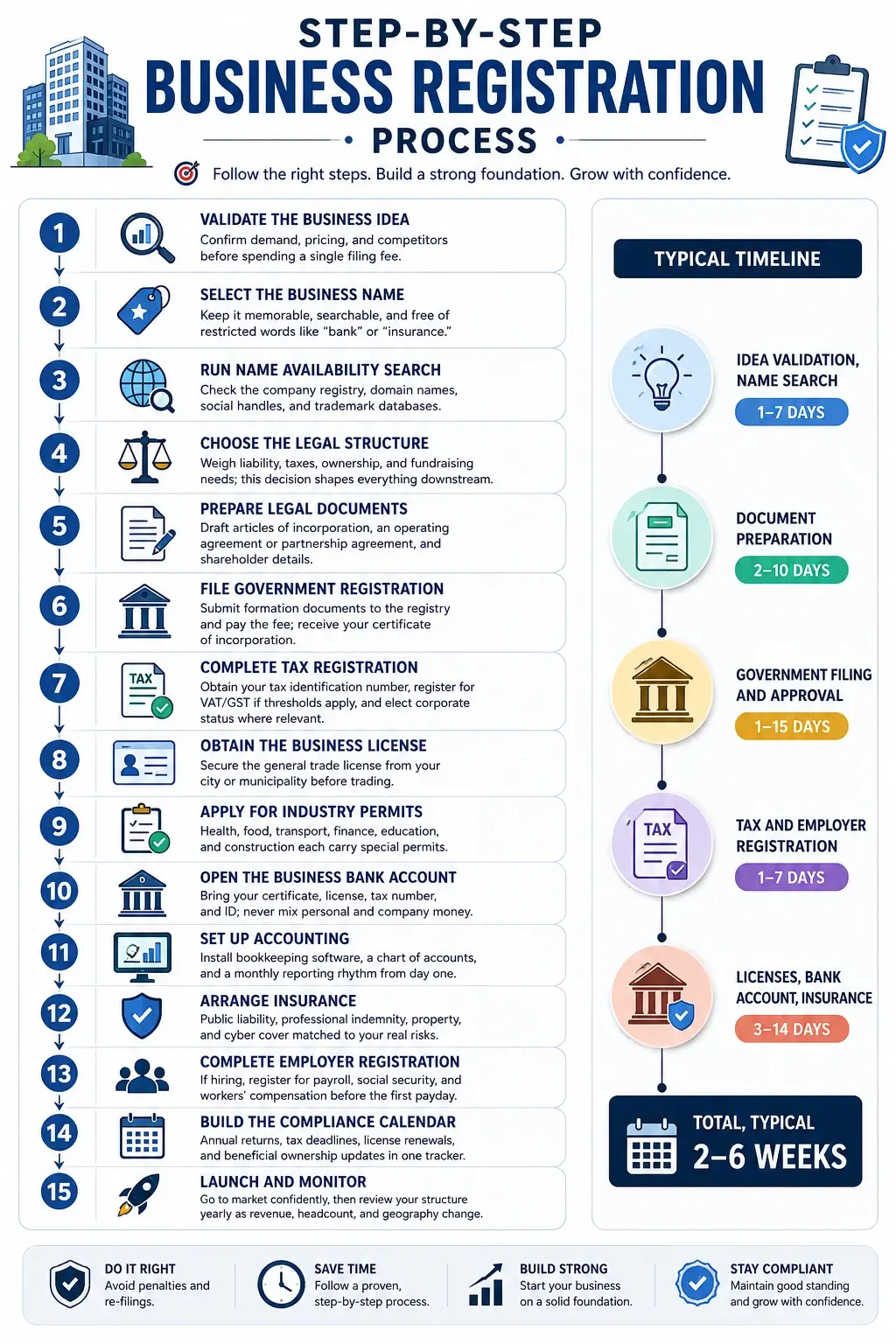
The sequence below is the same roadmap I charge clients for, refined across hundreds of projects. Follow it in order and your Business Registration stays predictable; skip steps and you will pay for it later in penalties, re-filings, or lost names. Treat this Business Registration workflow as your master plan.
- Validate the business idea: confirm demand, pricing, and competitors before spending a single filing fee.
- Select the business name: keep it memorable, searchable, and free of restricted words like “bank” or “insurance.”
- Run name availability search: check the company registry, domain names, social handles, and trademark databases simultaneously.
- Choose the legal structure: weigh liability, taxes, ownership, and fundraising needs; this decision shapes everything downstream.
- Prepare legal documents: draft articles of incorporation, an operating agreement or partnership agreement, and shareholder details.
- File government registration: submit formation documents to the registry and pay the fee; receive your certificate of incorporation.
- Complete tax registration: obtain your tax identification number, register for VAT/GST if thresholds apply, and elect corporate status where relevant.
- Obtain the business license: secure the general trade license from your city or municipality before trading.
- Apply for industry permits: health, food, transport, finance, education, and construction each carry special permits.
- Open the business bank account: bring your certificate, license, tax number, and ID; never mix personal and company money.
- Set up accounting: install bookkeeping software, a chart of accounts, and a monthly reporting rhythm from day one.
- Arrange insurance: public liability, professional indemnity, property, and cyber cover matched to your real risks.
- Complete employer registration: if hiring, register for payroll, social security, and workers’ compensation before the first payday.
- Build the compliance calendar: annual returns, tax deadlines, license renewals, and beneficial ownership updates in one tracker.
- Launch and monitor: go to market confidently, then review your structure yearly as revenue, headcount, and geography change.
Typical timeline:
| Phase | Typical Duration |
|---|---|
| Idea validation, name search | 1–7 days |
| Document preparation | 2–10 days |
| Government filing and approval | 1–15 days |
| Tax and employer registration | 1–7 days |
| Licenses, bank account, insurance | 3–14 days |
| Total, typical | 2–6 weeks |
Documents Required for Business Registration
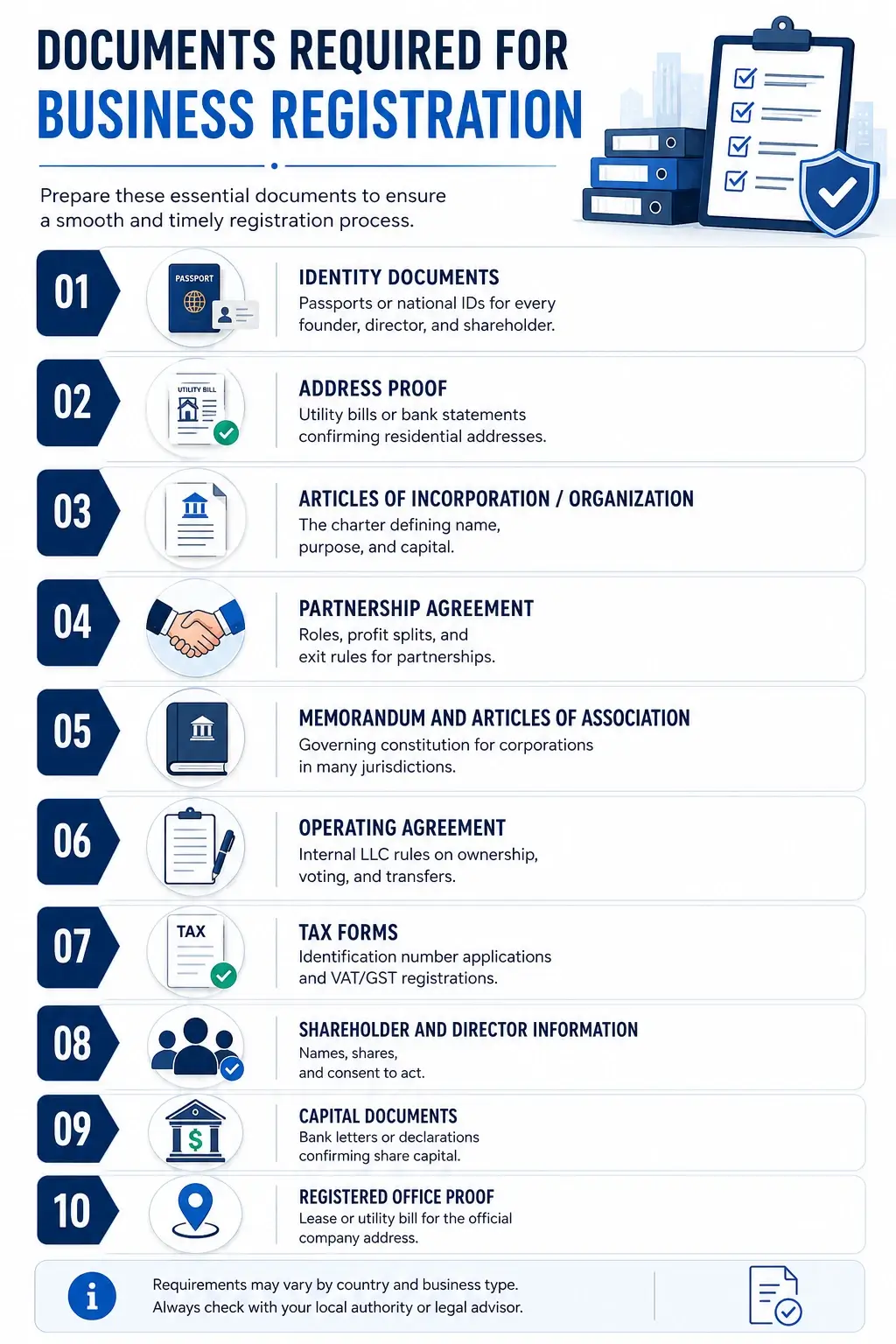
Authorities differ by country, yet the core file for Business Registration is remarkably consistent worldwide. Assemble these before you start, because every missing paper adds days of delay:
- Identity documents: passports or national IDs for every founder, director, and shareholder.
- Address proof: utility bills or bank statements confirming residential addresses.
- Articles of incorporation / organization: the charter defining name, purpose, and capital.
- Partnership agreement: roles, profit splits, and exit rules for partnerships.
- Memorandum and articles of association: governing constitution for corporations in many jurisdictions.
- Operating agreement: internal LLC rules on ownership, voting, and transfers.
- Tax forms: identification number applications and VAT/GST registrations.
- Shareholder and director information: names, shares, and consent to act.
- Capital documents: bank letters or declarations confirming share capital.
- Registered office proof: lease or utility bill for the official company address.
Choosing the Right Business Structure
Structure selection is the highest-leverage decision inside Business Registration, because changing it later triggers tax events, legal fees, and contract novations. Compare the four most common vehicles across the six dimensions that actually matter:
| Criterion | Sole Proprietorship | Partnership | LLC | Corporation |
|---|---|---|---|---|
| Taxes | Personal return | Pass-through to partners | Pass-through by default | Corporate tax; dividend double tax |
| Liability | Unlimited personal | Joint, unlimited | Limited to capital | Limited to shares |
| Ownership | One owner | Partners by agreement | Members by percentage | Shareholders by shares |
| Setup costs | $0–$100 | $50–$500 | $100–$1,500 | $300–$3,000+ |
| Flexibility | Total | Moderate | High | Low, formal |
| Scalability | Poor | Moderate | Good | Excellent |
My rule of thumb: test risk-free ideas as a sole proprietor, protect recurring revenue with an LLC, and incorporate when equity or institutional capital enters the story.
Common Mistakes During Business Registration
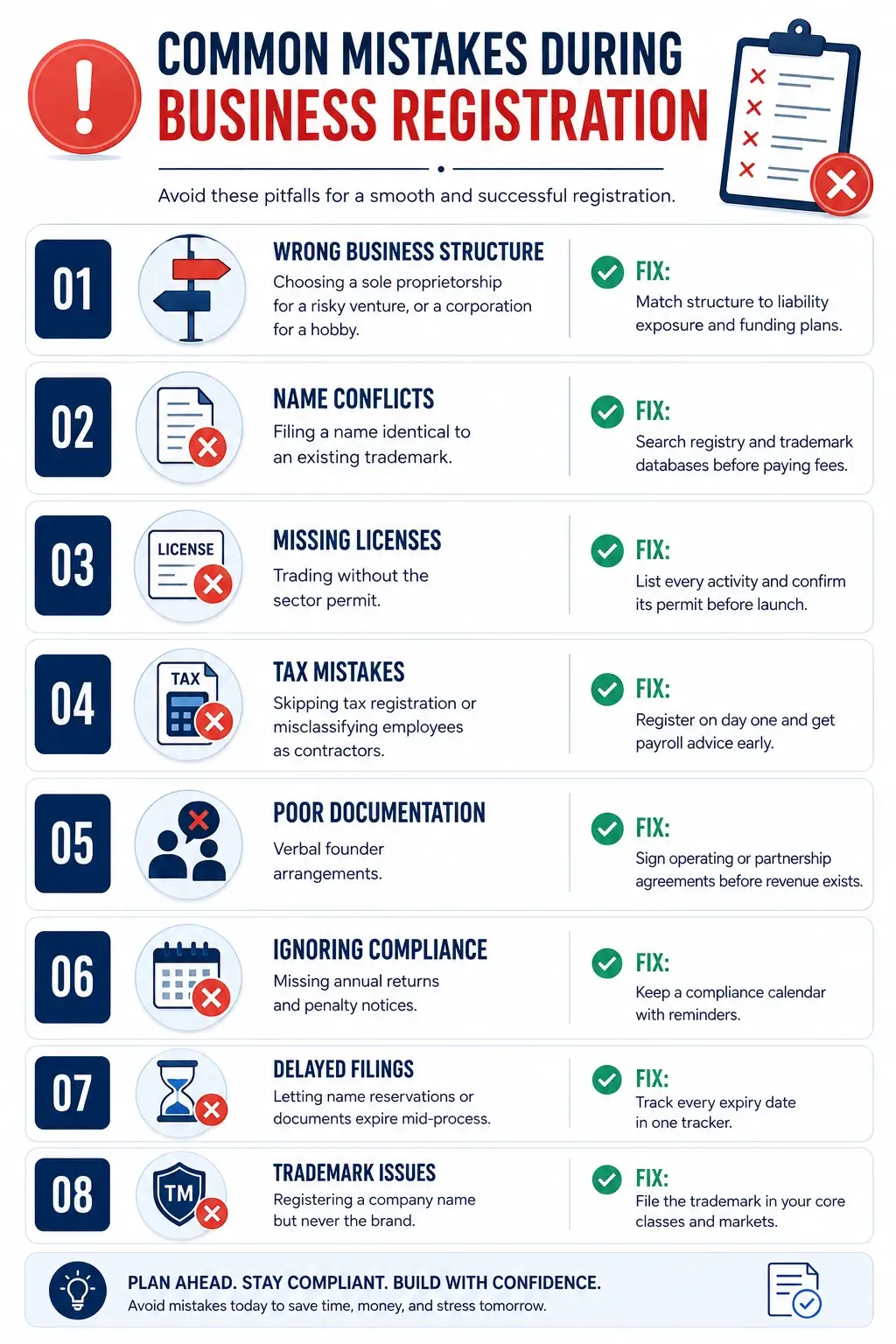
Most registration failures I am hired to repair follow the same eight patterns. Learn them once and your Business Registration avoids the usual traps:
- Wrong business structure: choosing a sole proprietorship for a risky venture, or a corporation for a hobby. Fix: match structure to liability exposure and funding plans.
- Name conflicts: filing a name identical to an existing trademark. Fix: search registry and trademark databases before paying fees.
- Missing licenses: trading without the sector permit. Fix: list every activity and confirm its permit before launch.
- Tax mistakes: skipping tax registration or misclassifying employees as contractors. Fix: register on day one and get payroll advice early.
- Poor documentation: verbal founder arrangements. Fix: sign operating or partnership agreements before revenue exists.
- Ignoring compliance: missing annual returns and penalty notices. Fix: keep a compliance calendar with reminders.
- Delayed filings: letting name reservations or documents expire mid-process. Fix: track every expiry date in one tracker.
- Trademark issues: registering a company name but never the brand. Fix: file the trademark in your core classes and markets.
Costs of Business Registration
Budget honestly: the sticker price of Business Registration is only the entry ticket. Government filing fees range from $50 to $800 in most markets, but the true first-year budget includes legal drafting, accounting setup, licensing, and protection. Here is a realistic range for a typical small company:
| Cost Item | Typical Range (USD) |
|---|---|
| Government filing fees | $50–$800 |
| Legal fees (agreements, review) | $0–$2,500 |
| Accounting and tax setup | $300–$1,500 |
| Business license and permits | $50–$1,000+ |
| Trademark registration (per class) | $250–$1,000 |
| First-year insurance | $500–$3,000 |
| Ongoing annual compliance | $200–$2,000 |
Founders who budget the full stack avoid the cash crunch that arrives six months in, when renewals and filings land together.
Business Registration in Different Countries
The mechanics of Business Registration converge globally—name search, filing, tax number, license—while costs, speed, and capital rules diverge sharply. Here is the comparative picture I brief to international clients:
| Country | Authority | Typical Time | Typical Government Cost |
|---|---|---|---|
| United States | State Secretary of State + IRS | 1–15 days | $50–$800 |
| United Kingdom | Companies House + HMRC | 24–72 hours | ~£50 |
| Canada | Corporations Canada / provinces | 1–10 days | CA$200–350 |
| Australia | ASIC + ATO | 1–2 days | ~AU$570 |
| United Arab Emirates | DED / free-zone authorities | 3–10 days | AED 5,500–25,000 |
| Saudi Arabia | MISA + Ministry of Commerce | 5–15 days | From SAR 2,000 |
| European Union | National registries (e.g., Estonia e-Residency) | 1–20 days | €100–€800 |
The similarity is digital: nearly every major economy now files online. The differences sit in capital requirements (Germany’s GmbH demands €25,000), sponsorship rules in Gulf markets, and post-incorporation tax onboarding speed.
Digital Business Registration
Modern Business Registration is increasingly a laptop exercise. Government portals such as the UK’s Companies House, Estonia’s e-Residency platform, and the UAE’s single-sign-on systems accept electronic filing, digital signatures, and online fee payment, with approvals arriving in hours rather than weeks. Digital dashboards then handle annual returns, registered-office updates, and compliance reminders. My advice: use the official portal, keep certified digital copies of every certificate, and beware of look-alike scam sites that charge multiples of the statutory fee for the same service.
Legal and Tax Considerations
Registration opens a permanent relationship with the tax authority, so treat business taxation as an ongoing discipline. Secure your tax identification number immediately, register for VAT/GST once turnover crosses the local threshold, and understand your corporate tax rate and deductible expenses. File annual returns and financial statements on time, keep records—invoices, contracts, bank statements—for at least five to seven years, and monitor compliance obligations such as beneficial ownership registers, payroll reporting, and license renewals. Clean records are not bureaucracy; they are the difference between a fundable company and an uninsurable one.
Business Registration Checklist
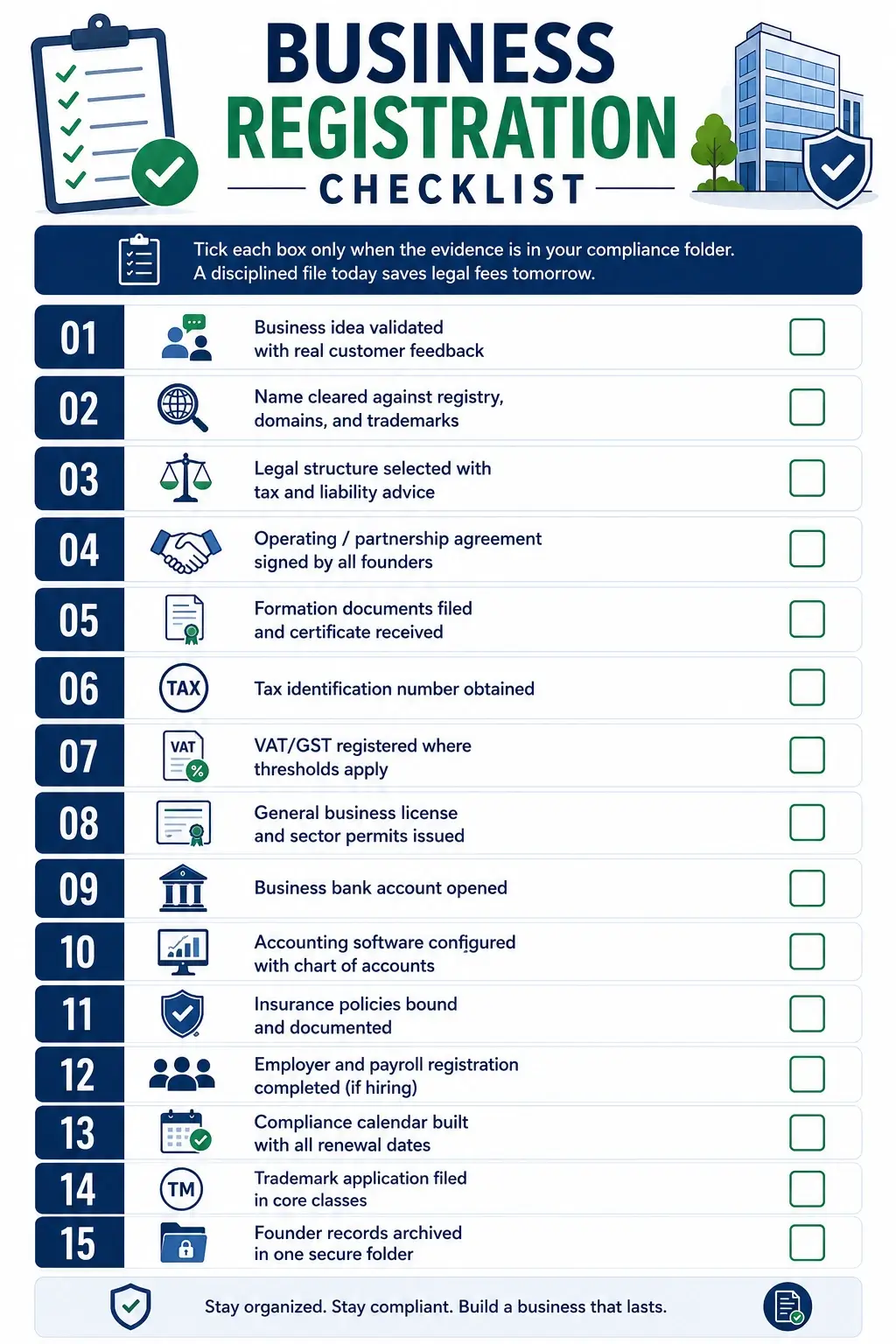
Use this checklist as your working document; tick each box only when the evidence sits in your compliance folder. A disciplined Business Registration file today saves legal fees tomorrow.
- [ ] Business idea validated with real customer feedback
- [ ] Name cleared against registry, domains, and trademarks
- [ ] Legal structure selected with tax and liability advice
- [ ] Operating / partnership agreement signed by all founders
- [ ] Formation documents filed and certificate received
- [ ] Tax identification number obtained
- [ ] VAT/GST registered where thresholds apply
- [ ] General business license and sector permits issued
- [ ] Business bank account opened
- [ ] Accounting software configured with chart of accounts
- [ ] Insurance policies bound and documented
- [ ] Employer and payroll registration completed (if hiring)
- [ ] Compliance calendar built with all renewal dates
- [ ] Trademark application filed in core classes
- [ ] Founder records archived in one secure folder
Expert Tips
These are the fifteen field-tested practices that separate smooth registrations from expensive repairs:
- Reserve your name before telling anyone about it; I have seen leaked ideas registered by others within days.
- Buy the .com and local domain the same hour you reserve the company name.
- Draft the founder agreement before incorporation, while everyone is still friendly.
- Choose the structure for your exit, not just your launch—conversions trigger taxes.
- Register for taxes the day after incorporation; late registration penalties are pure waste.
- Use a registered address you control; missed statutory mail causes strike-offs.
- Keep personal and business accounts separate from the first transaction, always.
- Trademark the brand early; company registration protects the name only partially.
- Read the license conditions, not just the license category—activities define permits.
- Set calendar reminders for annual returns the same day you incorporate.
- Hire an accountant before your first invoice, not after your first penalty.
- Document share issuances properly; informal “understandings” destroy fundraises.
- In regulated sectors, confirm permit timelines before promising clients launch dates.
- When expanding abroad, compare subsidiary versus branch tax costs before filing.
- Review your structure every year; growth changes the optimal legal architecture.
Frequently Asked Questions About Business Registration
1. What is Business Registration in simple terms?
It is the government process that turns your idea into a recognized legal business entity, giving it a name, number, and legal personality so it can contract, bank, and pay taxes lawfully.
2. Is Business Registration mandatory?
For casual hobby income, sometimes not; for ongoing commercial activity, effectively yes. Operating without registration risks fines, back taxes, contract unenforceability, and personal liability for every business debt.
3. How much does Business Registration cost?
Government fees alone run $50–$800 in most markets. Including legal drafts, licenses, and tax setup, budget $500–$5,000 for a clean small-company formation, plus annual compliance costs.
4. How long does Business Registration take?
Online filings in the UK, Australia, or Estonia complete within days; US states vary from same-day to two weeks; Gulf and EU notary systems can take one to three weeks.
5. Can I register a business online?
Yes. Nearly all major registries accept electronic filing, digital signatures, and online payment. Use official government portals only, and archive certified digital copies of every certificate.
6. What documents are needed for Business Registration?
Typically identity and address proof for founders, articles of incorporation or organization, an operating or partnership agreement, registered-office proof, and tax forms. Regulated sectors add qualifications.
7. What is the difference between registration and a business license?
Registration creates the legal entity; the business license grants permission to trade. A company can be registered yet still need municipal, sector, or activity licenses before invoicing customers.
8. Do freelancers need Business Registration?
Many start as sole proprietors with only tax registration, which is legitimate. Register a formal entity when liability exposure, client requirements, or income levels make protection worthwhile.
9. What happens if I operate without registration?
You trade as an unprotected individual or accidental partnership: personal assets exposed, contracts shaky, banks unwilling, and penalties accruing for unfiled taxes and missing licenses.
10. Can foreigners complete Business Registration?
Yes, in most economies. The US, UK, Canada, Australia, and EU welcome foreign owners; Gulf markets may require local sponsors or specific free-zone structures for certain activities.
11. Do I need a lawyer for Business Registration?
Simple sole proprietorships rarely need one. LLCs with co-founders, corporations issuing shares, or cross-border structures deserve professional drafting—cheap insurance against expensive disputes.
12. Which structure is best for a small business?
For most, the LLC: limited liability, pass-through taxation, and credibility with modest paperwork. Choose a corporation only when equity investment or employee share plans are imminent.
13. Does registering my company name protect my brand?
Partially. Registration stops identical company names in the registry, but trademark registration alone protects the brand across your market and classes. File both for real protection.
14. Is tax registration separate from company registration?
Yes. Incorporation creates the entity; tax registration enrolls it with the revenue authority for income tax, VAT/GST, and payroll. Both are required before trading compliantly.
15. Can I change my business structure later?
Yes, through conversion or re-registration, but changes can trigger taxes, fees, and contract transfers. Decide strategically now; future-you will pay for casual choices.
Conclusion
Let me leave you with the truth I repeat to every client: Business Registration is not bureaucracy; it is the legal foundation on which every contract, account, investment, and hire will stand. Choose the structure that matches your five-year ambition, register before you must, keep the compliance calendar religiously, and treat your registered company as an asset worth protecting. The founders who win treat paperwork as strategy. Your idea deserves more than a hobby’s legal footing—complete your Business Registration this quarter and let legitimacy compound into growth. Start today; tomorrow’s customers, banks, and investors will meet a real company. That is how Business Registration turns ambition into enterprise.

 Inar Learn