
Every business decision carries an implicit question: “Is this worth it?” Whether you’re a startup founder evaluating a marketing campaign, a Chief Financial Officer (CFO) assessing a new production line, or a project manager justifying a technology upgrade, you need a reliable yardstick. That yardstick is ROI (Return on Investment). It cuts through complexity and provides a clear percentage that says: for every dollar invested, this is how much you gained—or lost. In a landscape of tight budgets and competing priorities, ROI transforms gut feelings into data-driven choices. This article gives you a complete, practical understanding of ROI, from the core formula and real-world calculations to advanced applications, limitations, and future trends. By the end, you will be equipped to measure investment performance with confidence and use ROI analysis to accelerate business growth.
What Is ROI (Return on Investment)?
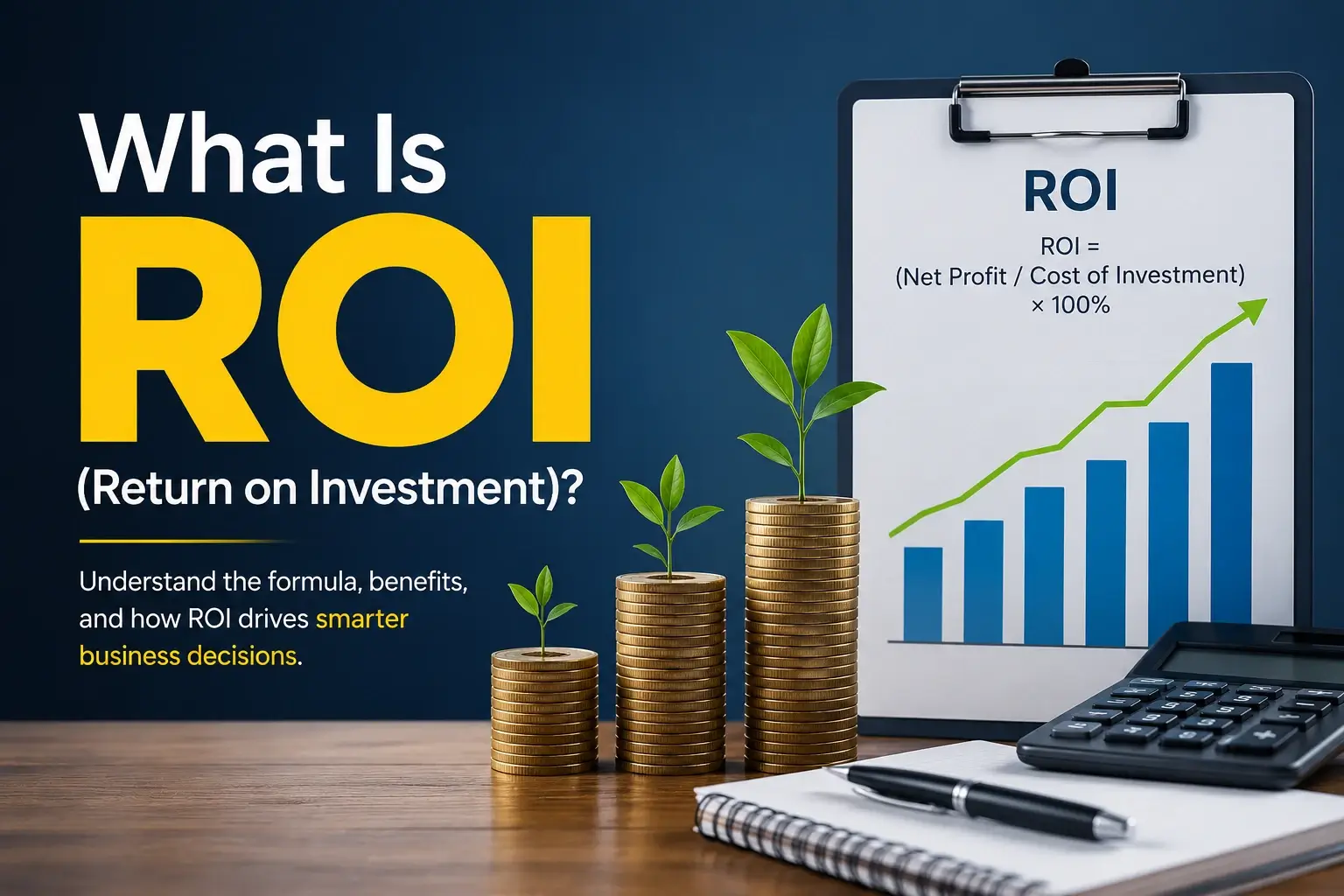
ROI (Return on Investment) is a financial performance indicator that measures the profitability or efficiency of an investment relative to its cost. In simple terms, it tells you how much return you gained compared to what you put in. It is expressed as a percentage, making it easy to compare vastly different projects, asset classes, or business initiatives side by side.
For a small business, ROI might reveal whether a $2,000 social media ad spend generated enough new sales to justify itself. For a multinational corporation, the same metric can inform a multi‑million‑dollar acquisition decision. At its core, ROI answers the universal question: “Did this investment create value?” Its widespread adoption stems from its simplicity and versatility—it can be applied to marketing, technology, training, real estate, and even personal finance decisions. As a core component of financial decision-making, ROI serves as both a retrospective scorecard and a prospective screening tool.
Understanding the ROI Formula and Calculation
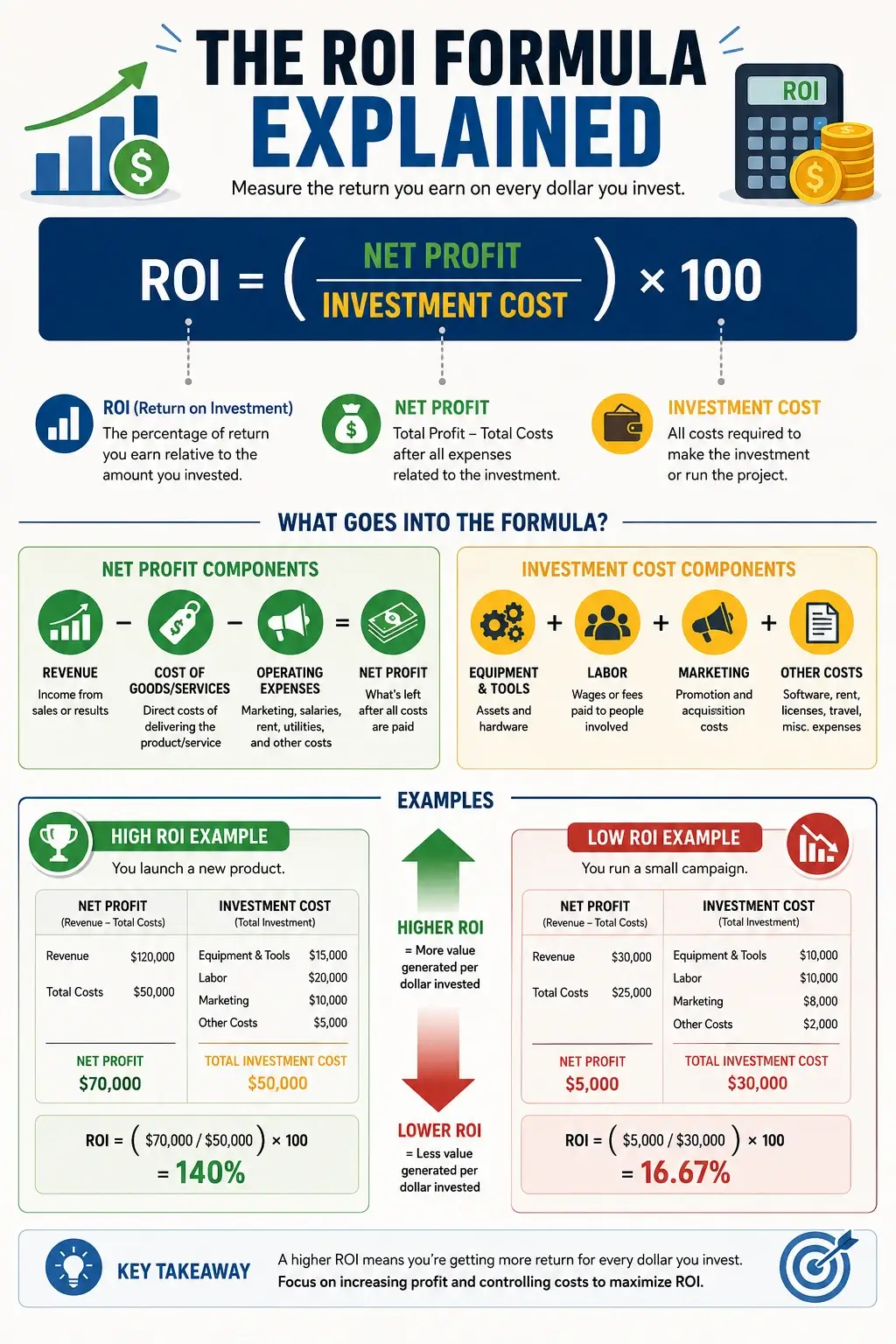
The classic ROI formula is straightforward:
ROI (%) = (Net Profit / Investment Cost) × 100
- Investment Cost includes all direct and attributable indirect expenses required to launch and maintain the initiative—equipment, software licenses, labor, advertising spend, and implementation fees.
- Net Profit (or net gain) is the total returns generated minus the investment cost. This can be incremental revenue, cost savings, or a mix of both.
- ROI Percentage Interpretation: A positive ROI means the investment earned more than its cost; 0% means you broke even; a negative ROI signals a loss.
Practical Calculation Example
A mid‑sized retail company invests $50,000 in a new e‑commerce platform, including website development, integration, and the first year of support. In the same year, the platform generates $90,000 in additional online sales with $10,000 in related operating costs (transaction fees, hosting). Net profit = ($90,000 – $10,000) – $50,000 = $30,000.
ROI = ($30,000 / $50,000) × 100 = 60%.
This means the company gained $0.60 in net return for every dollar invested—a strong signal that the e‑commerce investment was worthwhile.
Why ROI (Return on Investment) Is Important in Business
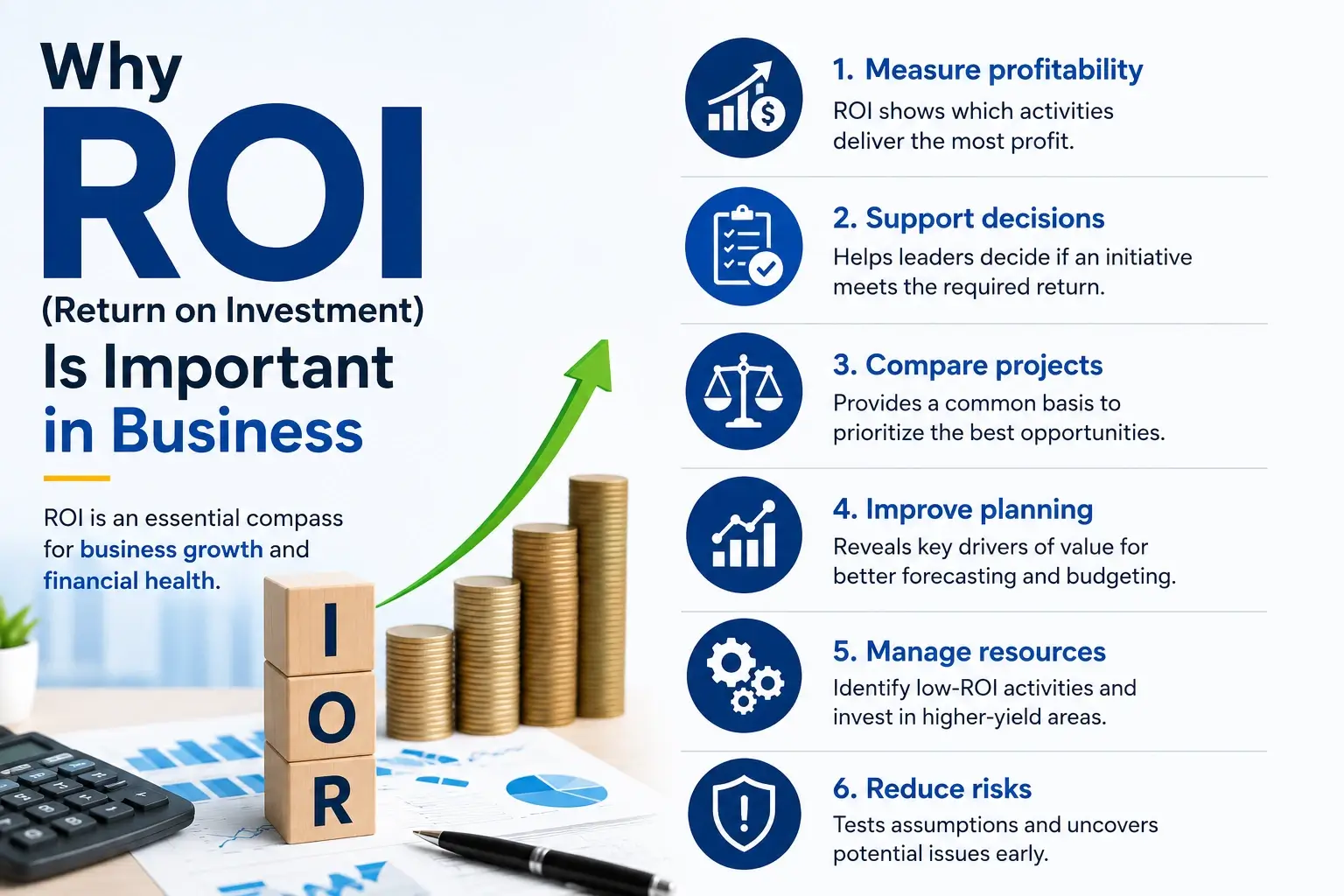
ROI is far more than a mathematics exercise; it is an essential compass for business growth and financial health.
- Measuring profitability: ROI translates diverse activities—from a display ad campaign to a warehouse automation project—into a standardized profitability measurement. This allows management to see what truly adds to the bottom line.
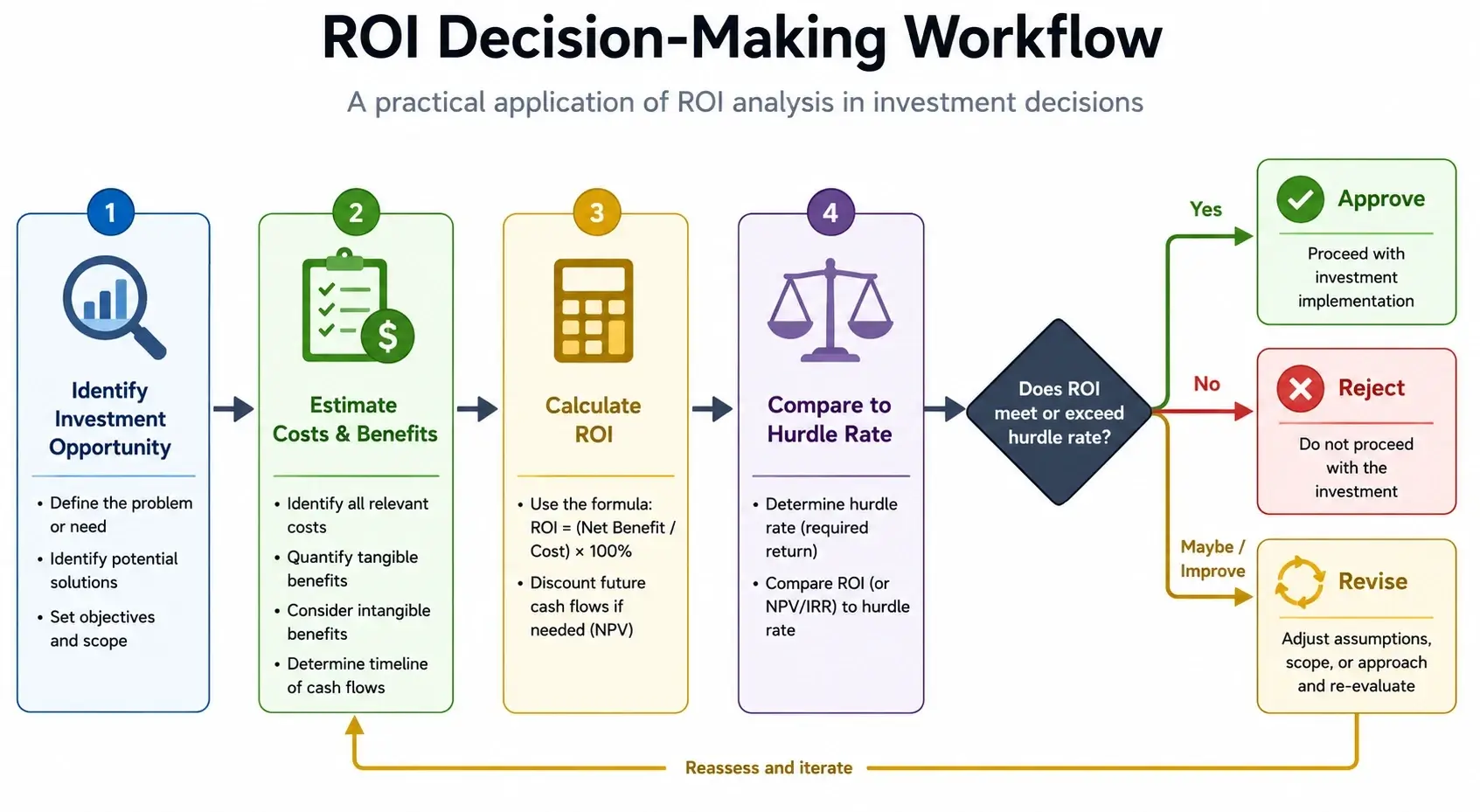
- Supporting investment decisions: Before committing capital, leaders rely on projected ROI to estimate whether an initiative meets the company’s hurdle rate. It provides a clear benchmark for go/no‑go decisions.
- Comparing projects: When resources are limited, ROI creates a common language. A 25% ROI on a customer loyalty program can be directly weighed against a 15% ROI on a fleet upgrade, enabling objective prioritization.
- Improving financial planning: Regular ROI analysis highlights which business metrics drive value, feeding into better forecasting and budget allocation.
- Managing resources: By identifying low‑ROI activities, companies can reallocate money, time, and talent to higher‑yield initiatives.
- Reducing risks: A rigorous ROI calculation forces teams to examine assumptions, cost estimates, and revenue forecasts, exposing weaknesses before money is spent.
Types of ROI and Common Applications
ROI adapts to nearly any business context. Here are the most common applications.
- Marketing ROI: Measures the revenue generated from advertising and promotional activities. For a digital campaign, ROI might be (Incremental Revenue – Campaign Cost) / Campaign Cost. Marketers use it to optimize channel mix, creative, and customer acquisition cost.
- Project ROI: Applied to infrastructure, process improvement, or new product launches. A manufacturing plant calculates ROI on a $2 million robotic assembly line by comparing labor cost savings and increased output over its useful life.
- Employee Training ROI: Quantifies the impact of upskilling. If a sales training program costs $30,000 and leads to a $120,000 increase in margin, the ROI helps HR justify future learning budgets. It often incorporates productivity gains and reduced error rates.
- Technology ROI: Used for software, cloud migration, and automation. A company adopting an AI‑powered inventory system would compare the reduction in stockouts and carrying costs against the total technology investment.
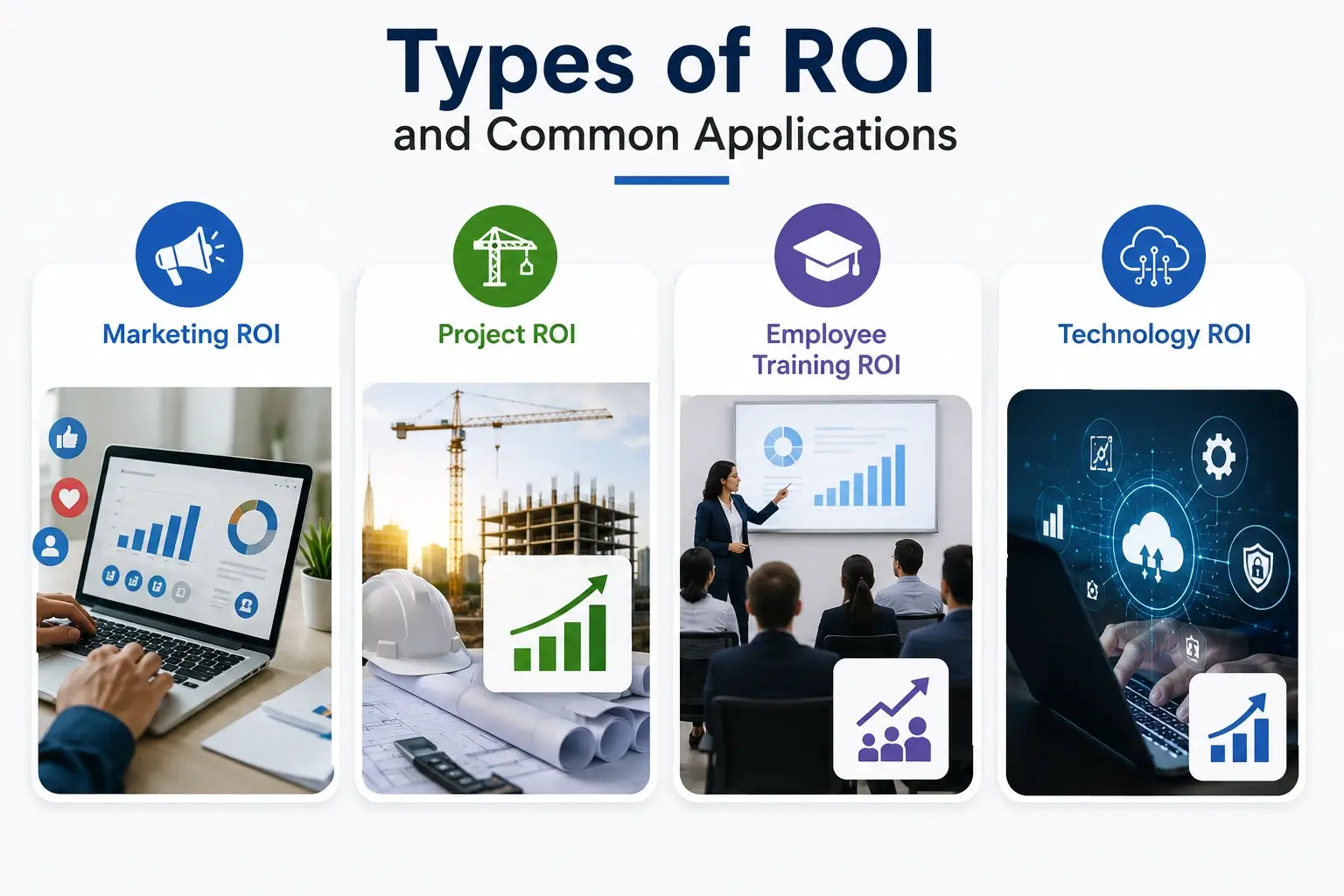
Each application uses the same foundational ROI formula but adjusts the inputs to capture relevant costs and benefits specific to the domain.
How Businesses Use ROI Analysis for Better Decisions
ROI analysis moves organizations from reactive spending to strategic investment. In practice, it touches multiple layers of the business.
Strategic planning: During annual planning, leaders set ROI thresholds aligned with corporate goals. Only projects that demonstrate a satisfactory projected ROI move forward, ensuring capital flows to high‑potential areas.
Budget allocation: Finance teams rank initiatives by forecasted ROI. A startup might assign 40% of its marketing budget to search engine ads with a proven 200% ROI while capping spending on untested channels.
Investment prioritization: When a portfolio of projects competes for funding, ROI acts as a tiebreaker. A large corporation evaluating 10 digital transformation projects can quickly identify the top three based on expected return.
Performance monitoring: Post‑investment reviews compare actual ROI to projections, creating a feedback loop that improves estimation accuracy and accountability.
Real‑world snapshot:
- Small business: A family‑owned restaurant invests $8,000 in a delivery partnership. After six months, the delivery orders net $4,000 profit, yielding a 50% ROI. The owner uses this data to negotiate better commission terms.
- Startup: A SaaS startup spends $25,000 on a content marketing pilot. When lifetime value of acquired customers minus costs shows an 80% ROI, it doubles the program.
- Large corporation: An energy company runs an ROI analysis on renewable asset upgrades across 12 facilities and prioritizes the sites with the highest expected return per dollar invested, reducing payback time by 18 months.
Factors That Affect ROI (Return on Investment)
ROI never exists in a vacuum. Several interconnected factors influence the final number, and smart managers monitor each one.
- Initial investment cost: A higher upfront cost reduces ROI unless it drives proportionally larger gains. Leasing equipment instead of buying, for example, changes the investment base.
- Revenue generation: Market demand, pricing strategy, and sales execution directly affect the “return” side. Even a perfectly executed project underperforms if the market shifts.
- Operating expenses: Ongoing costs—maintenance, subscription fees, additional staffing—erode net profit. ROI analysis must capture the full lifecycle cost.
- Market conditions: Economic cycles, regulatory changes, and competitive dynamics can compress margins. A real estate investment’s ROI looks very different in a rising versus declining market.
- Time period: ROI is highly sensitive to the measurement window. An initiative with a negative one‑year ROI might become strongly positive over three years as benefits accumulate.
- Risk level: Higher‑risk projects demand a higher ROI to justify the uncertainty. Adjusting for risk—through a risk‑adjusted discount rate—bridges ROI with more sophisticated cost-benefit analysis.
- Implementation efficiency: Delays, scope creep, and poor change management destroy value. The same capital can yield wildly different ROI depending on execution quality.
Advantages and Limitations of ROI
Advantages
- Simple measurement: ROI is intuitive and easy to communicate. Stakeholders at all levels understand a percentage gain or loss.
- Easy comparison: It provides a uniform metric across departments, enabling apples‑to‑apples project evaluation.
- Supports decision-making: ROI gives leaders a fact‑based foundation to defend investments and reject underperforming proposals.
- Improves financial awareness: The process of calculating ROI forces managers to think critically about costs, revenues, and assumptions.
Limitations
- May ignore time value of money: A basic ROI calculation treats a dollar earned in year five the same as a dollar earned today, potentially overstating attractiveness. Metrics like NPV correct this.
- May overlook qualitative benefits: Improved brand reputation, customer satisfaction, or employee morale are real but hard to quantify, leading to understated ROI for critical initiatives.
- Depends on data accuracy: Garbage in, garbage out. Overoptimistic revenue projections or incomplete cost tracking distort results.
- Short‑term ROI may conflict with long‑term goals: An easy 50% ROI on cutting R&D spending could cripple future innovation. Leaders must balance immediate returns with strategic vision.
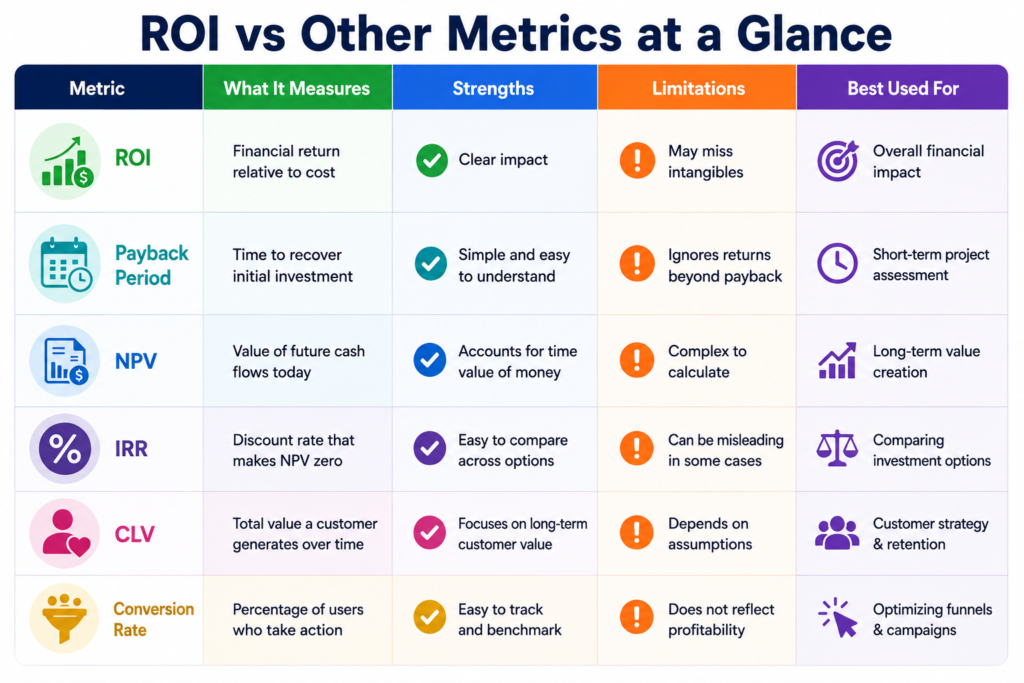
ROI vs Other Financial Metrics
No single metric tells the whole story. Here’s how ROI compares to other key financial performance indicators.
| Metric | What It Measures | Key Difference from ROI |
|---|---|---|
| ROI (Return on Investment) | Profitability relative to investment cost | Universal, percentage‑based, can be applied to any investment |
| ROE (Return on Equity) | Net income as a percentage of shareholders’ equity | Focuses on equity financing; primarily used by investors |
| ROA (Return on Assets) | Net income relative to total assets | Gauges how efficiently a company uses its asset base |
| Payback Period | Time required to recoup the initial investment | Emphasizes liquidity and risk, not profitability |
| NPV (Net Present Value) | Today’s value of future cash flows minus investment | Accounts for time value of money; gives an absolute dollar figure |
| IRR (Internal Rate of Return) | Discount rate that makes NPV zero | Closely related to ROI but incorporates timing of cash flows |
Savvy analysts use ROI alongside NPV and payback period to get a three‑dimensional view of investment attractiveness—profitability, value creation, and risk.
How to Improve ROI (Return on Investment)
Improving ROI often requires both top‑line growth and bottom‑line discipline. These practical strategies can shift the equation in your favor.
- Reduce unnecessary costs: Audit all investment‑related expenses. Renegotiate vendor contracts, eliminate redundant tools, and streamline processes to lower the cost base without sacrificing output.
- Improve operational efficiency: Standardize workflows, automate repetitive tasks, and invest in employee training. Even a small productivity boost can significantly lift net profit.
- Increase revenue opportunities: Test pricing strategies, upsell and cross‑sell to existing customers, or expand into adjacent markets. Incremental revenue with little additional investment magnifies ROI.
- Use data‑driven decisions: Apply predictive analytics to target high‑potential customers and allocate resources where marginal returns are highest.
- Optimize marketing performance: Shift spend to high‑ROI channels, refine audience targeting, and continuously A/B test creatives. A 10% improvement in conversion rate can double the ROI of a campaign.
- Monitor results continuously: Set up real‑time dashboards that track leading indicators of ROI. Early detection of underperformance allows mid‑course correction before losses accumulate.
Real-World ROI Example
Let’s walk through a detailed case study from the logistics sector.
Context: A regional logistics firm, FastTrack Logistics, handles 5,000 shipments per month. Delivery delays caused by manual route planning lead to customer penalties and overtime costs. The company decides to invest in a route optimization software.
Investment details:
- Software license and implementation: $40,000 (one‑time)
- Annual maintenance and support: $8,000
- Staff training: $4,000
- Total first‑year investment cost: $52,000
Results after one year:
- Fuel cost savings: $28,000 (fewer miles driven)
- Overtime reduction: $18,000
- Penalty avoidance from on‑time deliveries: $12,000
- Additional revenue from capacity increase (10% more shipments): $30,000
- Total gross gain: $88,000
Net profit = $88,000 – $52,000 = $36,000
ROI = ($36,000 / $52,000) × 100 = 69.2%
Decision: With a 69% ROI and a payback period under nine months, the management approved a full rollout across all depots and allocated budget for additional analytics modules. The ROI analysis not only justified the purchase but also set a performance baseline for future technology investments.
Future Trends in ROI Measurement
ROI measurement is evolving rapidly, powered by technology and shifting business priorities.
- Artificial intelligence in ROI analysis: Machine learning models can now forecast ROI under multiple scenarios by analyzing historical patterns and external variables. AI reduces the guesswork in revenue projections and flags hidden cost drivers.
- Advanced data analytics: Integration of ERP, CRM, and marketing platforms into a single source of truth enables near real‑time ROI tracking. Businesses no longer need to wait for month‑end reports to see investment performance.
- Automated reporting: Self‑service BI tools generate dynamic ROI dashboards, freeing analysts to focus on interpretation rather than data wrangling. This democratization accelerates financial decision-making across departments.
- Predictive financial models: Scenario‑planning tools allow companies to stress‑test ROI against changing interest rates, inflation, and demand shifts, building resilience into strategic plans.
- Digital transformation and intangibles: As companies invest heavily in digital assets and employee experience, ROI frameworks are being redefined to include proxy metrics for long‑term value, such as innovation velocity and customer lifetime value.
These trends are making ROI a more dynamic, forward‑looking metric, capable of guiding decisions in an increasingly uncertain business environment.
Conclusion
ROI (Return on Investment) remains the universal language of business accountability. It strips away complexity and forces a clear‑eyed look at whether an investment is generating genuine value or merely consuming resources. From a solo entrepreneur evaluating a weekend trade show to a global CFO modeling an acquisition, ROI provides the clarity needed to allocate capital wisely. By mastering the ROI formula, understanding its nuanced applications, and recognizing both its strengths and blind spots, professionals can transform financial decision-making into a strategic advantage. In a world of finite resources and infinite opportunities, measuring investment performance with rigor is not optional—it is the foundation of sustainable business growth and investment efficiency.
References
- Hayes, A. (2025, October 8). Learn how this simple formula can reveal smart investments. Investopedia. https://www.investopedia.com/terms/r/returnoninvestment.asp
- Hayes, A. (2024). Return on investment (ROI): How to calculate it and what it means. Investopedia. https://www.investopedia.com/terms/r/returnoninvestment.asp
- Vipond, T. (2020, February 27). Return on investment: Formula, meaning, and how to calculate it. Corporate Finance Institute. https://corporatefinanceinstitute.com/resources/accounting/return-on-investment-roi-formula/
- CFI Team. (2020, March 22). Return on investment (ROI). Corporate Finance Institute. https://corporatefinanceinstitute.com/resources/accounting/what-is-return-on-investment-roi/
- Corporate Finance Institute. (2023, October 30). Return on investment analysis. https://corporatefinance.ng
- HubSpot. (2024, August 29). Analyze your campaign ROI. HubSpot Knowledge Base. https://knowledge.hubspot.com
- DeBoe, T. (2025, November 26). The 2026 AI decision: Why measurement matters more than adoption. Forbes. https://www.forbes.com
- Forbes. (2026, April 1). Return on investment (ROI). https://www.forbes.com
- Harvard Business Review. (2025). How behavioral science can improve the return on AI investments. Harvard Business Review, 1-4. https://ink.library.smu.edu.sg/lkcsb_research/7843

 Inar Learn