

In today’s fast-paced corporate world, business terminology serves as the universal language that connects professionals across departments, industries, borders, and diverse Types of Businesses. Whether you’re a budding entrepreneur exploring the Entrepreneur vs Business Owner dynamic, a seasoned executive, or a student preparing for your first job, mastering the right business terminology can accelerate your career growth, improve decision-making, and enhance collaboration. 📈
This comprehensive guide will walk you through more than 80 critical business terminology terms, organized by category, complete with real-world examples and actionable insights. By the end, you’ll be equipped to speak the language of business with confidence and clarity.
Definition and Importance of Business Terminology
To truly grasp these concepts, it helps to start with the foundational question: What Is a Business? Once that baseline is established, you can see how specialized vocabulary drives its core operations. Business terminology refers to the specialized vocabulary, phrases, and acronyms used within the commercial and corporate environment. It encompasses everything from financial ratios, Business Models, and marketing metrics to operational processes and strategic frameworks.
Why is Business Terminology so important? 🤝
Using standardized business terminology isn’t just about sounding professional—it directly impacts your company’s bottom line and your personal career trajectory. Below are eight compelling reasons why mastering business terminology is non-negotiable.
| # | Reason | Consequence of Ignorance | Benefit of Mastery |
|---|---|---|---|
| 1 | Clarity & Precision | Misunderstood emails, rework, missed deadlines | Faster execution, fewer errors |
| 2 | Professional Credibility | Lost promotions, lost deals, reduced trust | Leadership respect, investor confidence |
| 3 | Efficiency in Communication | Long, confusing meetings, excessive follow-ups | Concise updates, 30% faster decisions |
| 4 | Global Alignment | Siloed teams, inconsistent reporting | Smooth cross-border collaboration |
| 5 | Risk Reduction | Legal exposure, compliance fines, contract disputes | Protected assets, audit readiness |
| 6 | Accelerated Onboarding | 3+ months to full productivity | 6 weeks to contribute meaningfully |
| 7 | Better Relationships | Customer churn, partner friction, lost renewals | Loyalty, referrals, long-term contracts |
| 8 | Data-Driven Decisions | Gut-feeling mistakes, subjective arguments | Confident, accurate, defensible choices |
Detailed Breakdown:
- Clarity & Precision: Saying “net profit margin” is instantly clearer than “how much money we keep after costs.” Ambiguity wastes hours.
- Professional Credibility: A founder who misuses “EBITDA” loses funding. A manager who confuses “churn” with “attrition” loses team respect.
- Efficiency: Terms like “ROI,” “KPI,” or “SLA” convey complex ideas in seconds, saving hours per week.
- Global Alignment: Common business terminology ensures everyone from New York to Tokyo interprets “Q3 forecast” identically.
- Risk Reduction: Confusing “indemnity” with “liability” in a contract could cost millions. Precise terms protect you.
- Accelerated Onboarding: New hires who know core business terminology ramp up 40% faster and join strategy talks immediately.
- Better Relationships: Using a client’s business terminology like “TCO” and “payback period” builds trust and wins deals.
- Data-Driven Decisions: Terms like LTV, CAC, NPS, and throughput are the vocabulary of analytics. Without them, you cannot read dashboards.
Without a solid grasp of business terminology, professionals risk miscommunication, missed opportunities, slower career progression, and even legal liability.
Key Categories of Business Terminology
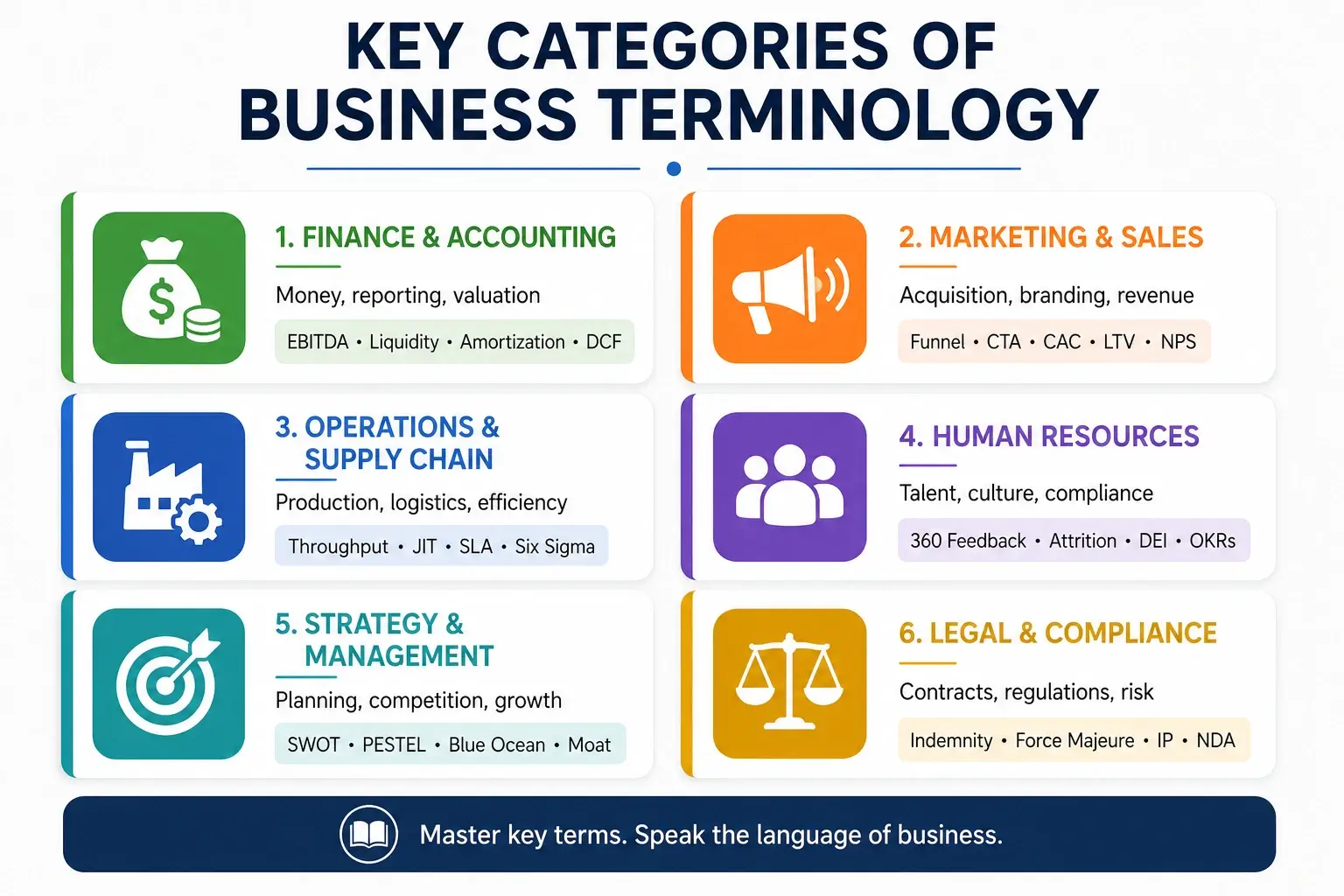
Understanding the landscape of business terminology becomes easier when terms are grouped by function. Below are the core categories every professional should recognize:
| Category | Focus Area | Representative Terms |
|---|---|---|
| 💰 Finance & Accounting | Money management, reporting, valuation | EBITDA, Liquidity, Amortization, DCF |
| 📢 Marketing & Sales | Customer acquisition, branding, revenue | Funnel, CTA, CAC, LTV, NPS |
| 🏭 Operations & Supply Chain | Production, logistics, efficiency | Throughput, JIT, SLA, Six Sigma |
| 👥 Human Resources | Talent management, culture, compliance | 360 Feedback, Attrition, DEI, OKRs |
| 🧠 Strategy & Management | Planning, competition, growth | SWOT, PESTEL, Blue Ocean, Moat |
| ⚖️ Legal & Compliance | Contracts, regulations, risk | Indemnity, Force Majeure, IP, NDA |
Each category contains dozens of terms, but mastering the most frequently used business terminology from these areas will give you a powerful vocabulary.
Common Business Terms Every Professional Should Know
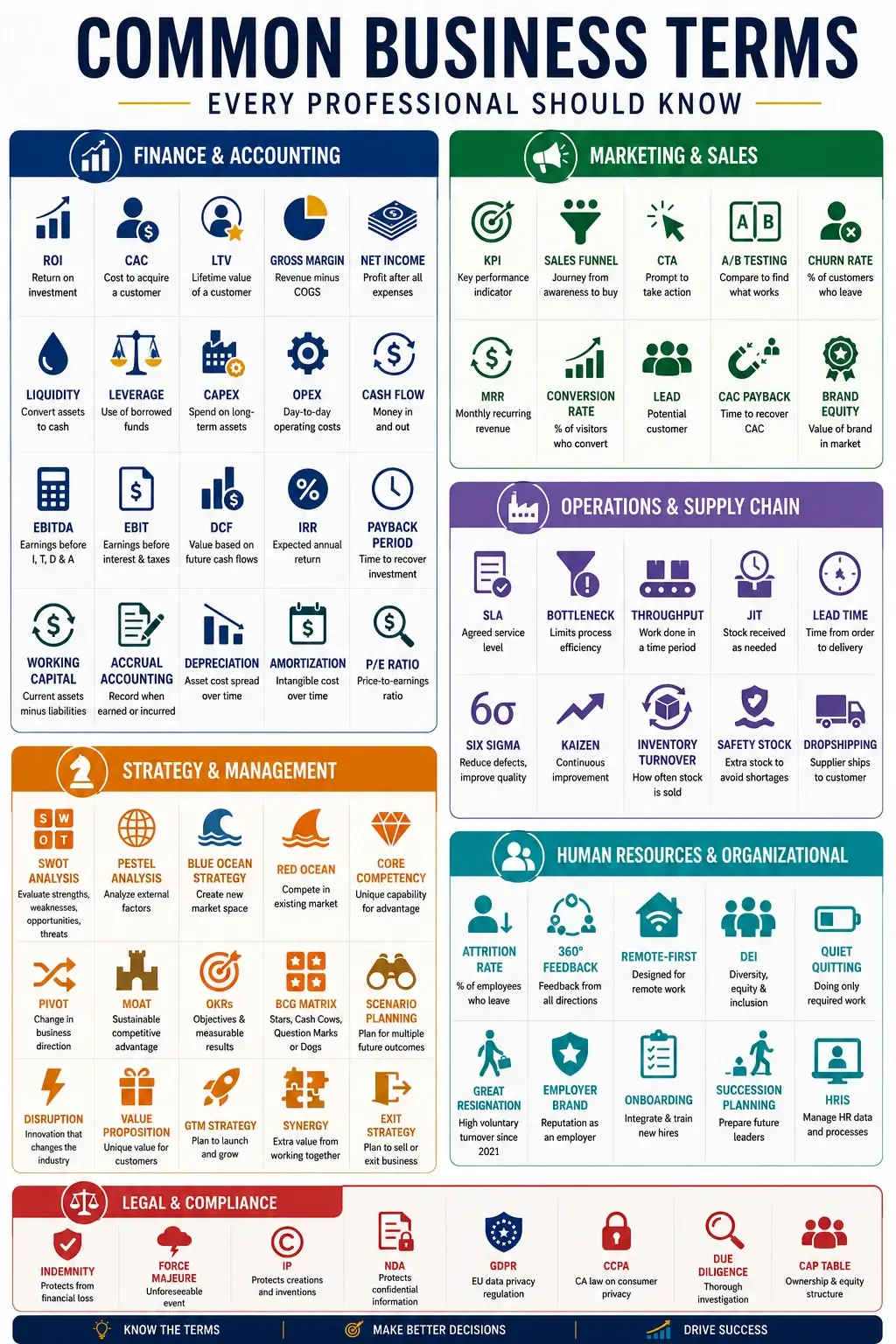
Here is an expanded, professionally organized list of essential business terminology with definitions and practical examples. 🎯
💰 Finance & Accounting Terms
| Term | Definition | Example in Context |
|---|---|---|
| ROI | Return on Investment – gain relative to cost | “Our email campaign delivered 200% ROI.” |
| EBITDA | Earnings before interest, taxes, depreciation, amortization | “EBITDA of $5M shows strong operating cash flow.” |
| Burn Rate | Rate at which a startup spends capital | “We have 8 months of runway at current burn rate.” |
| CAC | Customer Acquisition Cost | “Reducing CAC by 20% increased profitability.” |
| LTV | Lifetime Value of a customer | “LTV should be at least 3x CAC.” |
| Gross Margin | (Revenue – COGS) / Revenue | “A 70% gross margin leaves room for R&D.” |
| Net Income | Bottom line profit after all expenses | “Net income grew 15% year-over-year.” |
| Liquidity | Ability to convert assets to cash quickly | “High liquidity protects during downturns.” |
| Leverage | Use of borrowed capital | “Too much leverage increases bankruptcy risk.” |
| Amortization | Spreading cost of intangible assets | “Amortization of patents over 10 years.” |
| CapEx | Capital Expenditure (physical assets) | “CapEx budget for new factory: $2M.” |
| OpEx | Operating Expenses (daily costs) | “OpEx includes rent, salaries, utilities.” |
| DCF | Discounted Cash Flow (valuation method) | “DCF analysis gave a fair value of $50/share.” |
| IRR | Internal Rate of Return | “Project IRR of 18% exceeds our hurdle rate.” |
| Payback Period | Time to recover initial investment | “Payback period is 2.5 years.” |
| Working Capital | Current assets minus current liabilities | “Negative working capital signals trouble.” |
| Accrual | Revenue/expense recorded before cash exchange | “Accrual accounting matches revenue with expenses.” |
| Depreciation | Allocation of tangible asset cost over time | “Depreciation on vehicles is 20% annually.” |
| EBIT | Earnings Before Interest and Taxes | “EBIT focuses on operational profitability.” |
| P/E Ratio | Price-to-Earnings ratio (valuation) | “A P/E of 25 suggests growth expectations.” |
📢 Marketing & Sales Terms
| Term | Definition | Example in Context |
|---|---|---|
| KPI | Key Performance Indicator | “Conversion rate is our top KPI.” |
| Funnel | Customer journey from awareness to purchase | “Top of funnel has 10,000 leads.” |
| CTA | Call-to-Action (button or prompt) | “Change CTA from ‘Learn More’ to ‘Buy Now’.” |
| A/B Testing | Comparing two versions to see which performs better | “A/B test showed red button converts 12% higher.” |
| Churn Rate | % of customers who stop using service | “5% monthly churn is high for SaaS.” |
| MRR | Monthly Recurring Revenue | “MRR grew from $50k to $75k.” |
| NPS | Net Promoter Score (customer loyalty) | “NPS of +60 is world-class.” |
| Lead Generation | Identifying potential customers | “LinkedIn ads generated 200 leads.” |
| MQL | Marketing Qualified Lead | “Sales accepted 30% of MQLs.” |
| SQL | Sales Qualified Lead | “SQLs close at 40% rate.” |
| Upsell | Selling a higher-tier product | “Upsell to premium plan increased ARPU.” |
| Cross-sell | Selling related products | “Cross-sell email drove 15% more revenue.” |
| Brand Equity | Value added by brand perception | “Apple’s brand equity justifies premium pricing.” |
| TAM | Total Addressable Market | “TAM of $10B shows huge opportunity.” |
| Unit Economics | Profit per unit sold | “Unit economics break even at 5,000 units.” |
🏭 Operations & Supply Chain Terms
| Term | Definition | Example in Context |
|---|---|---|
| SLA | Service Level Agreement | “SLA guarantees 99.9% uptime.” |
| Bottleneck | Point of congestion limiting output | “Packaging is the bottleneck in our line.” |
| Throughput | Rate of production over time | “Increased throughput by 25% with automation.” |
| Just-in-Time (JIT) | Inventory system minimizing stock | “JIT reduces warehousing costs.” |
| Lead Time | Time from order to delivery | “Lead time of 3 days beat competitors.” |
| Six Sigma | Methodology to reduce defects | “Six Sigma cut defect rate to 3.4 per million.” |
| Kaizen | Continuous improvement philosophy | “Kaizen events saved $200k annually.” |
| Inventory Turnover | How often inventory sold per period | “High turnover indicates efficient sales.” |
| Safety Stock | Extra inventory to prevent stockouts | “Safety stock of 200 units avoids shortages.” |
| Drop-shipping | Supplier ships directly to customer | “Drop-shipping eliminates our warehouse needs.” |
🧠 Strategy & Management Terms
| Term | Definition | Example in Context |
|---|---|---|
| SWOT | Strengths, Weaknesses, Opportunities, Threats | “SWOT revealed our weak distribution network.” |
| PESTEL | Political, Economic, Social, Tech, Environmental, Legal | “PESTEL flagged new data privacy regulations.” |
| Blue Ocean | Creating uncontested market space | “Cirque du Soleil created a blue ocean.” |
| Red Ocean | Existing crowded market | “Airlines compete in a red ocean.” |
| Core Competency | Unique capability giving advantage | “Toyota’s core competency is lean manufacturing.” |
| Pivot | Strategic shift in business model | “Pivoted from B2C to B2B after low traction.” |
| Moat | Sustainable competitive advantage | “Patents and network effects form our moat.” |
| OKR | Objectives and Key Results | “OKR: Increase retention (O) with 90% renewal (KR).” |
| BCG Matrix | Portfolio tool (Stars, Cash Cows, Question Marks, Dogs) | “Our cash cow funds question marks.” |
| Scenario Planning | Preparing for multiple future outcomes | “Scenario planning modeled recession impact.” |
| Disruption | Innovation that displaces existing market | “Netflix disrupted Blockbuster.” |
| Value Proposition | Promise of value to customers | “Our value prop: 2-day shipping free.” |
| Go-to-Market (GTM) | Strategy to launch product | “GTM plan includes beta users and influencer seeding.” |
| Synergy | Combined effect greater than sum of parts | “Merger synergy saved $50M in costs.” |
| Exit Strategy | Plan to sell or close business | “Exit strategy: acquisition by larger player.” |
👥 Human Resources & Organizational Terms
| Term | Definition | Example in Context |
|---|---|---|
| Attrition Rate | Employee departure rate | “15% attrition is below industry average.” |
| 360 Feedback | Multi-source performance review | “360 feedback improved manager self-awareness.” |
| Remote-First | Culture designed for remote work | “Remote-first policy allows hiring globally.” |
| DEI | Diversity, Equity, Inclusion | “DEI initiatives boosted innovation scores.” |
| Quiet Quitting | Doing minimum required tasks | “Quiet quitting increased after pandemic.” |
| Great Resignation | Mass voluntary employee departures | “Great Resignation hit hospitality hardest.” |
| Employer Brand | Company’s reputation as employer | “Strong employer brand reduces recruitment costs.” |
| Onboarding | Process of integrating new hires | “6-week onboarding improved retention by 40%.” |
| Succession Planning | Preparing future leaders | “Succession plan identified 3 C-suite candidates.” |
| HRIS | Human Resource Information System | “HRIS automates payroll and benefits.” |
⚖️ Legal & Compliance Terms
| Term | Definition | Example in Context |
|---|---|---|
| Indemnity | Protection against financial loss | “Indemnity clause held us harmless.” |
| Force Majeure | Unforeseeable circumstances excusing contract | “Pandemic triggered force majeure.” |
| IP | Intellectual Property | “IP portfolio includes 12 patents.” |
| NDA | Non-Disclosure Agreement | “NDA prevents sharing trade secrets.” |
| GDPR | General Data Protection Regulation | “GDPR fines can reach €20M.” |
| CCPA | California Consumer Privacy Act | “CCPA requires opt-out option for data sale.” |
| Due Diligence | Investigation before deal | “Due diligence revealed hidden liabilities.” |
| Cap Table | Capitalization table showing ownership | “Series B round updated the cap table.” |
💡 Pro Tip: Create a personal glossary of business terminology relevant to your industry. With 80+ terms above, start with the 20 most relevant to your role and review them weekly.
Benefits of Understanding Business Terminology
Mastering business terminology unlocks tangible advantages. Let’s explore the key benefits. 🚀
| Benefit Area | Specific Impact | Measurable Outcome |
|---|---|---|
| Career Growth | Perceived as more competent and confident | 2x faster promotion rate (industry studies) |
| Cross-Functional Collaboration | Marketing and finance align on ROI and payback period | 30% reduction in project approval time |
| Decision-Making Quality | Use contribution margin, DCF, and breakeven analysis | 45% fewer bad investments |
| Negotiation Power | Precise terms like “indemnification” and “force majeure” | 15–20% better contract terms |
| Communication Efficiency | Shared language eliminates vague requests | 10+ hours saved per team per month |
| Investor Relations | Founders who know “valuation cap” and “dilution” | 3x higher funding success rate |
Practical Applications in Modern Business Environments
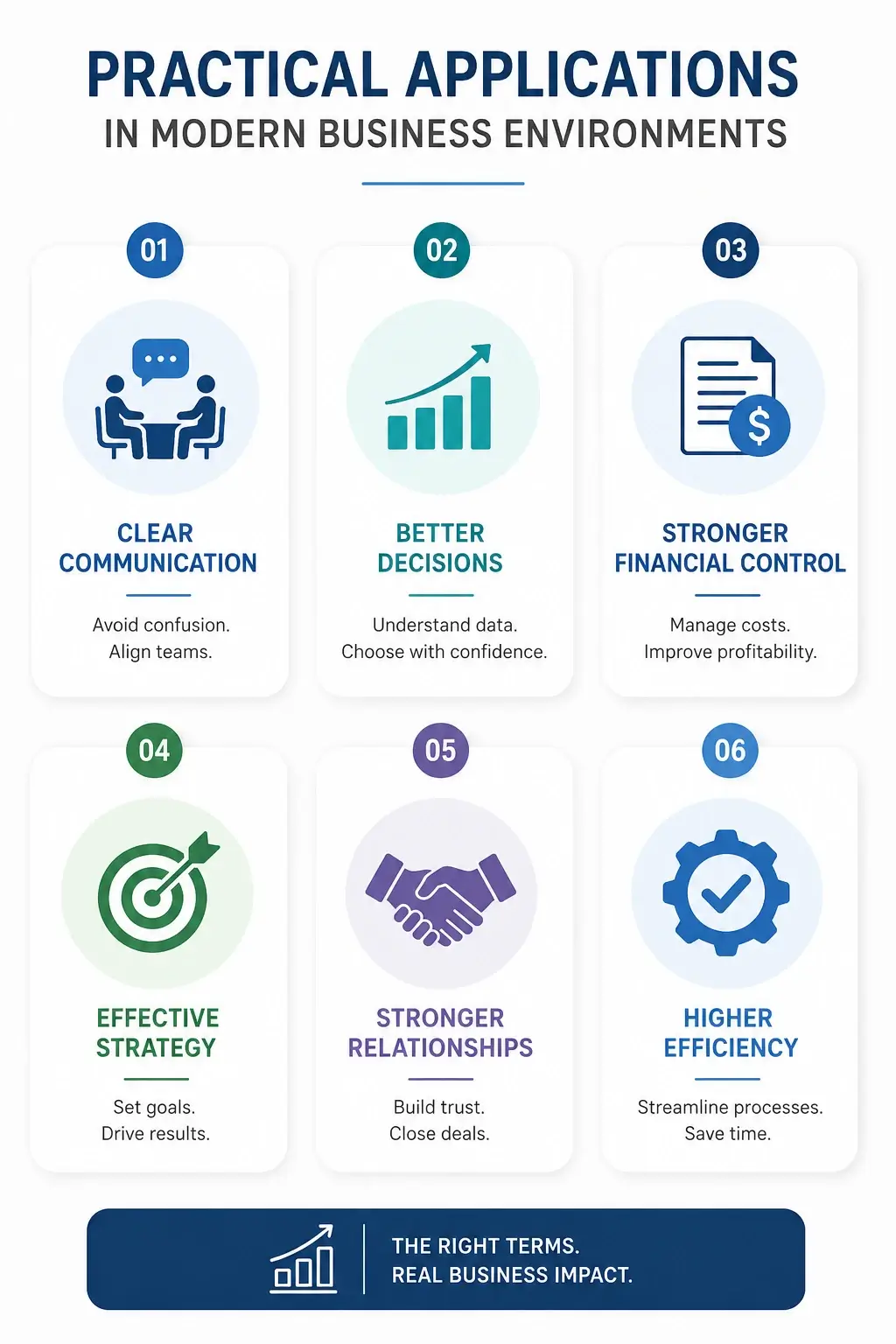
Knowing business terminology is one thing; applying it effectively is another. Here are real-world scenarios where business terminology makes a difference.
- Scenario 1: Weekly Leadership Meeting
Without terminology: “We’re doing okay, but sales could be better.”
With business terminology: “Our Q3 CAC increased 22% while LTV remained flat, causing a CAC-to-LTV ratio of 1:2.3. We should pivot our acquisition channels and run an A/B test.” - Scenario 2: Presenting a New Project
Use NPV, IRR, payback period, and core competency to justify the project’s viability and strategic alignment. - Scenario 3: Vendor Contract Negotiation
Apply indemnification, force majeure, SLA, and early termination fee to protect your company from unforeseen risks. - Scenario 4: Performance Reviews
Use 360 feedback, OKRs, competency gap, and development plan to structure constructive, forward-looking conversations. - Scenario 5: Startup Pitch Deck
Investors expect TAM, SAM, SOM, unit economics, churn rate, and exit strategy. Missing these terms can cost you crucial funding.
Challenges and Misunderstandings
Even experienced professionals struggle with business terminology from time to time. Here are common pitfalls and how to avoid them. ⚠️
| Challenge | Typical Consequence | Proactive Solution |
|---|---|---|
| Jargon Overload | Confusion, disengagement, slower decisions | Know your audience. Use simpler words for new hires or non-experts. |
| Acronym Confusion (e.g., ROI means different things) | Misaligned expectations, calculation errors | Spell out the term on first use: “Return on Investment (ROI).” |
| Cultural & Regional Differences | Misinterpretation in global teams | Create a shared glossary of business terminology in your company wiki. |
| Rapid Evolution (new terms like “generative AI”) | Outdated vocabulary, lost relevance | Subscribe to industry newsletters; learn 5 new terms monthly. |
| Overconfidence | Costly mistakes based on incorrect assumptions | Ask clarifying questions: “Can you walk me through how you calculated EBITDA?” |
Best Practices for Learning and Using Business Terminology
Ready to upgrade your business terminology skills? Follow these evidence-based best practices. 📚
| # | Practice | Implementation Tip |
|---|---|---|
| 1 | Learn in context | Read annual reports, case studies, and earnings call transcripts. |
| 2 | Use spaced repetition | Apps like Anki or Quizlet – 10 minutes daily. |
| 3 | Term of the day | Use one new term in a meeting, email, or Slack message. |
| 4 | Keep a living glossary | Document new terms with definition, example, and source. |
| 5 | Teach others | Run a 15-minute lunch-and-learn session weekly. |
| 6 | Shadow cross-functional meetings | Listen to how finance, marketing, and operations use terms differently. |
| 7 | Use visual aids | Create flowcharts linking related terms (e.g., revenue → gross profit → net income). |
| 8 | Take online courses | Coursera (Business Foundations), LinkedIn Learning, CFI. |
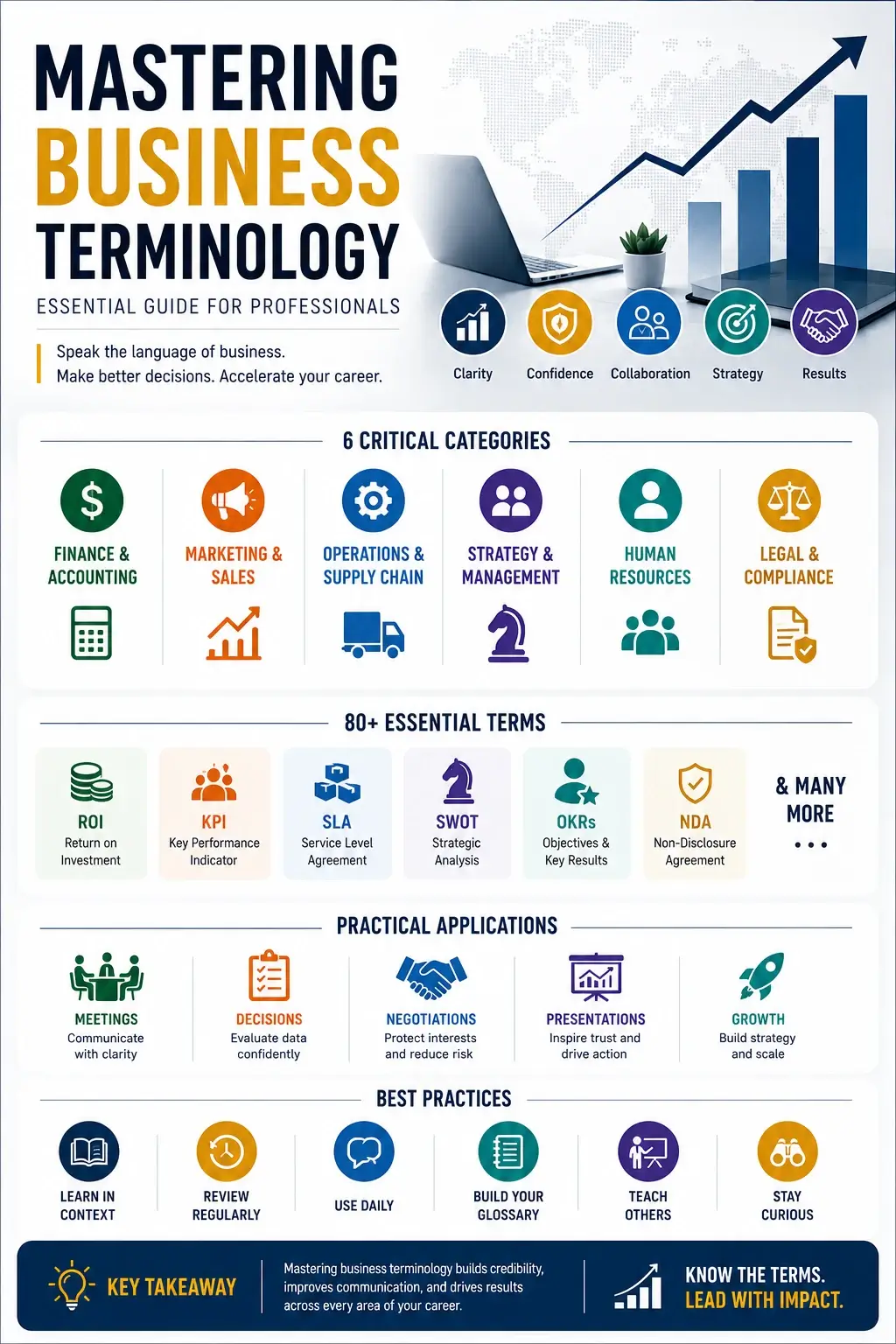
Infographic
Frequently Asked Questions (FAQ)
| # | Question | Answer |
|---|---|---|
| 1 | What is the most important business terminology for beginners? | Start with ROI, KPI, P&L, CAC, LTV, SWOT, Gross Margin, Net Income, Churn Rate, and OKRs. These 10 appear across all industries. |
| 2 | How many terms should I learn per week? | Aim for 5–10 new terms per week with active usage. Within three months, you’ll master over 100 terms. |
| 3 | Does business terminology differ between startups and large corporations? | Yes. Startups emphasize “runway,” “pivot,” “burn rate,” and “unit economics.” Large companies use “SLA,” “compliance,” “quarterly guidance,” and “succession planning.” |
| 4 | Where can I find authoritative definitions? | Trusted sources: Investopedia, Harvard Business Review glossary, Merriam-Webster’s Business Dictionary, and CFI (Corporate Finance Institute). |
| 5 | How can I avoid sounding like a buzzword-dropper? | Always pair a term with a concrete number or action. Instead of “We need synergy,” say “The merger will generate $10M in cost synergy by consolidating warehouses.” |
| 6 | Is there a difference between business terminology and business jargon? | Yes. Terminology is precise and necessary (e.g., “EBITDA”). Jargon is vague or overused (e.g., “circle back”). Focus on terminology; use jargon sparingly. |
| 7 | How often should I update my knowledge? | Set a recurring 30-minute session every two weeks to read one industry article or book chapter. Follow 2–3 newsletters to catch emerging terms. |
Conclusion
Mastering business terminology is not an academic exercise—it’s a career accelerator. From boardroom presentations to daily emails, the precise use of business terminology builds credibility, reduces friction, and drives results. 💼
With the 80+ terms provided in this guide, you now have a powerful toolkit. Remember that fluency comes with consistent, contextual practice. Start by focusing on the terms most relevant to your role and industry, then gradually expand your vocabulary across finance, marketing, operations, strategy, HR, and legal.
In a world where clarity equals competitive advantage, your command of business terminology is a superpower. Invest in it today, and you’ll reap the rewards for your entire career. 🚀
References
- Clarkson, K. W., Miller, R. L., & Cross, F. B. (2021). Business law: Text and cases (15th ed.). Cengage Learning. ISBN 978-0357985533
- Dessler, G. (2020). Human resource management (16th ed.). Pearson. ISBN 978-0135553022
- Doerr, J. (2018). Measure what matters: How Google, Bono, and the Gates Foundation rock the world with OKRs. Portfolio. ISBN 978-0525536222
- Heizer, J., Render, B., & Munson, C. (2020). Operations management: Sustainability and supply chain management (13th ed.). Pearson. ISBN 978-0135267622
- Kim, W. C., & Mauborgne, R. (2014). Blue ocean strategy, expanded edition: How to create uncontested market space and make the competition irrelevant. Harvard Business Review Press. ISBN 978-1625275530
- Kotler, P., & Keller, K. L. (2021). Marketing management (16th ed.). Pearson. ISBN 978-0135827604
- Law, J. (Ed.). (2016). A dictionary of business and management (6th ed.). Oxford University Press. https://doi.org/10.1093/acref/9780199684984.001.0001
- Ries, E. (2011). The lean startup: How today’s entrepreneurs use continuous innovation to create radically successful businesses. Crown Business. ISBN 978-0307887898
- Ross, S. A., Westerfield, R. W., & Jordan, B. D. (2022). Fundamentals of corporate finance (13th ed.). McGraw Hill. ISBN 978-1260619652
- Swensson, R. G. (2014). Business acumen: Strategic thinking to strategic action. Davies-Black Publishing. ISBN 978-1579936341
- Harvard Business Review. (2026). Strategy explained. HBR.org. Retrieved June 13, 2026, from https://hbr.org/strategy

 Inar Learn