
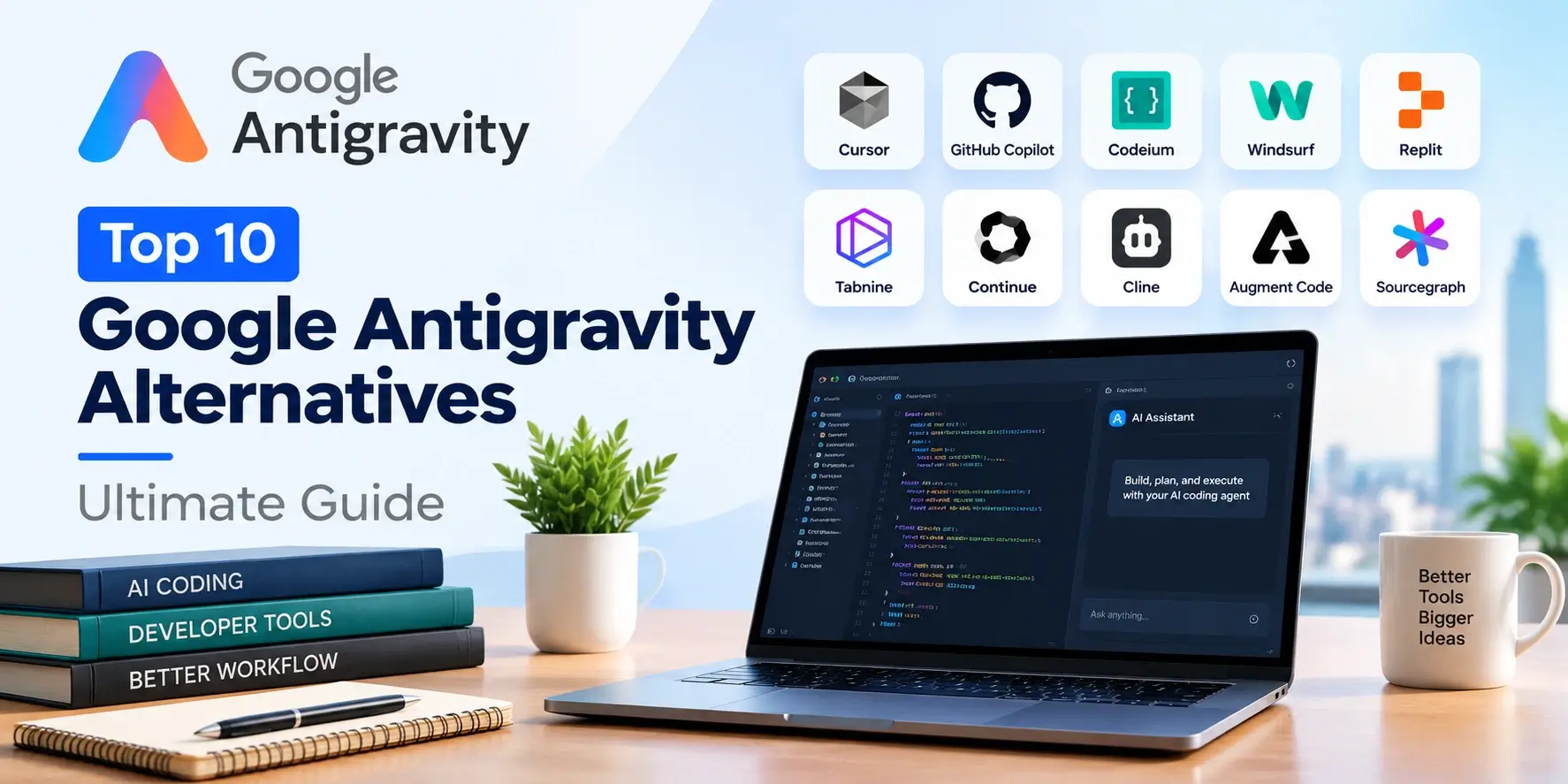
Google Antigravity is Google’s agent-first development platform — a VS Code fork that combines a traditional AI-powered editor with a Manager Surface for orchestrating multiple autonomous agents working in parallel. It launched in November 2025 alongside Gemini 3, and Antigravity 2.0 arrived in May 2026 with a standalone desktop app, a CLI, and a Python SDK. It is free for individuals during preview and achieved 76.2% on SWE-bench Verified.
But Antigravity has real limitations: it locks you into Google’s ecosystem, does not support bring-your-own API keys, restricts third-party models on enterprise plans, and is still in preview with unclear long-term pricing. For developers who need cross-IDE support, model flexibility, a terminal-first workflow, or a battle-tested production tool, there are powerful Google Antigravity Alternatives worth exploring.
The best of all Google Antigravity Alternatives depends on your priority: Cursor for the most mature AI-native IDE, Claude Code for terminal-first agentic coding, GitHub Copilot for the broadest IDE support, Kiro for spec-driven development, and Cline or Aider for free open-source options.
Why Look Beyond Google Antigravity?
Google Antigravity is a genuinely ambitious product. But it has specific limitations that push developers toward Google Antigravity Alternatives.
Preview status and pricing uncertainty
Antigravity is still in free preview, and Google has not committed to a stable pricing structure. Paid tiers run through Google AI subscriptions — Pro at $19.99/month, Ultra at $99.99/month, and Ultra Premium at $200/month — with usage set by quota refreshes and weekly limits rather than a published request count. For teams that need predictable costs and stable SLAs, this is a real concern. Several Google Antigravity Alternatives offer clearer, more predictable pricing.
No bring-your-own-key support
Antigravity does not support bring-your-own API keys. You cannot connect it to your own OpenAI, Anthropic, or OpenRouter credentials. You are locked into the models Google chooses to offer through its built-in menu. Tools like Cline, Aider, OpenCode, and Kilo Code all support BYOK, which matters enormously for teams that want cost control or provider flexibility. This is the single biggest reason developers seek out Google Antigravity Alternatives.
Limited IDE support
Antigravity is built as a modified VS Code fork. While it now offers extensions for Visual Studio Code, Visual Studio, JetBrains IDEs, Zed, and Xcode, the core experience is still VS Code-centric. Developers who prefer terminal-first workflows, JetBrains-native experiences, or cloud-based development will find better fits among Google Antigravity Alternatives.
If you want a free, agent-first IDE with multi-agent orchestration, browser control, artifact-based verification, and deep Gemini integration, Antigravity is excellent. This guide to Google Antigravity Alternatives is for developers who have hit a specific limitation and need something different.
Comparison Table: All 10 at a Glance
Use this table to narrow down your shortlist before diving into the detailed profiles below. It compares the most important Google Antigravity Alternatives side by side across price, platform, and best-fit use case.
| Tool | Type | Free Tier | Paid From | Best For |
|---|---|---|---|---|
| Cursor | AI-native IDE | Yes (limited) | $20/mo Pro | Most mature AI IDE, production teams |
| Claude Code | Terminal CLI | No | $20/mo Pro | Terminal-first agentic coding |
| GitHub Copilot | IDE plugin + cloud | Yes | $10/mo Pro | Broadest IDE support |
| Windsurf | AI-native IDE | Yes (25 credits/mo) | $15/mo Pro | Best value AI IDE |
| Kiro | Spec-driven IDE | Yes (50 credits/mo) | $20/mo Pro | Spec-driven development |
| Cline | VS Code extension | Yes (BYOK) | Free + API costs | Free open-source agent |
| Aider | Terminal CLI | Yes (BYOK) | Free + API costs | Git-native terminal pair programming |
| Devin | Autonomous cloud agent | No | $20/mo | Fully autonomous task delegation |
| Kilo Code | Multi-IDE extension | Yes (BYOK) | $19/mo Kilo Pass | 500+ models, open-source |
| OpenCode | Terminal CLI | Yes (BYOK) | Free + API costs | Open-source, 75+ providers |
Recommended Alternative Option
Before diving into the ten profiles below, here is the short answer on Google Antigravity Alternatives. Each card maps a specific priority — production readiness, terminal workflow, IDE support, budget, or autonomy — to the Google Antigravity Alternatives that fits it best.
Cursor
For most developers and teams switching away from Antigravity, Cursor is the strongest overall replacement among Google Antigravity Alternatives. Cursor 3.5 shipped Cloud Agents in May 2026 — spawning isolated VMs that run terminal, browser, and file operations asynchronously — and now supports up to five agents on parallel sub-tasks. It is the most mature AI-native IDE on the market, with the largest community, the most third-party integrations, and a proven track record at production scale.
See the full Cursor profilePick by Priority Among Google Antigravity Alternatives
Cursor
The most mature AI-native IDE with 1M+ downloads, 300K+ active users, Cloud Agents, Composer 2.5, and a community that has decisively chosen it over Antigravity for production teams.
Jump to CursorClaude Code
Terminal-first agentic CLI powered by Claude Opus 4.7. No new IDE required. Works across VS Code, JetBrains, and Zed. The strongest single-vendor agent for complex multi-step tasks.
Jump to Claude CodeGitHub Copilot
Works in VS Code, JetBrains, Visual Studio, Neovim, Xcode, and GitHub.com. 1.3M developers and 50K enterprise accounts. The only option among Google Antigravity Alternatives with Microsoft IP indemnification.
Jump to GitHub CopilotKiro
AWS-built agentic IDE that structures requirements, design, and tasks before writing code. Produces materially better production code for non-trivial features, with a generous free tier of 50 credits/month.
Jump to KiroCline
The OG open-source autonomous coding agent for VS Code with 5M+ installs. Bring your own key, any OpenAI or Anthropic endpoint, step-by-step permission gating, and MCP support. Completely free.
Jump to ClineDevin
The first fully autonomous AI software engineer. Plans, codes, tests, and deploys end-to-end through Slack or IDE integration. Proven ROI with companies like Nubank reporting 20x cost savings.
Jump to DevinMost developers do not need to choose just one. A common 2026 workflow is Cursor or Windsurf for IDE work, Claude Code for terminal tasks, and GitHub Copilot for team-wide deployment. Try two Google Antigravity Alternatives side by side for a week before committing.
Cursor
The most mature and widely adopted AI-native IDE. Cursor 3.5 added Cloud Agents that spawn isolated VMs for asynchronous terminal, browser, and file operations — converging on the same architecture as Antigravity 2.0 but with a proven production track record.
Key Features
- Cloud Agents spawn isolated VMs for asynchronous terminal, browser, and file operations — up to five parallel sub-tasks
- Composer 2.5 for multi-file editing with deep codebase context
- 1M+ downloads and 300K+ active users — the most widely adopted AI-native IDE
- Best-in-class tab completion with unlimited usage on Pro
- Scopes agent context to repositories or pinned repository groups, unlike Antigravity’s project-centric model
Why Consider It?
Cursor is the default choice for most engineering teams shipping production code in 2026. Where Antigravity 2.0 is architecturally interesting but still in free preview, Cursor has a proven track record at scale. Independent comparisons show the community decisively favoring Cursor over Antigravity, and the same pattern holds when comparing Cursor against Claude Code or Augment Code. Cursor 3.5’s Cloud Agents close the gap with Antigravity’s multi-agent orchestration, while Cursor’s context scoping to repositories gives teams more precise control over what the agent sees. Among all Google Antigravity Alternatives, Cursor is the safest procurement decision for production teams.
Advantages
- Most mature and widely adopted AI-native IDE
- Cloud Agents match Antigravity’s multi-agent orchestration
- Proven at production scale with 300K+ active users
- Repository-scoped context for precise agent control
- Unlimited tab completion on Pro
Limitations
- No terminal-first option — desktop IDE only
- Less model flexibility than BYOK tools like Cline
- Paid-only for meaningful agent usage ($20/mo)
- Closed source
Key Differences from Google Antigravity
Both tools converged on parallel agent orchestration in May 2026, but they took opposite paths. Antigravity tore the Agent Manager out of the IDE; Cursor built agents that run independently of it. Cursor is production-ready today; Antigravity is not yet a serious procurement option according to engineering leadership comparisons. Cursor scopes context to repositories; Antigravity uses a project-centric model. Cursor has a larger community and more third-party integrations.
Feature Comparison
| Feature | Cursor | Google Antigravity |
|---|---|---|
| Status | Production-ready | Free preview |
| Parallel agents | Up to 5 via Cloud Agents | Multi-agent orchestration |
| Context model | Repository-scoped | Project-centric |
| BYOK | No | No |
| Free tier | Limited | Generous |
Best Use Cases
- Production teams shipping code daily
- Complex multi-file refactors and feature work
- Teams wanting the most mature AI IDE experience
- Developers who want background agents running on isolated VMs
Compatibility & Migration
Cursor is a VS Code fork, so Antigravity’s VS Code extensions work without modification. Settings and keybindings transfer directly. Migration from Antigravity is straightforward for the IDE surface, though agent workflows need to be recreated. Cursor does not import Antigravity conversations. Among Google Antigravity Alternatives, Cursor has the lowest switching cost for VS Code users.
🔒 Security & Privacy
Enterprise-grade security with SOC 2 compliance. Privacy mode available. Code is not used to train shared models on paid plans.
🔌 Integrations
VS Code extension ecosystem, MCP support, rules files for custom instructions, and GitHub integration. Cloud Agents run in isolated VMs.
💬 Customer Support
Help center and email support. Priority support for Business and Enterprise plans. Active community forum and Discord.
Claude Code
Anthropic’s terminal-first agentic coding tool. Claude Code runs in your existing terminal — no new IDE required — and autonomously navigates codebases, edits files, runs commands, and completes complex software engineering tasks powered by Claude Opus 4.7.
Key Features
- Terminal-first agentic CLI that edits files, runs commands, and navigates codebases autonomously
- Powered by Claude Opus 4.7 and Sonnet — frontier reasoning for complex tasks
- MCP server support and custom slash commands for extensibility
- Cross-IDE integrations: VS Code, JetBrains, and Zed extensions available
- Permission gating and approval flows for sensitive actions
Why Consider It?
Claude Code represents a fundamentally different philosophy from Antigravity. Where Antigravity is GUI IDE-first with visual orchestration, Claude Code is terminal-first with explicit control. It is the strongest single-vendor agent for complex multi-step tasks, with polished minimalist terminal UX and Anthropic’s public postmortem accountability when things go wrong. Developers who want to hand entire tasks to a single deep agent that lives in their terminal consistently choose Claude Code over Antigravity. It is the best of all Google Antigravity Alternatives for terminal workflows and CI/CD automation.
Advantages
- No new IDE required — works in your existing terminal
- Frontier Claude Opus 4.7 reasoning
- Strongest single-vendor agent for complex tasks
- MCP and slash-command extensibility
- Anthropic publishes public postmortems
Limitations
- Locked to Anthropic models — no provider flexibility
- Usage-based costs can climb fast on agentic workloads
- Terminal UX less visual than Antigravity’s Manager Surface
- No free tier
Key Differences from Google Antigravity
Claude Code is terminal-first; Antigravity is GUI IDE-first. Claude Code is code-as-interface with explicit control over every step; Antigravity is agent-first with visual orchestration. Claude Code costs $20/month on Pro; Antigravity is free during preview. Claude Code is locked to Anthropic models; Antigravity offers Gemini, Claude, and GPT-OSS through its built-in menu. Choose Claude Code for terminal workflows and CI/CD; choose Antigravity for visual IDE work and browser testing.
Feature Comparison
| Feature | Claude Code | Google Antigravity |
|---|---|---|
| Interface | Terminal CLI | GUI IDE + Manager Surface |
| Model flexibility | Anthropic only | Gemini, Claude, GPT-OSS |
| Free tier | No | Yes (preview) |
| Pricing | $20/mo Pro | Free; $19.99+ Google AI |
| Postmortems | Public accountability | Not published |
Best Use Cases
- Multi-file refactors and migrations from the terminal
- Autonomous bug investigation and fixes
- Greenfield feature implementation with planning and execution
- Operations work via terminal commands under agent control
Compatibility & Migration
Claude Code does not import Antigravity conversations or project state. Migration is conceptual — terminal-first vs GUI-first. Most developers who switch keep their existing IDE and add Claude Code as a terminal tool, rather than replacing their editor entirely. Among Google Antigravity Alternatives, Claude Code is the most common companion tool rather than replacement.
🔒 Security & Privacy
Permission gating for sensitive actions. Enterprise compliance available. Anthropic publishes public postmortems for incidents — rare transparency among AI vendors.
🔌 Integrations
MCP servers, custom slash commands, VS Code extension, JetBrains extension, Zed extension, and GitHub Actions for CI/CD automation.
💬 Customer Support
Anthropic’s standard support channels, extensive documentation, and priority support on Max plans.
GitHub Copilot
The most widely deployed AI coding assistant in the world. GitHub Copilot works across VS Code, JetBrains, Visual Studio, Neovim, Xcode, and GitHub.com — with 1.3 million developers, 50,000 enterprise accounts, and Microsoft IP indemnification on Business and Enterprise tiers.
Key Features
- Inline suggestions and Next Edit across VS Code, JetBrains, Visual Studio, Neovim, Xcode, and GitHub Mobile
- Agent mode for multi-step autonomous file edits across the codebase
- Copilot Chat in IDE and on GitHub.com for cross-repo Q&A
- Code review automation in pull requests — summarize, review, and suggest changes
- Microsoft IP indemnification on Business and Enterprise tiers — unique among Google Antigravity Alternatives
Why Consider It?
GitHub Copilot’s defining strength is breadth. Where Antigravity is limited to a VS Code fork, Copilot works everywhere developers code. It is the only option among Google Antigravity Alternatives with Microsoft’s IP indemnification, which matters enormously for enterprise legal teams. Copilot also has the most mature GitHub-native workflows — pull request review automation, cross-repo Q&A, and codebase indexing on Enterprise. It is not the most aggressive on agentic autonomy, but for teams that need broad IDE support, enterprise safety, and GitHub-native workflows, Copilot is the safest choice.
Advantages
- Broadest IDE support of any Google Antigravity Alternative
- Microsoft IP indemnification on Business and Enterprise
- Strong enterprise security, SSO, and admin controls
- Codebase-wide indexing on Enterprise
- Mature, battle-tested at Fortune 500 scale
Limitations
- Quality often trails purpose-built agents like Claude Code or Cursor
- Usage-based AI Credits (June 2026) make budgeting harder
- Enterprise total cost ($60/user/mo with GitHub Enterprise Cloud) is steep
- Less aggressive on agentic and autonomous workflows than competitors
Key Differences from Google Antigravity
Copilot works in every major IDE; Antigravity is a VS Code fork. Copilot offers IP indemnification; Antigravity does not. Copilot has mature GitHub-native workflows; Antigravity focuses on agent orchestration. Copilot is less aggressive on agentic workflows; Antigravity’s entire architecture is built around autonomous agents. Choose Copilot for breadth and enterprise safety; choose Antigravity for agent-first orchestration.
Feature Comparison
| Feature | GitHub Copilot | Google Antigravity |
|---|---|---|
| IDE support | VS Code, JetBrains, Visual Studio, Neovim, Xcode | VS Code fork + extensions |
| IP indemnification | Yes (Business+) | No |
| Enterprise scale | 50,000 accounts | Limited, preview |
| Agentic autonomy | Moderate | Aggressive multi-agent |
| Free tier | Yes | Yes (preview) |
Best Use Cases
- Enterprise rollouts with IP indemnification requirements
- Teams using multiple IDEs across the organization
- Pull request review and summary automation
- Cross-repo Q&A via Copilot Chat on GitHub.com
Compatibility & Migration
Copilot is an extension, not a replacement IDE, so migration from Antigravity means installing the plugin in your existing editor rather than switching tools. Antigravity’s VS Code extensions work alongside Copilot. There is no conversation import, but the migration is additive — most teams add Copilot rather than replacing their editor. Among Google Antigravity Alternatives, Copilot has the lowest switching cost for teams that want to keep their current IDE.
🔒 Security & Privacy
Enterprise-grade security with SSO, admin controls, and IP indemnification. Code referencing filters prevent suggestions matching public code. Suggestions are not used to train shared models.
🔌 Integrations
VS Code, JetBrains, Visual Studio, Neovim, Xcode, GitHub.com, GitHub Mobile, CLI, and deep GitHub workflow integration for issues and pull requests.
💬 Customer Support
GitHub’s standard support channels. Enterprise support available for Copilot Business and Enterprise customers. Extensive documentation and admin tooling.
Windsurf
The best-value AI-native IDE among Google Antigravity Alternatives. Windsurf combines copilot-style code completion with agentic multi-file editing through Cascade, its deep context engine — at $15/month, undercutting both Cursor and Antigravity’s paid tiers.
Key Features
- Cascade agentic AI for powerful multi-file editing and deep codebase understanding
- Supercomplete context-aware completion — reportedly better than GitHub Copilot
- Most generous free tier with 25 credits/month among AI coding assistants
- Competitive pricing at $15/month versus Cursor at $20/month
- Flow-based AI collaboration for rapid prototyping and codebase learning
Why Consider It?
Windsurf is the value play among Google Antigravity Alternatives. It offers Cascade — a deep context engine that autonomously plans and executes multi-step coding tasks — at $15/month, undercutting both Cursor and Antigravity’s paid tiers. Its free tier includes 25 credits/month, the most generous among AI coding assistants. Independent comparisons show Windsurf’s autocomplete is reportedly better than GitHub Copilot’s, and its Cascade agent handles multi-file editing and codebase understanding well. For individual developers and small teams who want agentic IDE features without premium pricing, Windsurf is the best budget option.
Advantages
- Best value at $15/month Pro
- Most generous free tier with 25 credits/month
- Cascade agentic AI for multi-file editing
- Excellent autocomplete — reportedly better than Copilot
- Flow-based collaboration model
Limitations
- Free tier 25 credits feel restrictive for real-world usage
- Occasional Cascade instability and limited deployment quotas
- VS Code fork carries performance overhead
- Newer product with less maturity than Cursor
Key Differences from Google Antigravity
Windsurf and Antigravity have a complicated relationship — Antigravity is widely reported to be a proprietary fork of Windsurf, and Google reportedly paid around $2.4 billion for technology licensing. The visual layouts are nearly identical. However, Windsurf is a standalone product with its own roadmap and pricing, while Antigravity is integrated into Google’s ecosystem and requires a Google account. Windsurf is cheaper, has a more generous free tier, and does not lock you into Google’s ecosystem. Among Google Antigravity Alternatives, Windsurf is the closest architectural cousin.
Feature Comparison
| Feature | Windsurf | Google Antigravity |
|---|---|---|
| Pricing | $15/mo Pro | Free; $19.99+ Google AI |
| Free tier | 25 credits/month | Generous preview |
| Agent | Cascade | Agent Manager |
| Account requirement | Windsurf account | Google account |
| Ecosystem lock-in | None | Google ecosystem |
Best Use Cases
- Individual developers on a budget
- Multi-file code changes and refactors
- Rapid prototyping and learning new codebases
- Teams wanting agentic features without premium pricing
Compatibility & Migration
Windsurf is a VS Code fork, so Antigravity’s VS Code extensions work without modification. Settings and keybindings transfer directly. Because Antigravity is reportedly built on Windsurf’s technology, migration between the two is smoother than switching to unrelated tools. However, Windsurf’s Cascade agent workflows differ from Antigravity’s Manager Surface, so some reconfiguration is needed.
🔒 Security & Privacy
Standard cloud security. Privacy mode available. Code is not used to train models on paid plans. No IP indemnification.
🔌 Integrations
VS Code extension ecosystem, MCP support, and built-in AI chat. Extension marketplace compatible with VS Code.
💬 Customer Support
Help center and email support. Community Discord and forum. Priority support on Pro and Teams plans.
Kiro
AWS-built agentic IDE for spec-driven development. Kiro structures requirements, design, and tasks before writing code — producing materially better production code for non-trivial features than ad-hoc prompt-based tools.
Key Features
- Spec-driven development — requirements → design → task breakdown before code generation
- Multi-model flexibility with Auto mode routing: Claude Opus 5, Sonnet 4.6, OpenAI GPT-5, Qwen3 Coder Next, DeepSeek v3.2, and MiniMax 2.1
- Generous perpetual free tier at $0 with 50 credits each month and no card required
- $20 sign-up credit on first upgrade
- MCP client with governance controls for enterprise deployments
Why Consider It?
Kiro’s spec-driven methodology is its defining advantage. Instead of ad-hoc prompting, Kiro structures work into requirements, design, and tasks — producing materially better production code with edge case handling, security, and maintainability that prompt-based tools cannot match at scale. Independent research shows Kiro exceeds the baseline on weak assertions and shows lower blocking-error and flakiness rates than competing IDEs. Its perpetual free tier of 50 credits/month with no card required makes it easy to evaluate. Among Google Antigravity Alternatives, Kiro is the best choice for teams that value structure over speed.
Advantages
- Spec-driven methodology produces better production code
- Multi-model flexibility with Auto routing
- Perpetual free tier with 50 credits/month
- Lower blocking-error and flakiness rates in research
- AWS-backed with enterprise governance
Limitations
- Newly launched with fewer community resources
- Credit system makes cost forecasting harder
- Spec-driven approach adds upfront overhead
- Smaller ecosystem than Cursor or GitHub Copilot
Key Differences from Google Antigravity
Kiro is spec-driven; Antigravity is agent-first. Kiro structures work into requirements, design, and tasks before generating code; Antigravity spawns agents to plan and execute autonomously. Kiro offers multi-model flexibility with Auto routing; Antigravity offers a fixed menu of Gemini, Claude, and GPT-OSS. Kiro has a perpetual free tier of 50 credits/month; Antigravity is free during preview with unclear future pricing. Choose Kiro for structured development; choose Antigravity for autonomous agent orchestration.
Feature Comparison
| Feature | Kiro | Google Antigravity |
|---|---|---|
| Approach | Spec-driven | Agent-first |
| Free tier | 50 credits/month perpetual | Free during preview |
| Model routing | Auto mode across 6+ models | Fixed menu |
| Enterprise | AWS governance | Limited |
| Research quality | Lower flakiness rate | Baseline |
Best Use Cases
- Non-trivial features requiring edge case handling
- Teams wanting structured requirements before code
- AWS ecosystem users
- Projects where maintainability and security matter
Compatibility & Migration
Kiro is VS Code-based, so Antigravity’s VS Code extensions work. Settings and keybindings transfer directly. Kiro offers CLI and web access alongside its IDE, giving more flexibility than Antigravity’s desktop-first approach. Migration from Antigravity requires adapting to the spec-driven methodology, which is a workflow change rather than a tool change.
🔒 Security & Privacy
AWS enterprise-grade security. MCP governance controls. Suitable for regulated industries. Code not used to train shared models.
🔌 Integrations
MCP client with governance, AWS services integration, VS Code extension ecosystem, CLI, and web access.
💬 Customer Support
AWS support channels. Documentation and community resources are growing. Enterprise support available.
Cline
The original open-source autonomous coding agent for VS Code, with 5M+ installs. Cline creates and edits files, runs terminal commands, controls the browser, and supports MCP — all step-by-step with your permission. Completely free, bring your own key.
Key Features
- Free open-source autonomous coding agent with 5M+ VS Code installs
- Bring your own key — any OpenAI or Anthropic endpoint, zero markup
- Creates and edits files, runs terminal commands, and controls the browser
- Step-by-step permission gating — approve every action before it runs
- MCP support and plan mode for structured multi-step workflows
Why Consider It?
Cline is the original open-source autonomous coding agent, and it remains the best free option among Google Antigravity Alternatives. It supports any OpenAI or Anthropic endpoint with zero markup, meaning you can use your own API keys and control costs precisely. Step-by-step permission gating gives you more control than Antigravity’s autonomous mode. Plan mode lets you structure multi-step workflows. For developers who want agentic coding without a subscription and without vendor lock-in, Cline is the definitive choice. It is Apache-2.0 licensed and has 5M+ installs, proving its reliability at scale.
Advantages
- Completely free and open source (Apache-2.0)
- Bring your own key — any OpenAI or Anthropic endpoint
- 5M+ installs — proven at scale
- Step-by-step permission gating for control
- MCP support and plan mode
Limitations
- Requires your own API keys and separate billing
- Less polished UX than commercial IDEs
- Extension-based rather than a full IDE
- Agentic autonomy less aggressive than Antigravity
Key Differences from Google Antigravity
Cline is free and open source; Antigravity is closed-source and will eventually require a paid Google AI subscription for meaningful use. Cline supports bring-your-own-key; Antigravity does not. Cline is an extension for your existing VS Code or JetBrains IDE; Antigravity is a full IDE fork. Cline’s permission gating gives you more control; Antigravity’s Turbo preset gives agents more autonomy. Choose Cline for cost control and openness; choose Antigravity for visual orchestration and browser control.
Feature Comparison
| Feature | Cline | Google Antigravity |
|---|---|---|
| Cost | Free (BYOK) | Free preview; paid later |
| Source | Open source (Apache-2.0) | Closed source |
| BYOK | Yes | No |
| IDE support | VS Code, JetBrains | VS Code fork + extensions |
| Permission model | Step-by-step | Presets with Turbo |
Best Use Cases
- Developers wanting free agentic coding
- Teams with existing API keys wanting cost control
- Users who want step-by-step approval for every action
- Open-source contributors and hobbyists
Compatibility & Migration
Cline installs as an extension in VS Code or JetBrains, so migration from Antigravity means adding Cline to your existing editor. Since Antigravity is a VS Code fork, all Cline-compatible extensions work. Migration is additive rather than replacement — you can use Cline alongside any IDE. Among Google Antigravity Alternatives, Cline has the lowest switching cost for developers who want to keep their current editor.
🔒 Security & Privacy
Open source and auditable. No telemetry by default. Step-by-step permission gating gives you control over every action. Code stays with your chosen model provider.
🔌 Integrations
VS Code and JetBrains extensions, MCP support, browser control, terminal integration, and any OpenAI or Anthropic endpoint.
💬 Customer Support
Community support via GitHub Issues and Discord. Active open-source community. Documentation is thorough and improving.
Aider
The open-source standard for AI pair programming via the CLI. Aider edits code directly in your local git repository, creates proper git commits, supports all major LLMs, and can work across multiple files simultaneously.
Key Features
- Edits code directly in your local git repository with automatic commits and undo
- Diff-based changes provide full transparency and control over every edit
- Supports all major LLMs — OpenAI, Anthropic, Google, and local models via Ollama
- Multi-file project handling with intelligent change detection
- Free installation with pay-per-use model (USD 0.01–0.10 per feature)
Why Consider It?
Aider is the open-source standard for AI pair programming via the CLI. Its git-native approach is unique among Google Antigravity Alternatives: every change is committed as a proper git commit, so you can review, revert, or cherry-pick individual changes. Diff-based editing provides full transparency — you see exactly what changed. Aider supports all major LLMs, so you can switch between OpenAI, Anthropic, Google, or local models without changing your workflow. Independent comparisons show Aider leads in output quality and reliability, while Antigravity leads in autonomy and speed. For developers who want control and transparency, Aider is the better choice.
Advantages
- Git-native — automatic commits and undo for every change
- Diff-based changes for full transparency
- Supports all major LLMs including local models
- Free installation with pay-per-use pricing
- Leads in output quality and reliability
Limitations
- Requires local setup and Git knowledge
- No tight IDE integration — terminal-focused
- Occasional prompt refinement needed
- Lacks automated compliance features for enterprise legal teams
Key Differences from Google Antigravity
Aider is git-native with automatic commits; Antigravity does not have built-in git commit automation. Aider supports all major LLMs including local models; Antigravity offers a fixed menu. Aider is terminal-based; Antigravity is GUI IDE-first. Aider leads in output quality and reliability; Antigravity leads in autonomy and speed. Choose Aider for control and transparency; choose Antigravity for visual orchestration and parallel agents.
Feature Comparison
| Feature | Aider | Google Antigravity |
|---|---|---|
| Interface | Terminal CLI | GUI IDE |
| Git integration | Automatic commits | Manual |
| Model support | All major LLMs + local | Fixed menu |
| Cost | Free + API tokens | Free preview; paid later |
| Reliability | Leads in output quality | Baseline |
Best Use Cases
- Terminal-first developers who prefer CLI workflows
- Projects requiring git-native change tracking
- Teams using local or self-hosted models
- Developers who want full transparency in every edit
Compatibility & Migration
Aider does not replace your IDE — it is a terminal tool that works alongside any editor. Migration from Antigravity means adopting a terminal-first workflow for AI pair programming while keeping your existing editor for manual coding. Aider works with any git repository, so no project migration is needed. Among Google Antigravity Alternatives, Aider is the most complementary tool rather than a direct replacement.
🔒 Security & Privacy
Open source and auditable. Works with local models for complete privacy. No telemetry. Code stays in your git repository.
🔌 Integrations
Git repositories, all major LLM providers, Ollama for local models, and voice input. Works alongside any IDE.
💬 Customer Support
Community support via GitHub Issues and Discord. Extensive documentation. Active open-source community.
Devin
The first fully autonomous AI software engineer. Devin plans, codes, tests, and deploys entire development tasks from start to finish using its own code editor, terminal, and browser — with Slack and IDE integration for task delegation.
Key Features
- Fully autonomous software engineer that plans, codes, tests, and deploys
- Full development environment access — its own code editor, terminal, and browser
- Slack and IDE integration for task delegation without context switching
- Parallel task execution across multiple workstreams
- Proven ROI with companies like Nubank reporting 20x cost savings
Why Consider It?
Devin is the most autonomous option among Google Antigravity Alternatives. Where Antigravity orchestrates multiple agents that you supervise, Devin operates as a complete software engineer that you delegate tasks to. It plans, codes, tests, and deploys without human intervention. Companies like Nubank have reported 20x cost savings from using Devin for routine engineering work. It handles bug fixes, tests, glue code, and well-scoped tickets effectively. For teams that want to delegate entire engineering tasks rather than supervise agents step by step, Devin is the most capable tool available.
Advantages
- Fully autonomous — plans, codes, tests, and deploys end-to-end
- Slack integration reduces context switching
- Proven ROI with 20x cost savings at Nubank
- Strong performance on routine tasks, bug fixes, and glue code
- Parallel task execution
Limitations
- Completes only 15% of complex tasks without human help
- Gets stuck in technical dead-ends requiring intervention
- Tasks can take days instead of hours for straightforward work
- Cannot handle integration conflicts or unclear decision points
Key Differences from Google Antigravity
Devin is a fully autonomous software engineer; Antigravity is an agent-first IDE that orchestrates agents you supervise. Devin works in the cloud; Antigravity runs locally on your desktop. Devin can complete entire tickets; Antigravity assists you while you work. Devin’s code quality rates 3.5/5 versus Antigravity’s 4/5, but Devin’s autonomy is significantly higher. Choose Devin for full task delegation; choose Antigravity for visual IDE work and agent orchestration.
Feature Comparison
| Feature | Devin | Google Antigravity |
|---|---|---|
| Autonomy | Fully autonomous | Supervised multi-agent |
| Deployment | Cloud | Desktop + CLI |
| Task completion | 15% complex without help | Requires supervision |
| Pricing | $20/mo + usage | Free preview |
| ROI proof | 20x at Nubank | Preview stage |
Best Use Cases
- End-to-end feature development
- Bug fixing with full autonomy
- Repository-wide migrations
- Automated testing and QA
Compatibility & Migration
Devin works on your existing codebase through cloud integration, so no local migration is needed. It connects via Slack or IDE plugins. Migration from Antigravity means shifting from supervised agent orchestration to full task delegation — a workflow change rather than a tool change. Among Google Antigravity Alternatives, Devin requires the most significant adjustment in how you work with AI.
🔒 Security & Privacy
Cloud-based with enterprise security. Code runs in isolated environments. SOC 2 compliance. Enterprise plans available.
🔌 Integrations
Slack, IDE plugins, GitHub, GitLab, and full development environment access. API for custom integrations.
💬 Customer Support
Email support and help center. Priority support on enterprise plans. Documentation and onboarding resources available.
Kilo Code
Open-source AI coding agent for VS Code, JetBrains, CLI, Cloud, and Slack with parallel agents and 500+ models. Forked from Cline and Roo Code, Kilo Code is MIT-licensed and model-agnostic with zero markup on BYOK.
Key Features
- Open-source MIT-licensed with 500+ models across 60+ providers
- Connect any provider through BYOK with zero markup
- Multi-mode architecture: Architect, Code, Debug, Ask, and Orchestrator modes
- Parallel agents across 6+ surfaces including Cloud Agents, Slack, and Code Reviewer
- 27.4k GitHub stars and 5M+ users — validated broad developer adoption
Why Consider It?
Kilo Code is the most flexible option among Google Antigravity Alternatives. It supports 500+ models across 60+ providers with zero markup on BYOK, giving you complete control over cost and model selection. Its multi-mode architecture separates planning and execution into distinct roles — Architect plans, Code executes, Debug troubleshoots, and Orchestrator coordinates — with subagent delegation across concurrent git worktrees. Cloud Agents, Slack, and Code Reviewer extend beyond IDE-only workflows. Trusted by developers at Meta, Amazon, Airbnb, PayPal, Square, and Red Hat, Kilo Code has the broadest enterprise validation of any open-source agent.
Advantages
- 500+ models across 60+ providers with zero markup
- MIT-licensed open source
- Multi-mode architecture with parallel agents
- Trusted by Meta, Amazon, Airbnb, PayPal, and more
- Works across VS Code, JetBrains, CLI, Cloud, and Slack
Limitations
- BYOK requires your own API keys and separate billing
- More complex to configure than single-purpose tools
- Kilo Pass managed inference costs $19/mo
- Less polished UX than commercial IDEs
Key Differences from Google Antigravity
Kilo Code is open source; Antigravity is closed. Kilo Code supports 500+ models; Antigravity offers a fixed menu. Kilo Code has zero markup on BYOK; Antigravity does not support BYOK at all. Kilo Code works across VS Code, JetBrains, CLI, Cloud, and Slack; Antigravity is a VS Code fork with extensions. Kilo Code’s multi-mode architecture separates planning from execution; Antigravity’s agent manager handles both.
Feature Comparison
| Feature | Kilo Code | Google Antigravity |
|---|---|---|
| Models | 500+ | Fixed menu |
| BYOK | Yes, zero markup | No |
| License | MIT open source | Closed |
| Surfaces | 6+ including Slack and Cloud | Desktop, IDE, CLI |
| Enterprise trust | Meta, Amazon, Airbnb, PayPal | Limited |
Best Use Cases
- Teams wanting model flexibility and cost control
- Developers who need parallel agents across multiple worktrees
- Organizations using Slack for engineering coordination
- Open-source contributors and enterprise teams
Compatibility & Migration
Kilo Code installs as an extension in VS Code or JetBrains, or as a CLI tool. Migration from Antigravity means installing Kilo Code in your existing editor and configuring your preferred models. Since it is MIT-licensed and open source, there is no vendor lock-in. Among Google Antigravity Alternatives, Kilo Code offers the most flexibility and the least lock-in.
🔒 Security & Privacy
Open source and auditable. BYOK means your code goes directly to your chosen provider. No intermediary markup or data retention.
🔌 Integrations
VS Code, JetBrains, CLI, Cloud, Slack, GitHub, GitLab, 500+ models, MCP support, and parallel git worktrees.
💬 Customer Support
Community support via GitHub Issues and Discord. Enterprise support available. Active open-source community with 27.4k stars.
OpenCode
The open-source AI coding agent built for the terminal. OpenCode connects to 75+ providers through Models.dev and expects you to bring your own keys — maximum flexibility, minimum lock-in, completely free software.
Key Features
- Connects to 75+ providers through Models.dev — bring your own keys
- MIT-licensed open source with no vendor lock-in
- Terminal and desktop surfaces for flexible workflows
- Works with any OpenAI or Anthropic-compatible endpoint
- Can run agents for much longer than Antigravity on paid plans, since you control the API budget
Why Consider It?
OpenCode is the most flexible terminal agent among Google Antigravity Alternatives. It connects to 75+ providers through Models.dev and expects you to bring your own keys — which means you control the provider relationship, the pricing, and the data flow. A Google AI developer forum thread specifically recommended OpenCode as an alternative for Antigravity users hitting weekly quota limits, noting that while quality is slightly lower, you can run agents for much longer because you control the API budget. For developers who want terminal-native agentic coding without any vendor lock-in, OpenCode is the definitive choice.
Advantages
- 75+ providers through Models.dev
- Complete control over API budget and provider
- MIT-licensed open source
- Run agents longer than quota-limited tools
- Terminal and desktop surfaces
Limitations
- Requires API key setup and provider management
- Quality can vary by provider choice
- Less polished UX than commercial tools
- No built-in models or managed inference
Key Differences from Google Antigravity
OpenCode supports 75+ providers with BYOK; Antigravity offers a fixed menu with no BYOK. OpenCode is terminal-first; Antigravity is GUI IDE-first. OpenCode is MIT-licensed open source; Antigravity is closed. OpenCode lets you run agents longer by controlling your API budget; Antigravity is limited by quota refreshes and weekly limits. Choose OpenCode for maximum flexibility and cost control; choose Antigravity for visual orchestration and browser control.
Feature Comparison
| Feature | OpenCode | Google Antigravity |
|---|---|---|
| Providers | 75+ via Models.dev | Fixed menu |
| BYOK | Yes | No |
| License | MIT | Closed |
| Quota | Controlled by your API budget | Weekly quota limits |
| Interface | Terminal + desktop | GUI IDE |
Best Use Cases
- Developers hitting Antigravity’s weekly quota limits
- Teams wanting maximum provider flexibility
- Terminal-first workflows without vendor lock-in
- Users who want to run agents for extended periods
Compatibility & Migration
OpenCode is a terminal tool that works alongside any editor. Migration from Antigravity means switching to a terminal-based agent while keeping your existing IDE for manual coding. You configure your own API keys through Models.dev. Among Google Antigravity Alternatives, OpenCode has the lowest ongoing cost if you already have API credits with a provider.
🔒 Security & Privacy
Open source and auditable. BYOK means your code goes directly to your chosen provider with no intermediary. No telemetry.
🔌 Integrations
75+ providers through Models.dev, any OpenAI or Anthropic-compatible endpoint, terminal and desktop surfaces, MCP support.
💬 Customer Support
Community support via GitHub Issues and Discord. Documentation available. Active open-source community.
How to Choose the Right Alternative
Choosing among Google Antigravity Alternatives depends entirely on how you work. This section walks through the six dimensions that matter most when evaluating Google Antigravity Alternatives.
The six decision dimensions
Production readiness
Cursor and GitHub Copilot are production-ready today. Antigravity is still in free preview and not yet a serious procurement option for most teams. If you need stability and SLAs, Cursor is the top pick among Google Antigravity Alternatives.
Interface preference
Cursor, Windsurf, and Kiro are GUI IDE-first. Claude Code, Aider, and OpenCode are terminal-first. Cline and Kilo Code are extensions for your existing IDE. Pick by how you actually work.
Budget & pricing model
Cline, Aider, and OpenCode are free with BYOK. Windsurf is $15/mo. Cursor and Kiro are $20/mo. GitHub Copilot is $10/mo. Antigravity is free during preview but will require a Google AI subscription eventually.
Model flexibility
Kilo Code supports 500+ models. OpenCode supports 75+ providers. Cline and Aider support any OpenAI or Anthropic endpoint. Antigravity offers a fixed menu of Gemini, Claude, and GPT-OSS. BYOK tools win on flexibility.
IDE and platform support
GitHub Copilot supports VS Code, JetBrains, Visual Studio, Neovim, and Xcode. Kilo Code supports VS Code, JetBrains, CLI, Cloud, and Slack. Antigravity is VS Code-centric with extensions for other IDEs.
Autonomy level
Devin is fully autonomous — you delegate entire tickets. Antigravity and Cursor offer supervised multi-agent orchestration. Claude Code is terminal-first with explicit control. Cline offers step-by-step permission gating. Choose your level of trust.
Quick decision flowchart
Best Practices When Switching from Google Antigravity
Migrating from Antigravity to any of the Google Antigravity Alternatives is easier than it looks because most tools are VS Code-based or terminal-based. These habits make the transition smoother.
Do not try to replace everything at once
Keep Antigravity for the tasks it does best — visual multi-agent orchestration and browser testing — while moving specific workflows to specialist Google Antigravity Alternatives.
Export your Antigravity conversations and agent state
Before reducing Antigravity usage, save any conversation context or agent artifacts you may need. No Google Antigravity Alternative can import them.
Test with your real repositories
Do not evaluate Google Antigravity Alternatives with demo projects. Run the same five real tasks you actually do and compare outputs.
Recreate MCP servers and hooks
Antigravity uses MCP Store and JSON-based hooks. Most Google Antigravity Alternatives support MCP, but hook configurations need to be recreated in the new tool.
Give it at least a week
Every agentic coding tool has a different workflow. Give each Google Antigravity Alternative at least a week of real use before deciding.
Keep Antigravity as a fallback
Do not delete your Antigravity setup immediately. Keep it active during the transition so you can fall back on browser control and parallel agents for urgent tasks.
Check BYOK support first
If cost control matters, prioritize Google Antigravity Alternatives that support bring-your-own-key: Cline, Aider, OpenCode, and Kilo Code. Antigravity itself does not support BYOK.
Be willing to use multiple tools
The 2026 best practice is not to pick one Google Antigravity Alternative — it is to combine them. Many developers use Cursor for IDE work, Claude Code for terminal tasks, and GitHub Copilot for team deployment.
Frequently Asked Questions
What is Google Antigravity?
Google Antigravity is Google’s agent-first development platform, announced in November 2025 alongside Gemini 3. Built as a modified VS Code fork, it combines a traditional AI-powered editor with a Manager Surface for orchestrating multiple autonomous agents working in parallel. Antigravity 2.0 (May 2026) added a standalone desktop app, a CLI, and a Python SDK. It achieved 76.2% on SWE-bench Verified and is free for individuals during preview.
What is the best Google Antigravity alternative?
Cursor is the best overall Google Antigravity Alternative for most developers and teams. It is the most mature AI-native IDE, with Cloud Agents that match Antigravity’s multi-agent orchestration, a proven production track record, and a community that has decisively chosen it over Antigravity for production work. Claude Code is the best terminal-first alternative, and GitHub Copilot is the best for broad IDE support and enterprise safety.
Is Google Antigravity free?
Yes, Antigravity is free for individuals during preview. Paid tiers run through Google AI subscriptions: Pro at $19.99/month, Ultra at $99.99/month, and Ultra Premium at $200/month. However, pricing and availability are subject to change because Antigravity is still in preview. Most Google Antigravity Alternatives with free tiers — Cline, Aider, OpenCode, GitHub Copilot, and Windsurf — offer more predictable pricing.
Does Google Antigravity support bring-your-own-key?
No. Antigravity does not support bring-your-own API keys. You cannot connect it to your own OpenAI, Anthropic, or OpenRouter credentials. This is one of the biggest reasons developers seek out Google Antigravity Alternatives. Cline, Aider, OpenCode, and Kilo Code all support BYOK with zero markup.
Which Google Antigravity alternative is best for terminal workflows?
Claude Code is the strongest terminal-first Google Antigravity Alternative, powered by Claude Opus 4.7 with permission gating and MCP support. Aider is the best free option with git-native automatic commits. OpenCode is the most flexible with 75+ providers and BYOK.
Which alternative is best for enterprise teams?
GitHub Copilot is the best enterprise Google Antigravity Alternative, with 50,000 enterprise accounts, Microsoft IP indemnification on Business and Enterprise tiers, SSO, and admin controls. Kilo Code is the best open-source enterprise option, trusted by Meta, Amazon, Airbnb, PayPal, and Red Hat.
What is the best free Google Antigravity alternative?
Cline is the best free open-source Google Antigravity Alternative, with 5M+ installs, step-by-step permission gating, MCP support, and BYOK for any OpenAI or Anthropic endpoint. Aider and OpenCode are also completely free with BYOK. GitHub Copilot has a free tier with limited features.
Can I import my Antigravity projects into another tool?
Antigravity is a VS Code fork, so its projects are standard VS Code workspaces that open directly in Cursor, Windsurf, Kiro, VS Code with Copilot, and other VS Code-based Google Antigravity Alternatives. However, agent conversation history and Manager Surface state cannot be imported — those must be recreated.
Which alternative is most similar to Antigravity?
Windsurf is the most similar Google Antigravity Alternative. Antigravity is widely reported to be a proprietary fork of Windsurf — Google reportedly paid around $2.4 billion for technology licensing — and the visual layouts are nearly identical. Windsurf is cheaper at $15/month, has a more generous free tier, and does not lock you into Google’s ecosystem.
Which Google Antigravity alternative has the best spec-driven development?
Kiro is the best Google Antigravity Alternative for spec-driven development. AWS-built Kiro structures requirements, design, and tasks before writing code, producing materially better production code for non-trivial features. Independent research shows Kiro has lower blocking-error and flakiness rates than competing IDEs.
Key Takeaways
- Cursor is the best overall Google Antigravity Alternative — the most mature AI-native IDE with Cloud Agents, production readiness, and 300K+ active users.
- Claude Code is the best terminal-first Google Antigravity Alternative, powered by Claude Opus 4.7.
- GitHub Copilot is the best Google Antigravity Alternative for broad IDE support and enterprise safety with IP indemnification.
- Windsurf is the best value Google Antigravity Alternative at $15/month, and the most architecturally similar to Antigravity.
- Kiro is the best Google Antigravity Alternative for spec-driven development with lower flakiness rates.
- Cline is the best free open-source Google Antigravity Alternative with 5M+ installs and step-by-step permission gating.
- Aider is the best git-native Google Antigravity Alternative with automatic commits and full transparency.
- Devin is the most autonomous Google Antigravity Alternative — full task delegation with proven 20x ROI at Nubank.
- Kilo Code supports the most models (500+) with zero markup on BYOK, trusted by Meta, Amazon, and Airbnb.
- OpenCode is the most flexible terminal Google Antigravity Alternative with 75+ providers and full BYOK control.
- Antigravity does not support bring-your-own-key. If cost control matters, choose Cline, Aider, OpenCode, or Kilo Code.
- The smartest 2026 workflow combines multiple Google Antigravity Alternatives: Cursor for IDE work, Claude Code for terminal tasks, and GitHub Copilot for team deployment.
What to Learn Next
Now that you know the landscape of Google Antigravity Alternatives, the next step is to deepen your understanding of the tools you are considering.
Start with the tools most likely to fit your workflow among these Google Antigravity Alternatives — cursor-getting-started-guide, claude-code-workflow-guide, and kiro-spec-driven-guide.
From there, explore the broader AI coding ecosystem that supports all Google Antigravity Alternatives: mcp-server-guide, agentic-coding-best-practices, and byok-cost-optimization-guide.

 Inar Learn