
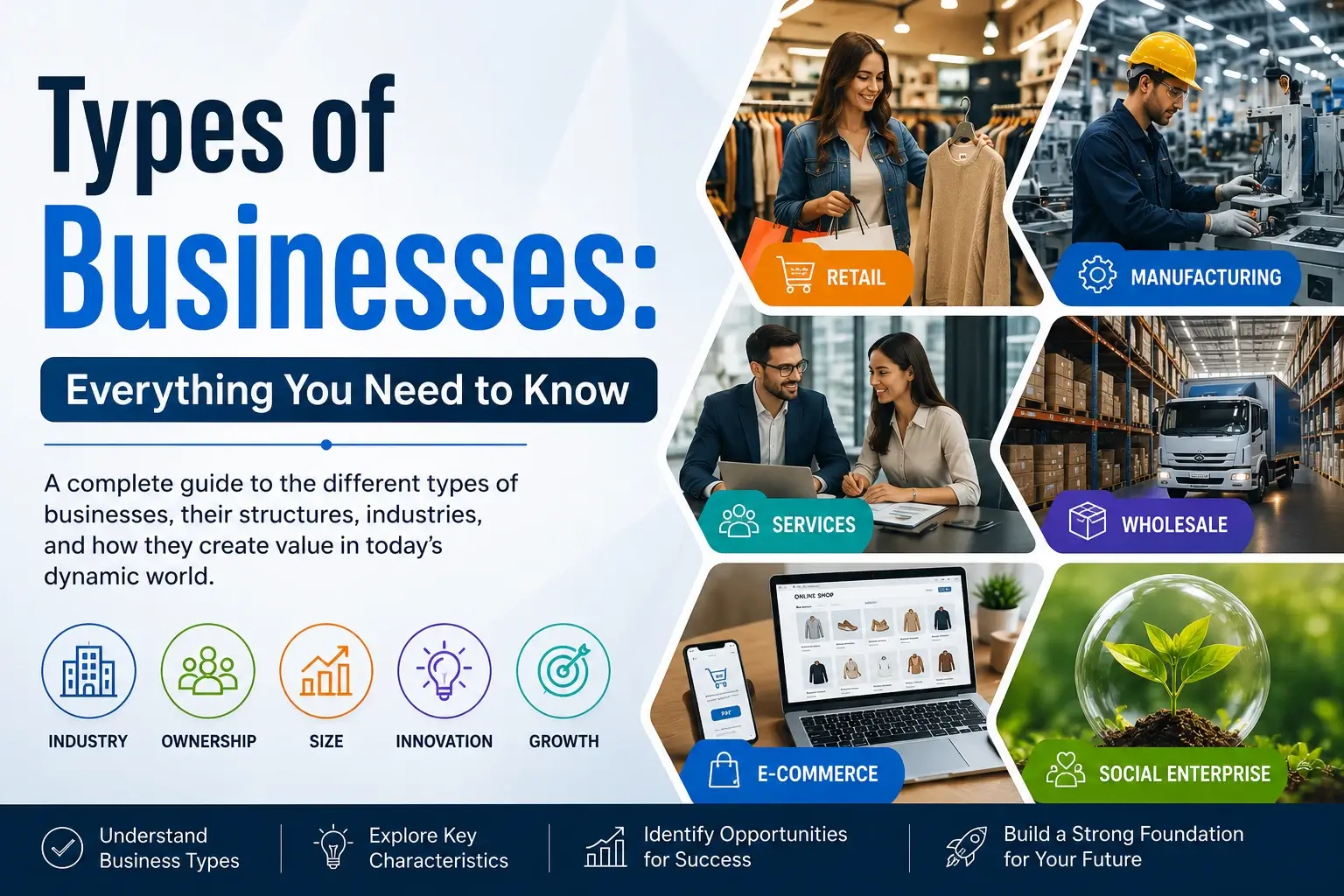
When you ask “What is a business?” the answer naturally leads to another question: “What types of businesses exist?” The business world is incredibly diverse. You can categorize businesses by their activity, their size, their legal ownership structure, and even their degree of innovation. Understanding these categories will help you decide what kind of venture to start, invest in, or work for. This guide goes deep into every major classification, providing clear examples and practical insights.
Table of Contents
Types of Businesses – A Complete Overview
🏭 Classification by Industry or Activity
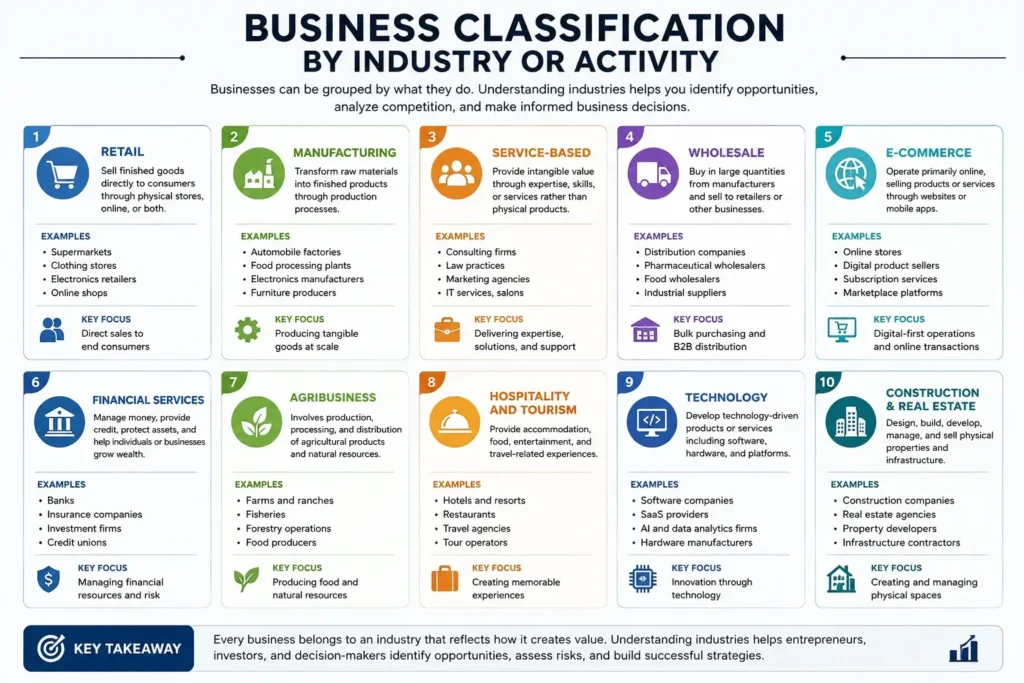
One of the most common and practical ways to classify businesses is by the industry or economic activity they perform. This method focuses on what a company actually does to create value, generate revenue, and serve its customers.
Industry classification helps entrepreneurs identify market opportunities, investors compare companies within the same sector, governments track economic activity, and consumers better understand the products and services available to them. While some organizations operate across several industries, most businesses have a primary activity that defines their place within the economy.
Understanding these industry categories provides valuable insight into business operations, competitive dynamics, growth opportunities, and market trends.
🛍️ Retail
Retail businesses sell finished products directly to consumers for personal use. They serve as the final link in the supply chain, connecting manufacturers and wholesalers with end customers.
Retailers can operate through physical stores, online platforms, or a combination of both. Modern retail has evolved significantly due to technology, with many businesses adopting omnichannel strategies that integrate online and offline shopping experiences.
Key Characteristics
- ✅ Direct customer interaction
- ✅ High focus on customer experience
- ✅ Inventory management is critical
- ✅ Revenue generated through product sales
Common Retail Formats
- 🏪 Supermarkets and Grocery Stores
- 👗 Fashion and Apparel Stores
- 📱 Electronics Retailers
- 🛒 Online Retail Platforms
- 🏠 Home Improvement Stores
- 💄 Beauty and Cosmetics Shops
Industry Challenges
- ⚠️ Intense competition
- ⚠️ Changing consumer preferences
- ⚠️ Inventory and supply chain management
- ⚠️ Increasing e-commerce disruption
Industry Opportunities
- 🚀 Personalized shopping experiences
- 🚀 Loyalty programs and customer retention
- 🚀 Expansion into online sales channels
- 🚀 Data-driven marketing strategies
🏭 Manufacturing
Manufacturing businesses convert raw materials, components, or semi-finished goods into finished products through industrial processes. This sector is often considered the backbone of economic development because it creates the goods used by consumers and businesses alike.
Manufacturing operations range from small workshops producing specialty products to massive industrial facilities serving global markets.
Key Characteristics
- ✅ Production-focused operations
- ✅ Significant investment in equipment and facilities
- ✅ Quality control systems
- ✅ Supply chain integration
Types of Manufacturing
- 🔩 Discrete Manufacturing (automobiles, electronics)
- 🍫 Process Manufacturing (food, chemicals, beverages)
- 🧵 Textile Manufacturing
- 💊 Pharmaceutical Manufacturing
- 🪑 Furniture Manufacturing
Industry Challenges
- ⚠️ Rising production costs
- ⚠️ Supply chain disruptions
- ⚠️ Labor shortages
- ⚠️ Environmental regulations
Industry Opportunities
- 🚀 Automation and robotics
- 🚀 Smart factories and Industry 4.0
- 🚀 Sustainable manufacturing practices
- 🚀 Global export markets
💼 Service-Based Businesses
Service businesses provide expertise, labor, support, or solutions rather than physical products. In many developed economies, the service sector represents the largest portion of economic activity.
Success often depends on reputation, customer relationships, professional expertise, and service quality.
Key Characteristics
- ✅ Intangible offerings
- ✅ Customer-focused delivery
- ✅ Knowledge-driven operations
- ✅ Lower inventory requirements
Examples
- ⚖️ Law Firms
- 📊 Accounting Practices
- 📣 Marketing Agencies
- 💻 IT Consultancies
- 🎨 Design Studios
- 🧹 Cleaning Services
- 🏥 Healthcare Providers
Industry Challenges
- ⚠️ Difficulty scaling expertise
- ⚠️ Dependence on skilled employees
- ⚠️ Customer retention requirements
- ⚠️ Service quality consistency
Industry Opportunities
- 🚀 Premium consulting services
- 🚀 Digital service delivery
- 🚀 Remote work capabilities
- 🚀 Specialized niche expertise
📦 Wholesale
Wholesalers purchase products in large quantities from manufacturers and distribute them to retailers, institutions, or other businesses. They play a crucial role in ensuring products move efficiently through the supply chain.
Without wholesalers, many manufacturers would struggle to reach thousands of retail locations effectively.
Key Characteristics
- ✅ Business-to-business transactions
- ✅ Bulk purchasing
- ✅ Warehousing and logistics management
- ✅ Supply chain coordination
Examples
- 🚚 Distribution Companies
- 📦 Consumer Goods Wholesalers
- 💊 Pharmaceutical Distributors
- 🍎 Food Distribution Firms
- 🛠 Industrial Supply Companies
Industry Challenges
- ⚠️ Inventory carrying costs
- ⚠️ Transportation expenses
- ⚠️ Supply chain disruptions
- ⚠️ Narrow profit margins
Industry Opportunities
- 🚀 Logistics optimization
- 🚀 Supply chain technology
- 🚀 International trade expansion
- 🚀 Value-added distribution services
🌐 E-Commerce
E-commerce businesses conduct transactions primarily through digital platforms. While many traditional businesses now sell online, some companies operate entirely without physical storefronts.
The rise of smartphones, digital payments, and global logistics networks has transformed e-commerce into one of the fastest-growing sectors worldwide.
Key Characteristics
- ✅ Online-first operations
- ✅ Global market reach
- ✅ Digital marketing dependence
- ✅ Technology-driven customer experience
Types of E-Commerce
- 🛒 B2C (Business-to-Consumer)
- 🏢 B2B (Business-to-Business)
- 👥 C2C (Consumer-to-Consumer)
- 📱 D2C (Direct-to-Consumer)
Examples
- 👕 Online Fashion Stores
- 📚 Digital Course Providers
- 🎵 Music Download Platforms
- 📦 Subscription Businesses
- 📱 Mobile Commerce Applications
Industry Challenges
- ⚠️ Cybersecurity threats
- ⚠️ High customer acquisition costs
- ⚠️ Intense online competition
- ⚠️ Logistics management
Industry Opportunities
- 🚀 Global scalability
- 🚀 Automated operations
- 🚀 AI-powered personalization
- 🚀 Subscription revenue models
💳 Financial Services
Financial service businesses manage money, facilitate transactions, provide credit, and help individuals and organizations build and protect wealth.
The sector serves as the foundation of economic activity by enabling investment, lending, and financial planning.
Key Characteristics
- ✅ Highly regulated environment
- ✅ Trust-based relationships
- ✅ Risk management focus
- ✅ Capital-intensive operations
Examples
- 🏦 Commercial Banks
- 🛡 Insurance Providers
- 📈 Investment Firms
- 💰 Wealth Management Companies
- 💳 Credit Unions
- 📉 Brokerage Firms
Industry Challenges
- ⚠️ Regulatory compliance
- ⚠️ Economic uncertainty
- ⚠️ Fraud and cybersecurity risks
- ⚠️ Market volatility
Industry Opportunities
- 🚀 FinTech innovation
- 🚀 Digital banking
- 🚀 Mobile payment systems
- 🚀 Artificial intelligence in finance
🌾 Agribusiness
Agribusiness encompasses all activities involved in producing, processing, distributing, and selling agricultural products. It extends beyond farming to include technology, logistics, manufacturing, and food production.
As global food demand continues to rise, agribusiness remains one of the world’s most essential industries.
Key Characteristics
- ✅ Resource-intensive operations
- ✅ Dependence on environmental conditions
- ✅ Long production cycles
- ✅ Complex supply chains
Examples
- 🚜 Farms and Ranches
- 🐟 Fisheries
- 🌲 Forestry Companies
- 🌽 Crop Producers
- 🥛 Dairy Businesses
- 🌱 Agricultural Technology Firms
Industry Challenges
- ⚠️ Climate change
- ⚠️ Water scarcity
- ⚠️ Commodity price fluctuations
- ⚠️ Supply chain disruptions
Industry Opportunities
- 🚀 Precision agriculture
- 🚀 Sustainable farming practices
- 🚀 Agricultural biotechnology
- 🚀 Smart irrigation systems
🏨 Hospitality and Tourism
Hospitality and tourism businesses focus on delivering experiences, comfort, entertainment, and travel-related services.
This industry contributes significantly to employment and economic development across many countries.
Key Characteristics
- ✅ Experience-driven services
- ✅ Strong customer service focus
- ✅ Seasonal demand fluctuations
- ✅ High dependence on reputation
Examples
- 🏨 Hotels and Resorts
- 🍽 Restaurants and Cafés
- ✈️ Travel Agencies
- 🗺 Tour Operators
- 🚢 Cruise Companies
- 🎟 Event Management Firms
Industry Challenges
- ⚠️ Economic downturns
- ⚠️ Travel restrictions
- ⚠️ Labor shortages
- ⚠️ Customer review management
Industry Opportunities
- 🚀 Luxury tourism
- 🚀 Eco-tourism
- 🚀 Digital booking platforms
- 🚀 Personalized travel experiences
💻 Technology
Technology businesses develop innovative solutions through software, hardware, data analytics, cloud computing, artificial intelligence, and digital infrastructure.
Technology is unique because it continuously influences and transforms nearly every other industry.
Key Characteristics
- ✅ Innovation-driven growth
- ✅ High scalability
- ✅ Rapid market evolution
- ✅ Strong research and development focus
Examples
- 🤖 Artificial Intelligence Companies
- ☁️ Cloud Computing Providers
- 🔒 Cybersecurity Firms
- 📱 Mobile App Developers
- 🖥 Hardware Manufacturers
- 📊 Data Analytics Companies
Industry Challenges
- ⚠️ Rapid technological change
- ⚠️ Talent shortages
- ⚠️ Cybersecurity threats
- ⚠️ Global competition
Industry Opportunities
- 🚀 Artificial Intelligence
- 🚀 Machine Learning
- 🚀 Internet of Things (IoT)
- 🚀 Cloud Infrastructure
- 🚀 Digital Transformation Services
🏗️ Construction and Real Estate
This sector focuses on designing, building, developing, managing, and selling physical infrastructure and properties.
Examples
- 🏗 Construction Contractors
- 🏠 Real Estate Agencies
- 🏢 Commercial Developers
- 🌉 Infrastructure Companies
- 🏘 Property Management Firms
Importance
Construction and real estate directly influence economic growth, urban development, housing availability, and business expansion.
⚡ Energy and Utilities
Energy and utility companies provide essential resources required for modern life and business operations.
Examples
- ⚡ Electricity Providers
- ☀️ Solar Energy Companies
- 💨 Wind Energy Firms
- 🚰 Water Utilities
- 🔥 Natural Gas Suppliers
- 🔋 Energy Storage Companies
Industry Trends
- 🌱 Renewable energy adoption
- 🔋 Battery technology advancements
- 🏭 Carbon reduction initiatives
- ⚙️ Smart grid development
🎯 Key Takeaway
Classifying businesses by industry or activity provides a practical framework for understanding how organizations create value and contribute to the economy. Whether a company is manufacturing products 🏭, selling goods 🛍️, providing services 💼, building technology 💻, feeding populations 🌾, or creating memorable experiences 🏨, its industry classification shapes its operations, competition, growth potential, and strategic priorities.
💡 Business Insight: Many modern organizations span multiple industries. For example, an online retailer may operate in both E-commerce 🌐 and Technology 💻, while a hotel chain combines elements of Hospitality 🏨, Retail 🛍️, and Service-Based 💼 business models. Understanding these classifications helps entrepreneurs, investors, and business professionals better navigate today’s increasingly interconnected business environment.
📏 Classification by Size
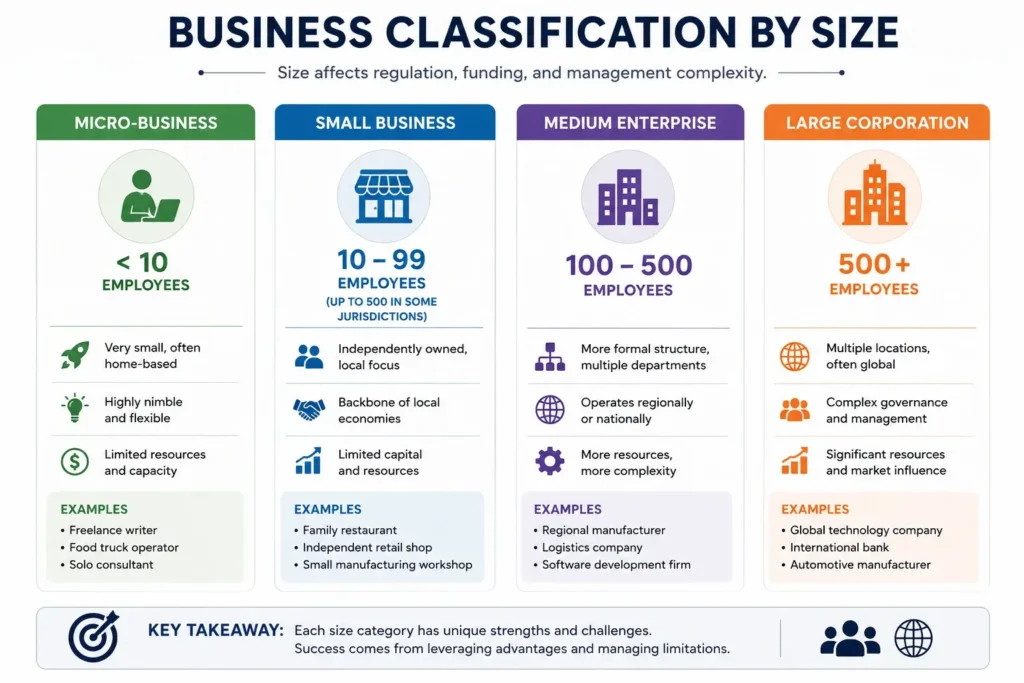
Another important way to classify businesses is by their size. Business size influences everything from management structure and regulatory requirements to financing options, growth opportunities, and market influence.
Governments, financial institutions, and economic organizations often use business size classifications when developing policies, determining tax obligations, allocating grants, or assessing economic performance. Although exact definitions vary between countries and industries, businesses generally fall into four main categories.
👤 Micro-Business
Micro-businesses are the smallest type of commercial organization, typically employing fewer than 10 people. In many cases, they are owned and operated by a single individual or a small family team.
These businesses are often highly specialized and serve local markets. Because decision-making is concentrated in one person or a small group, micro-businesses can adapt quickly to customer needs and market changes.
🔑 Key Characteristics
- ✅ Very small workforce
- ✅ Low startup and operating costs
- ✅ Direct owner involvement
- ✅ Flexible and agile operations
📌 Examples
- ✍️ Freelance Writers
- 🎨 Graphic Designers
- 📸 Photographers
- 🚚 Food Truck Operators
- 💼 Independent Consultants
- 🛠 Local Tradespeople
👍 Advantages
- 🚀 Fast decision-making
- 🚀 Strong customer relationships
- 🚀 Low bureaucracy
- 🚀 High flexibility
👎 Challenges
- ⚠️ Limited financial resources
- ⚠️ Heavy dependence on the owner
- ⚠️ Restricted growth capacity
- ⚠️ Limited economies of scale
💡 Business Insight
Many successful companies begin as micro-businesses before expanding into larger organizations. Their ability to innovate and respond quickly often gives them a competitive edge in niche markets.
🏪 Small Business
Small businesses are independently owned organizations that typically employ fewer than 100 to 500 employees, depending on the country and industry.
They are often considered the backbone of local economies because they create jobs, support communities, and stimulate economic activity.
🔑 Key Characteristics
- ✅ Independent ownership
- ✅ Local or regional market focus
- ✅ Limited management layers
- ✅ Moderate revenue and resources
📌 Examples
- 🍽 Family Restaurants
- 🛍 Independent Retail Stores
- 🔧 Repair Shops
- 🏭 Small Manufacturing Facilities
- 💻 Local IT Companies
- 🏠 Real Estate Agencies
👍 Advantages
- 🚀 Strong community connections
- 🚀 Flexible operations
- 🚀 Personalized customer service
- 🚀 Easier communication across teams
👎 Challenges
- ⚠️ Limited access to capital
- ⚠️ Strong competition from larger firms
- ⚠️ Resource constraints
- ⚠️ Dependence on key employees
🌍 Economic Importance
Small businesses account for a significant share of employment and economic activity in most countries, making them critical drivers of innovation and entrepreneurship.
🏢 Medium-Sized Enterprise (SME)
Medium-sized enterprises represent the transition between small businesses and large corporations. They typically employ between 100 and 500 people, though definitions vary by region.
At this stage, companies usually develop more formal organizational structures, specialized departments, and professional management systems.
🔑 Key Characteristics
- ✅ Multiple departments
- ✅ Professional management teams
- ✅ Regional or national operations
- ✅ Greater operational complexity
📌 Examples
- 🏭 Regional Manufacturing Companies
- 🚚 Logistics Providers
- 💻 Software Development Firms
- 🏨 Hotel Chains
- 🏗 Construction Companies
- 📦 Distribution Businesses
👍 Advantages
- 🚀 Greater financial resources
- 🚀 Improved scalability
- 🚀 Stronger market presence
- 🚀 Ability to attract specialized talent
👎 Challenges
- ⚠️ Increased bureaucracy
- ⚠️ More complex management
- ⚠️ Higher compliance requirements
- ⚠️ Greater operational costs
📈 Growth Potential
Medium-sized enterprises often represent some of the fastest-growing businesses because they combine the flexibility of smaller companies with the resources needed for expansion.
🌐 Large Corporation
Large corporations are major organizations that may employ thousands or even hundreds of thousands of people across multiple locations, regions, or countries.
These businesses often have significant market influence, substantial financial resources, and sophisticated governance structures.
🔑 Key Characteristics
- ✅ Large workforce
- ✅ Global or national operations
- ✅ Complex organizational structure
- ✅ Significant market influence
📌 Examples
- 🏦 Major Banks
- 🚗 Automotive Manufacturers
- 💻 Global Technology Companies
- ✈️ Airlines
- 🏭 Multinational Industrial Firms
- 🛒 International Retail Chains
👍 Advantages
- 🚀 Strong brand recognition
- 🚀 Access to significant capital
- 🚀 Economies of scale
- 🚀 Global market reach
- 🚀 Advanced research and development capabilities
👎 Challenges
- ⚠️ Slow decision-making processes
- ⚠️ Complex organizational structures
- ⚠️ Increased regulatory scrutiny
- ⚠️ Higher operating costs
🌎 Global Impact
Large corporations influence international markets, employment, technological innovation, and even government policy. Their decisions can affect industries and economies worldwide.
📊 Comparison at a Glance
| Size Category | Typical Employees | Scope of Operations | Management Complexity |
|---|---|---|---|
| 👤 Micro-Business | 1–9 | Local | Very Low |
| 🏪 Small Business | 10–99 (or up to 500 in some jurisdictions) | Local / Regional | Low |
| 🏢 Medium Enterprise | 100–500 | Regional / National | Moderate |
| 🌐 Large Corporation | 500+ to Thousands | National / Global | High |
🎯 Key Takeaway
Business size significantly influences how an organization operates, grows, and competes. While micro-businesses 👤 excel in flexibility and personal service, small businesses 🏪 drive local economies, medium-sized enterprises 🏢 combine scalability with agility, and large corporations 🌐 leverage extensive resources and global reach.
💡 Business Insight: Bigger does not always mean better. Each size category offers unique advantages and challenges. The most successful businesses are those that effectively leverage their size while managing the limitations that come with it.
🏛️ Classification by Ownership and Legal Structure
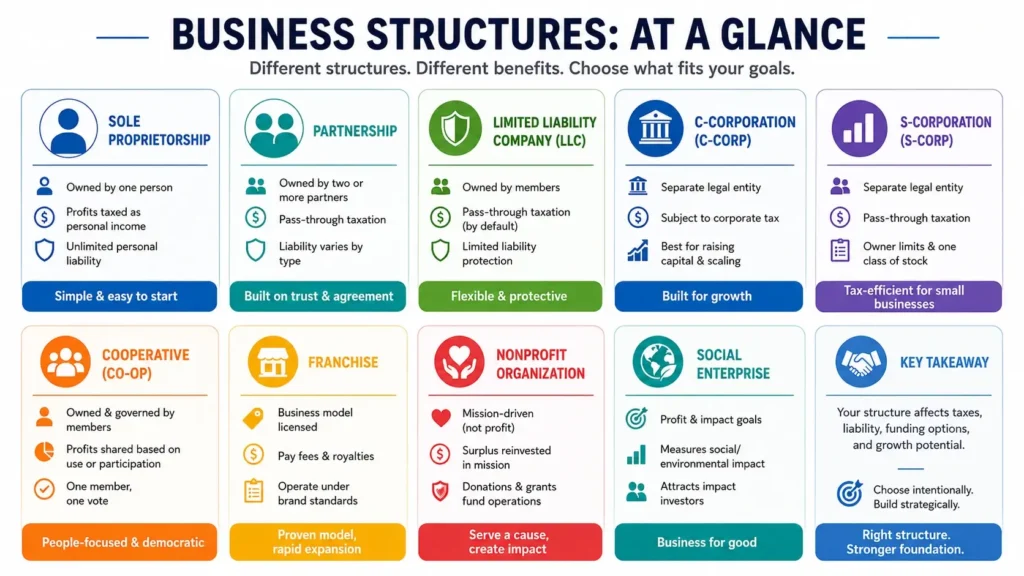
Choosing a legal structure is not just an administrative step—it is a strategic architecture decision that determines how the business behaves under law, how it scales, how it is taxed, and how risk is distributed across stakeholders.
👤 Sole Proprietorship
A non-incorporated business model where the owner and the business are legally identical.
- 🧑 Legal Identity: No separation (owner = business)
- 💰 Tax Treatment: Personal income taxation (Schedule C-style in some systems)
- ⚖️ Liability Exposure: Unlimited and direct
- 🧾 Accounting: Simple cash-based tracking is often sufficient
- 🏦 Banking: Often no separation between personal and business accounts (unless voluntarily structured)
🔍 Structural Characteristics
- No governance layer (no board, no formal oversight)
- Decision-making velocity is maximum (single decision node)
- No equity issuance capability
📌 Strategic Implications
- Suitable for low-risk, low-capital intensity operations
- Scaling is constrained because:
- No external equity investment structure
- Debt financing is often personally guaranteed
- Business continuity is fragile (ends with owner exit unless transferred)
🤝 Partnership
A contractually governed multi-owner business structure.
- 👥 Legal Basis: Partnership agreement (critical governing instrument)
- 💰 Taxation: Pass-through (profits allocated to partners)
- ⚖️ Liability: Varies by subtype
🔹 Governance Architecture
- Shared fiduciary responsibility among partners
- Authority typically proportional to agreement (not necessarily equal ownership)
- Capital accounts track contributions and withdrawals
🔹 Advanced Types
- General Partnership (GP): Full agency and full liability
- Limited Partnership (LP): Separation of control vs capital risk
- Limited Liability Partnership (LLP): Partial liability shielding for professional services firms
🔍 Strategic Implications
- High trust dependency structure (relational governance matters)
- Common in:
- Professional services (law, audit, consulting)
- Investment vehicles (private equity, real estate syndicates)
⚠️ Structural Weakness
- “Agency conflict risk”: one partner’s actions can bind others legally in GP structures
🏢 Limited Liability Company (LLC)
A statutory hybrid entity combining corporate liability shielding with partnership tax flow-through.
- 🧑🤝🧑 Owners: Members
- 🏛️ Legal Status: Separate legal personhood (in most jurisdictions)
- 💰 Taxation: Default pass-through; optional corporate taxation election
🔹 Governance Models
- Member-managed LLC: decentralized control
- Manager-managed LLC: delegated executive control layer (similar to corporate structure)
🔹 Capital Structure Flexibility
- Non-uniform ownership percentages allowed
- Special allocations of profit/loss permitted (depending on jurisdiction rules)
- No mandatory share class system like corporations
🔍 Strategic Implications
- Highly optimized for:
- SMEs requiring liability protection without heavy compliance burden
- Venture-stage “pre-corporate” structures in some markets
- Often used as a stepping stone entity before incorporation
🏛️ Corporation (C-Corp / S-Corp)
A fully independent juridical entity with perpetual existence.
- 🏢 Legal Identity: Separate from shareholders
- 🧾 Governance System: Hierarchical (Shareholders → Board → Executives)
- ♾️ Continuity: Perpetual unless dissolved
💼 C-Corporation (C-Corp)
🔹 Financial Architecture
- Subject to entity-level taxation + dividend taxation
- Unlimited reinvestment capacity (no requirement to distribute profits)
🔹 Capital Markets Function
- Can issue:
- Common stock
- Preferred stock
- Convertible instruments
- Primary vehicle for:
- Venture capital funding
- IPO pathways
🔍 Strategic Implications
- Designed for scale, not simplicity
- Preferred for:
- High-growth startups
- Multinational expansion
- Institutional fundraising
📉 S-Corporation (S-Corp)
🔹 Tax Optimization Structure
- Pass-through taxation
- Avoids corporate double taxation
🔹 Constraints
- Shareholder limits (jurisdiction-dependent)
- Restrictions on foreign ownership in many systems
- Typically limited to one class of stock
🔍 Strategic Implications
- Efficient for:
- Owner-operated companies with moderate growth
- Tax optimization for small shareholder groups
🧑🤝🧑 Cooperative (Co-op)
A member-governed economic democracy model.
- 🗳️ Voting Power: One member = one vote (non-capital weighted)
- 📊 Economic Logic: Patronage-based surplus distribution
- 🏛️ Legal Identity: Varies by jurisdiction but typically a distinct entity type
🔹 Economic Mechanics
- Surplus = revenue − operational cost
- Surplus is:
- redistributed
- reinvested
- or allocated to reserves
🔹 Governance Complexity
- Requires:
- formal bylaws
- member assemblies
- democratic decision cycles
🔍 Strategic Implications
- Optimized for:
- networked participants with shared interest
- reducing intermediary extraction (e.g., agricultural markets, finance)
🏷️ Franchise
A contract-based replication system of a proven business model.
- 🏢 Franchisor: Owns IP, systems, brand
- 🏪 Franchisee: Operates local unit under contract
🔹 Structural Economics
- Initial franchise fee (entry cost)
- Ongoing royalty (% of revenue or fixed fee)
- Mandatory operational standards (SOP enforcement)
🔹 Control Layer
- Brand compliance enforcement mechanisms:
- audits
- operational inspections
- supply chain constraints
🔍 Strategic Implications
- Functions as a scalable distributed execution model
- Ideal for:
- standardized consumer services
- rapid geographic expansion
🌱 Nonprofit Organization
A purpose-constrained entity where surplus is legally non-distributable.
- 🎯 Primary Objective: Mission fulfillment (not profit maximization)
- 💰 Revenue Sources: Donations, grants, service fees
- 🏛️ Governance: Board fiduciary duty to mission
🔹 Financial Structure
- Surplus reinvestment requirement
- Restricted vs unrestricted funding streams
- Compliance-heavy reporting obligations
🔍 Strategic Implications
- Strong in:
- public goods provision
- social services
- advocacy systems
- Weakness:
- dependence on external funding cycles
🌍 Social Enterprise
A dual-objective organizational model integrating profit logic with measurable impact mandates.
- 💡 Core Duality: Financial sustainability + social/environmental outcomes
- 📊 Measurement Layer: Impact KPIs (ESG, SROI, SDG alignment)
- 🏗️ Legal Forms: Benefit Corporation, CIC, hybrid LLC structures
🔹 Capital Structure Behavior
- Can attract:
- impact investors
- ESG funds
- blended finance instruments
🔹 Governance Evolution
- Expands fiduciary duty beyond shareholders to stakeholders
🔍 Strategic Implications
- Represents post-traditional capitalism architecture
- Optimized for:
- sustainability markets
- ethical supply chains
- climate-tech and development sectors
🚀 Classification by Innovation Level
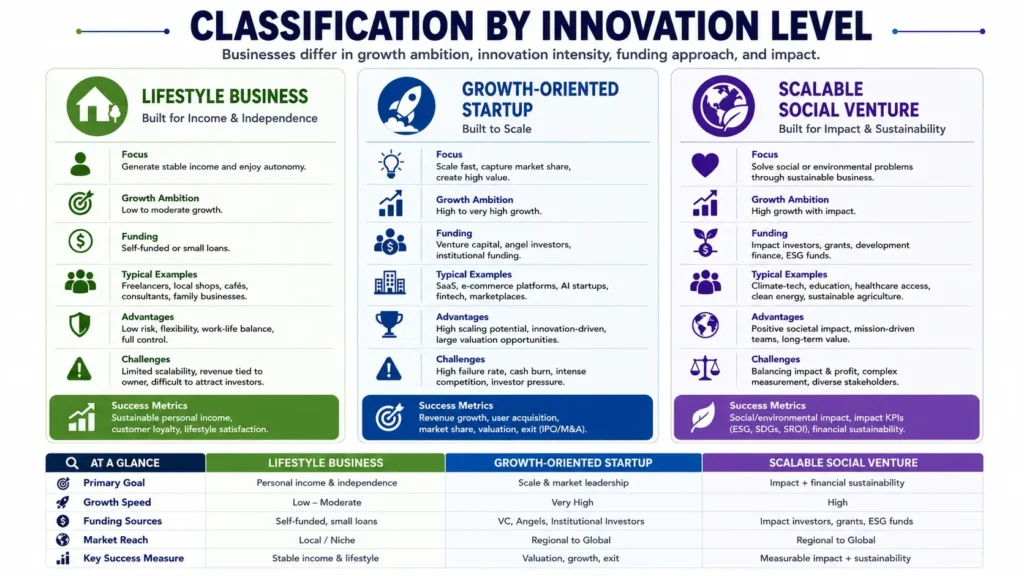
Businesses can also be classified based on their innovation intensity, growth ambition, scalability, and impact potential. This framework helps distinguish businesses designed for stability from those built for rapid expansion or societal transformation.
🌱 Lifestyle Business
“Built for Income & Independence”
A lifestyle business is created primarily to provide a stable and comfortable living for its owner rather than achieving rapid growth or market dominance.
🔑 Key Characteristics
- 👤 Owner-centric operation
- 💰 Focus on consistent income generation
- 🏠 Often locally or niche market focused
- 📉 Limited scalability ambitions
- 💵 Usually self-funded or financed through small business loans
- ⚡ Fast decision-making due to simple ownership structure
🛠 Typical Examples
- 🎨 Freelance designers
- 📷 Photography studios
- ☕ Local cafés
- 🏋️ Personal training businesses
- 💻 Independent consultants
✅ Advantages
- ✔ Full control and autonomy
- ✔ Lower operational complexity
- ✔ Better work-life balance
- ✔ Reduced pressure from investors
⚠ Challenges
❌ Revenue often tied to owner’s involvement
❌ Limited scalability
❌ Difficult to attract institutional investment
❌ Business continuity may depend on owner
📊 Success Metrics
💰 Personal income
😊 Lifestyle satisfaction
🤝 Customer loyalty
📈 Stable profitability
📈 Growth-Oriented Startup
“Built to Scale”
A growth-oriented startup is designed to grow rapidly by leveraging innovation, technology, and scalable business models. The objective is often to achieve significant market share and create substantial enterprise value.
🔑 Key Characteristics
- 🚀 High-growth mindset
- 💡 Innovation-driven products or services
- 🌎 Large addressable market
- 📱 Technology-enabled scalability
- 💸 Venture capital or angel investment funding
- 🎯 Focus on rapid customer acquisition
🛠 Typical Examples
- 📱 SaaS companies
- 🛒 E-commerce platforms
- 🤖 AI startups
- 🏦 FinTech ventures
- 🚚 Logistics technology platforms
💰 Funding Sources
- 👼 Angel investors
- 💼 Venture capital firms
- 🏢 Corporate investors
- 💵 Seed and Series A/B/C funding rounds
✅ Advantages
- ✔ Rapid expansion potential
- ✔ Large valuation opportunities
- ✔ Access to investment capital
- ✔ Ability to disrupt industries
⚠ Challenges
- ❌ High failure rates
- ❌ Intense competition
- ❌ Investor pressure for growth
- ❌ Cash burn and funding dependency
🎯 Exit Objectives
- 🏆 IPO (Initial Public Offering)
- 🤝 Acquisition by larger company
- 💰 Strategic sale
- 📈 Long-term market leadership
📊 Success Metrics
- 🚀 Revenue growth
- 👥 User acquisition
- 📈 Market share
- 💎 Company valuation
🌍 Scalable Social Venture
“Built for Impact & Sustainability”
A scalable social venture combines business principles with a mission to solve social or environmental challenges. It seeks both financial sustainability and measurable positive impact.
🔑 Key Characteristics
- ❤️ Mission-driven purpose
- 💼 Revenue-generating model
- 🌱 Social and environmental objectives
- 📊 Impact measurement systems
- 🤝 Stakeholder-centered governance
- ♻ Sustainable growth strategy
🛠 Typical Examples
- 🌳 Climate-tech companies
- 📚 Education technology for underserved communities
- 🏥 Affordable healthcare solutions
- 💧 Clean water initiatives
- 🌾 Sustainable agriculture platforms
💰 Funding Sources
- 🌍 Impact investors
- 🏦 Development finance institutions
- 🎁 Grants and philanthropic funding
- 📈 ESG-focused investment funds
✅ Advantages
- ✔ Creates meaningful societal impact
- ✔ Attracts mission-aligned investors
- ✔ Strong brand trust and reputation
- ✔ Long-term sustainability focus
⚠ Challenges
- ❌ Balancing mission and profitability
- ❌ Impact measurement complexity
- ❌ Longer growth timelines
- ❌ Diverse stakeholder expectations
📊 Success Metrics
- 🌍 Lives improved
- ♻ Environmental outcomes
- 📈 Financial sustainability
- 🎯 Impact KPIs (ESG, SDGs, SROI)
📊 Innovation-Level Comparison
| Aspect | 🌱 Lifestyle Business | 📈 Growth Startup | 🌍 Social Venture |
|---|---|---|---|
| 🎯 Primary Goal | Personal income | Rapid scaling | Impact + sustainability |
| 🚀 Growth Ambition | Low–Moderate | Very High | High |
| 💰 Funding | Self-funded, loans | VC, Angels, PE | Impact funds, grants |
| 📈 Scalability | Limited | Extremely High | High |
| 💡 Innovation Requirement | Low–Moderate | High | High |
| ⚠ Risk Level | Moderate | High | Moderate–High |
| 🌎 Market Reach | Local/Niche | Regional to Global | Regional to Global |
| 🏆 Success Measure | Stable income | Valuation & growth | Measurable impact + profit |
| ⏳ Time Horizon | Long-term stability | Fast growth | Sustainable transformation |
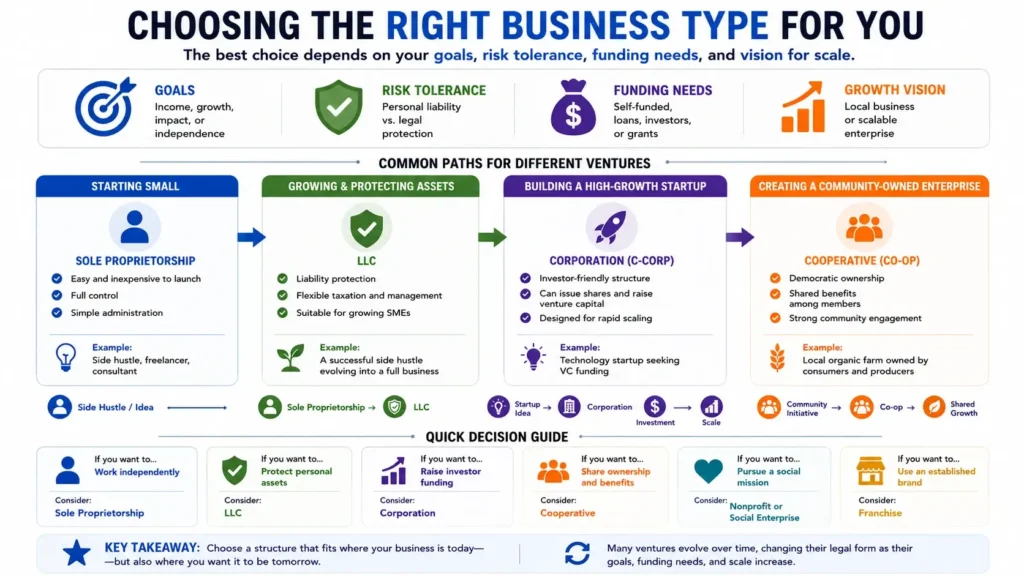
🎯 Choosing the Right Business Type for You
There is no one-size-fits-all structure.
The best choice depends on your:
🎯 Goals – Income, growth, impact, or independence
⚖️ Risk Tolerance – Personal liability vs. legal protection
💰 Funding Needs – Self-funded, loans, investors, or grants
📈 Growth Vision – Local business or scalable enterprise
🌱 Starting Small
Best Fit: Sole Proprietorship
✅ Easy and inexpensive to launch
✅ Full control and simple administration
⚠️ Personal liability remains high
Example: Side hustle, freelancer, consultant
🛡️ Growing & Protecting Assets
Best Fit: LLC
✅ Liability protection
✅ Flexible taxation and management
✅ Suitable for growing SMEs
Example: A successful side hustle evolving into a full business
Typical Path:
🌱 Sole Proprietorship ➜ 🛡️ LLC
🚀 Building a High-Growth Startup
Best Fit: Corporation (C-Corp)
✅ Investor-friendly structure
✅ Can issue shares and raise venture capital
✅ Designed for rapid scaling
Example: Technology startup seeking VC funding
Typical Path:
💡 Startup Idea ➜ 🏢 Corporation ➜ 💰 Investment ➜ 📈 Scale
🤝 Creating a Community-Owned Enterprise
Best Fit: Cooperative (Co-op)
✅ Democratic ownership
✅ Shared benefits among members
✅ Strong community engagement
Example: Local organic farm owned by consumers and producers
Typical Path:
🌾 Community Initiative ➜ 🤝 Co-op ➜ 🌱 Shared Growth
📌 Quick Decision Guide
| If You Want To… | Consider |
|---|---|
| 👤 Work independently | Sole Proprietorship |
| 🛡️ Protect personal assets | LLC |
| 🚀 Raise investor funding | Corporation |
| 🤝 Share ownership and benefits | Cooperative |
| ❤️ Pursue a social mission | Nonprofit or Social Enterprise |
| 🏪 Use an established brand | Franchise |
💡 Key Takeaway
Choose a structure that fits where your business is today—but also where you want it to be tomorrow. Many ventures evolve over time, changing their legal form as their goals, funding needs, and scale increase. 🚀
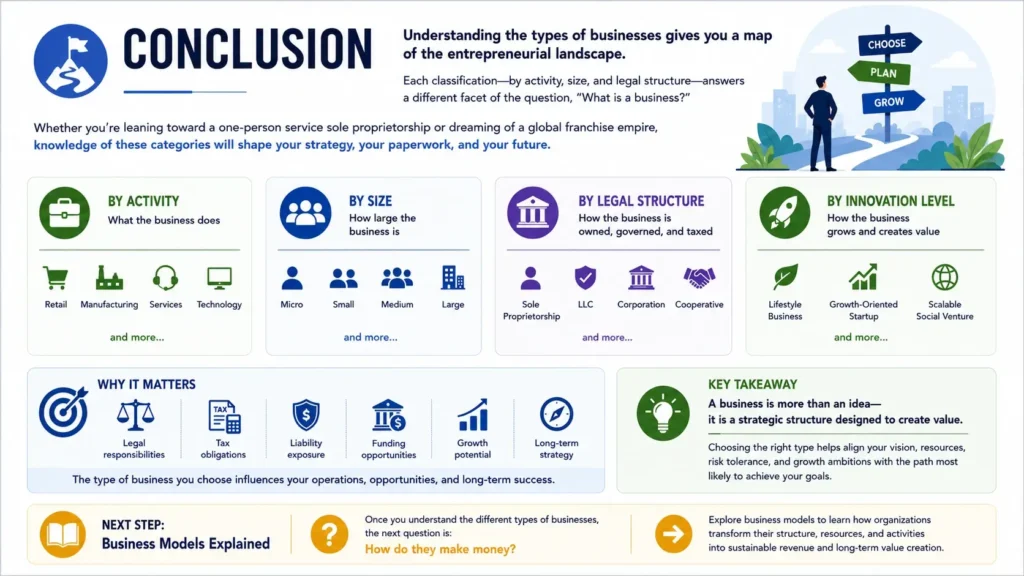
🎯 Conclusion
Understanding business types provides a roadmap for navigating the entrepreneurial landscape. Each classification offers a different perspective on what a business is and how it operates:
📦 By Activity → What the business does
📊 By Size → How large the business is
🏛️ By Legal Structure → How the business is owned, governed, and taxed
🚀 By Innovation Level → How the business grows and creates value
💡 Why It Matters
The type of business you choose influences:
⚖️ Legal responsibilities
💰 Tax obligations
🛡️ Liability exposure
🏦 Funding opportunities
📈 Growth potential
🎯 Long-term strategy
🛤️ Your Business Journey
Whether you are:
👨💻 Starting a solo service business
🏪 Opening a local retail store
🚀 Launching a high-growth startup
🤝 Building a cooperative enterprise
🌍 Creating a social-impact venture
🏢 Expanding into a franchise network
the structure you choose will shape your operations, opportunities, and future success.
🔑 Key Takeaway
A business is more than an idea—it is a strategic structure designed to create value.
Choosing the right type helps align your vision, resources, risk tolerance, and growth ambitions with the path most likely to achieve your goals.
References
- U.S. Small Business Administration (SBA). Choose a Business Structure.
U.S. Small Business Administration (SBA) - Internal Revenue Service (IRS). Business Structures.
Internal Revenue Service (IRS) - World Bank. Small and Medium Enterprises (SMEs) Finance.
World Bank - Organisation for Economic Co-operation and Development (OECD). SMEs and Entrepreneurship.
OECD - Encyclopaedia Britannica. Business Organization.
Encyclopaedia Britannica - International Labour Organization (ILO). Enterprises and Employment.
International Labour Organization (ILO) - Harvard Business Review (HBR). Business and Management Resources.
Harvard Business Review (HBR) - Investopedia. Business: Definition, Types, and Examples.
Investopedia - Forbes. Entrepreneurship and Business Articles.
Forbes - Entrepreneur. Business Planning and Startup Resources.
Entrepreneur Magazine

 Inar Learn