
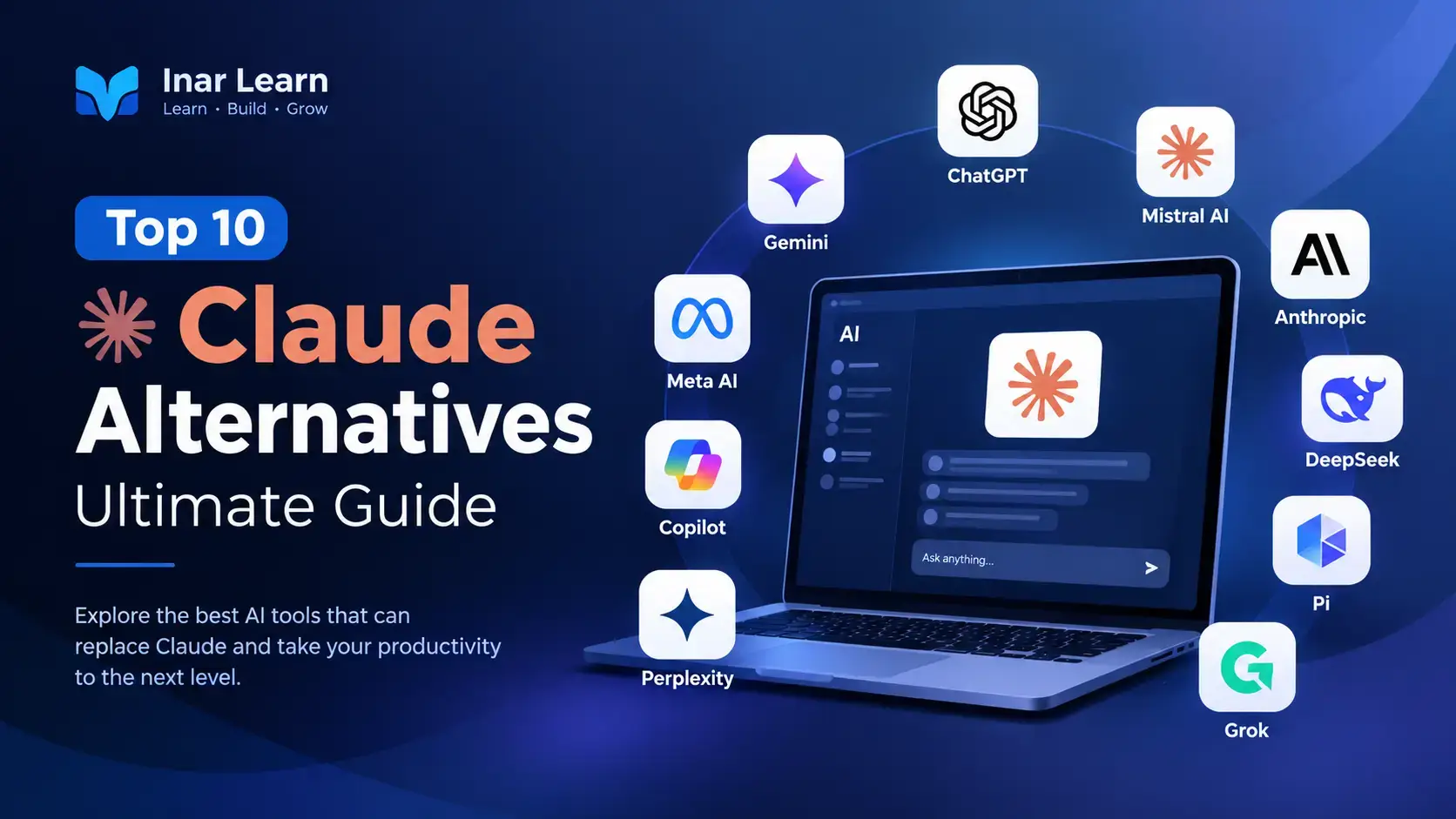
Anthropic’s Claude is one of the strongest general-purpose AI assistants in 2026, particularly for long-document analysis, nuanced writing, and agentic coding. With the Claude 5.5 family (Opus 5.5, Sonnet 5.5, and Haiku 5.5), Anthropic has pushed frontier reasoning and coding benchmarks. Claude remains the top choice for many developers and knowledge workers who value consistent tone, safety, and a 200K–1M token context window.
But Claude is not the right fit for everyone. Usage limits on the $20 Pro plan can feel restrictive, there is no free access to Opus‑class models, and the ecosystem is smaller than OpenAI’s or Google’s. Organisations that need real-time web data, a 10‑million‑token context window, self‑hosted open‑weights, or a deeply integrated productivity suite often look at Claude Alternatives. This guide covers the ten strongest options in 2026 across consumer chat, API, and enterprise deployment.
The best Claude alternative depends on your priority: ChatGPT for the broadest ecosystem and deep research, Google Gemini for a 1M‑token multimodal context and Google Workspace integration, Grok for real‑time X/web data, Meta Llama for self‑hosted open‑weights, and DeepSeek for the lowest‑cost frontier‑class API.
Why Look Beyond Claude?
Claude is an excellent product, but its pricing structure, usage caps, and model‑access policy create friction for certain workflows. These are the most common reasons teams evaluate Claude alternatives.
Usage limits and pricing uncertainty
Claude’s Free tier is severely limited, and the Pro plan at $20/month imposes a rolling five‑hour session cap plus a weekly limit[reference:0]. Heavy users often hit these ceilings, especially when working with Opus‑class models. The Max plans at $100 and $200/month remove some limits but raise the cost substantially[reference:1]. For teams that need predictable, high‑volume usage, alternatives such as DeepSeek or Llama offer dramatically lower per‑token pricing.
No self‑hosted or open‑weight option
Claude is a closed, API‑only model. Organisations with strict data‑residency requirements, air‑gapped environments, or a need to fine‑tune on proprietary data cannot run Claude inside their own infrastructure. Meta Llama 4 and Mistral Large 3 provide open weights that can be self‑hosted, while DeepSeek offers extremely low‑cost API access for cost‑sensitive workloads[reference:2].
Smaller ecosystem and no real‑time data
Claude does not have a native real‑time web‑search product comparable to Grok’s X integration or Perplexity’s cited answer engine. Its consumer app also lacks the deep productivity‑suite integration that Microsoft Copilot has with Microsoft 365 or that Gemini has with Google Workspace. Teams that need current information or in‑app assistance often pair Claude with another tool — or switch entirely.
If you prioritise writing quality, long‑document reasoning, safety‑focused outputs, and a clean API with strong coding performance, Claude remains excellent. This guide to Claude alternatives is for teams that have hit a specific limit — cost, context, deployment model, or ecosystem — and need a different trade‑off.
Comparison Table: All 10 at a Glance
Use this table to narrow your shortlist before reading the detailed profiles. It compares the most important Claude alternatives across type, free access, entry pricing, and best‑fit use case.
| Tool | Type | Free Tier | Paid From | Best For |
|---|---|---|---|---|
| ChatGPT | Chat + API | Yes (limited GPT‑5.2) | $20/mo Plus | Broadest ecosystem, deep research, plugins |
| Google Gemini | Chat + API | Yes (Flash models) | $20/mo AI Pro | 1M‑token context, multimodal, Google Workspace |
| Grok | Chat + API | Yes (limited) | $30/mo SuperGrok | Real‑time X/web data, social analytics |
| Meta Llama 4 | Open‑weight model | Self‑hosted | Free (infra costs) | Data sovereignty, fine‑tuning, 10M context |
| DeepSeek | Chat + API | Yes (web chat) | ~$0.27/M input | Lowest‑cost frontier reasoning and coding |
| Microsoft Copilot | Productivity suite | Yes (limited) | $30/user/mo | Microsoft 365 integration, enterprise compliance |
| Perplexity AI | Answer engine | Yes (limited) | $20/mo Pro | Cited research, real‑time web answers |
| Mistral AI (Le Chat) | Chat + API | Yes (limited) | ~$1.50/M input | European data sovereignty, open weights |
| Cohere (Command) | Enterprise API | Free trial | Custom | RAG, enterprise search, private deployment |
| Poe | Multi‑model aggregator | Yes (limited) | $20/mo | Access multiple models in one interface |
Recommended Claude Alternatives
Before the detailed profiles, here is the short answer. Each card maps a specific priority — ecosystem, context length, real‑time data, cost, or deployment control — to the Claude alternative that fits it best.
ChatGPT
For most individuals and teams switching away from Claude, ChatGPT is the strongest overall replacement. GPT‑5.2 delivers competitive reasoning and coding, the plugin and GPT ecosystem is unmatched, and Deep Research produces cited reports that Claude cannot yet match. The free tier is genuinely usable, and the $20 Plus plan removes the most painful limits.
See the full ChatGPT profilePick by Priority Among Claude Alternatives
ChatGPT
GPT‑5.2, Deep Research, custom GPTs, plugins, and the largest third‑party integration ecosystem. The safest default for general‑purpose work.
Jump to ChatGPTGoogle Gemini
Gemini 4 Argon supports a unified 1M‑token context, native multimodal input, and deep Google Workspace integration. Ideal for large codebases and document sets.
Jump to GeminiGrok
Built‑in X (Twitter) and web search, aggressive pricing on the 2M‑token Fast variant, and strong reasoning in thinking mode. Best for social and news analysis.
Jump to GrokMeta Llama 4
Self‑host Llama 4 Scout or Maverick for full data control, fine‑tuning, and context windows up to 10 million tokens. No vendor lock‑in.
Jump to LlamaDeepSeek
Frontier‑class reasoning at a fraction of Claude’s API price. DeepSeek V3 costs ~$0.27 per million input tokens, with off‑peak discounts that push costs even lower.
Jump to DeepSeekMicrosoft Copilot
Native integration across Word, Excel, Outlook, and Teams. Enterprise compliance and Microsoft Graph grounding. The default for Microsoft‑centric organisations.
Jump to CopilotMost teams do not need to replace Claude entirely. A common 2026 workflow is ChatGPT for general reasoning and plugins, Gemini for large‑context document work, and Claude for writing‑heavy tasks where its tone remains best‑in‑class. Test two alternatives side by side on your real workload before committing.
ChatGPT
OpenAI’s flagship assistant remains the most direct Claude alternative for general reasoning, production use, and the broadest third‑party ecosystem. GPT‑5.2 dominates industry benchmarks and powers Deep Research, custom GPTs, and a vast plugin marketplace.
Key Features
- GPT‑5.2 with 272K context and 128K output — strong general reasoning and coding
- Deep Research: autonomous multi‑step browsing that cites sources and exports reports
- Custom GPTs and a mature plugin ecosystem for domain‑specific workflows
- Canvas and live preview for coding and document editing
- Memory and custom instructions for personalised responses
Why Consider It?
ChatGPT is the most direct drop‑in replacement for Claude across general knowledge work. Where Claude often leads on writing nuance and long‑document safety, GPT‑5.2 is stronger on deep research, plugin breadth, and the sheer number of third‑party tools that integrate with the OpenAI API. The free tier is genuinely usable, and the $20 Plus plan provides generous access to GPT‑5.2 Thinking. For teams building AI‑first products or complex agentic workflows, OpenAI’s developer ecosystem is the most mature in the industry[reference:3].
Advantages
- Broadest plugin and GPT ecosystem
- Deep Research with cited, exportable reports
- Usable free tier and generous Plus limits
- Strong developer tooling and API maturity
- Memory and personalisation across sessions
Limitations
- Occasionally over‑optimises and changes code you did not ask it to touch
- Less consistent tone than Claude for sensitive or legal content
- Pro tier is expensive at $200/month
- Closed‑source, no self‑hosting
Key Differences from Claude
Claude leads on writing quality, tone consistency, and long‑form coherence. ChatGPT leads on ecosystem breadth, deep research, and plugin availability. Claude’s Team and Enterprise plans offer strong privacy guarantees with no training on your data by default; ChatGPT Enterprise provides similar guarantees but at a different price point. Claude’s Pro plan caps usage at a rolling five‑hour session plus a weekly limit; ChatGPT Plus is more generous for general chat but can throttle during peak periods.
Feature Comparison
| Feature | ChatGPT | Claude |
|---|---|---|
| Free tier | Yes (GPT‑5.2 Instant) | Yes (limited) |
| Entry paid price | $20/mo Plus | $20/mo Pro |
| Context window | 272K tokens | 200K–1M tokens |
| Deep Research | Yes, cited reports | No native equivalent |
| Plugin ecosystem | Large | Smaller |
| Writing quality | Strong | Best‑in‑class |
Best Use Cases
- General‑purpose knowledge work and brainstorming
- Deep research with cited sources
- Building AI‑first products with a mature API
- Teams that need a large plugin and GPT ecosystem
Compatibility & Migration
ChatGPT is a standalone web and mobile app with a REST API. There is no direct import of Claude conversations. Migration is conceptual: teams typically recreate prompts and workflows in ChatGPT’s interface. The API is OpenAI‑compatible, so applications already built on the OpenAI SDK can switch models with minimal changes.
🔒 Security & Privacy
SOC 2 compliance, enterprise data controls, and no training on business data by default on paid plans. Zero data retention options available for API.
🔌 Integrations
Custom GPTs, plugins, Zapier, Microsoft Teams, Slack, and a vast third‑party integration ecosystem. API supports function calling and structured outputs.
💬 Customer Support
Help centre, email support, and priority support for Enterprise. Active developer community and extensive documentation.
Google Gemini
Google’s frontier model has become a genuine performance leader with Gemini 4 Argon: a unified 1‑million‑token context window, native multimodal input, and deep integration with Google Workspace, Search, and Cloud.
Key Features
- Unified 1M‑token context window for input and output — ideal for entire codebases or large document sets
- Native text, image, audio, and video processing
- Deep integration with Google Workspace (Docs, Sheets, Gmail) and Google Search
- Competitive API pricing: $2/M input and $10/M output for Argon (introductory)
- Adjustable thinking levels (low, medium, high) for latency‑sensitive workloads
Why Consider It?
Gemini’s 1M‑token context is a genuine differentiator for workflows that involve entire repositories, hour‑long meeting recordings, or multi‑hundred‑page legal documents. Where Claude often requires chunking, Gemini can ingest the full artefact in one pass. Its multimodal capabilities are also broader: native video understanding is not available in Claude. For teams already embedded in Google Workspace, Gemini appears directly in Docs, Sheets, and Gmail, reducing context switching. The Flash variants are exceptionally cheap for high‑volume workloads[reference:4][reference:5].
Advantages
- 1M‑token unified context window
- Native multimodal including video
- Deep Google Workspace integration
- Aggressive API pricing, especially Flash
- Strong on large‑context reasoning
Limitations
- Outputs can be verbose and less precise at sentence‑level reasoning
- Slightly behind Claude and GPT‑5 on complex debugging
- Privacy posture is less strong than Claude’s for sensitive content
- Consumer app experience is less polished than ChatGPT
Key Differences from Claude
Claude’s context window is typically 200K–1M tokens depending on the model; Gemini offers a unified 1M tokens across input and output. Claude leads on writing quality and tone consistency; Gemini leads on multimodal breadth and Google ecosystem integration. Claude’s Enterprise plan offers stronger default privacy guarantees; Gemini’s data‑use policies vary by tier. Claude’s Pro plan caps usage; Gemini AI Pro is more generous for general chat but may throttle advanced features.
Feature Comparison
| Feature | Gemini | Claude |
|---|---|---|
| Context window | 1M unified tokens | 200K–1M tokens |
| Video understanding | Native | No |
| Workspace integration | Docs, Sheets, Gmail | Limited |
| API input price | $2/M (Argon intro) | $4/M (Opus 5.5) |
| Writing quality | Good | Best‑in‑class |
Best Use Cases
- Analysing entire codebases or large document sets
- Processing video and audio alongside text
- Teams embedded in Google Workspace
- High‑volume, cost‑sensitive API workloads with Flash
Compatibility & Migration
Gemini is accessible through a web app, mobile app, Google Workspace sidebar, and REST API. There is no conversation import from Claude. For developers, the Gemini API is not OpenAI‑compatible, so existing code that targets the OpenAI SDK requires an adapter or a switch to the Google AI SDK.
🔒 Security & Privacy
Google Cloud enterprise security, data‑residency options, and VPC Service Controls. Consumer data may be used for training depending on settings; enterprise tiers offer stronger guarantees.
🔌 Integrations
Google Workspace, Google Search, Android, Google Cloud, and Vertex AI. API supports function calling, grounding, and multimodal inputs.
💬 Customer Support
Google Cloud support for enterprise customers. Community forums and documentation for developers. Consumer support via Google One.
Grok
xAI’s Grok has established itself as the go‑to assistant for real‑time information. Built‑in X (Twitter) and web search, a 2M‑token Fast variant, and strong reasoning make it the best Claude alternative for social analytics and current‑events research.
Key Features
- Built‑in real‑time X (Twitter) and web search — no separate plugin required
- Grok 4.1 Fast variant with a 2M‑token context window at aggressive pricing ($0.20 input / $0.50 output per million tokens)
- Thinking mode that ranks near the top on LM Arena reasoning benchmarks
- Deep integration with the X platform for social‑media analysis
- API access with server‑side search tools for real‑time grounding
Why Consider It?
Claude has no native real‑time web‑search product comparable to Grok’s X integration. If your work depends on current events, social sentiment, or breaking news, Grok is the most direct Claude alternative. Its 2M‑token Fast variant also offers a compelling price‑to‑context ratio for long‑document tasks where current information matters. For social‑media teams, brand monitoring, and newsroom workflows, Grok is purpose‑built in a way that Claude is not[reference:6][reference:7].
Advantages
- Real‑time X and web search built in
- 2M‑token Fast variant at low cost
- Strong reasoning in thinking mode
- Deep social‑media analytics capability
- Useful for breaking‑news and trend analysis
Limitations
- Enterprise tooling and compliance documentation less mature
- Less suitable for safety‑critical or regulated content
- Search and X‑search calls are billed separately
- Smaller third‑party ecosystem than OpenAI or Google
Key Differences from Claude
Grok’s defining advantage is real‑time data; Claude’s is writing quality and long‑document reasoning. Grok’s context window can reach 2M tokens on the Fast variant; Claude typically offers 200K–1M. Grok is less conservative on sensitive topics, while Claude is deliberately safety‑focused. Grok’s enterprise compliance posture is less mature than Anthropic’s, which matters for regulated industries.
Feature Comparison
| Feature | Grok | Claude |
|---|---|---|
| Real‑time search | Built‑in X + web | No native search |
| Context window | Up to 2M tokens | 200K–1M tokens |
| Writing quality | Good | Best‑in‑class |
| Enterprise compliance | Less mature | Strong |
| Free tier | Yes, limited | Yes, limited |
Best Use Cases
- Real‑time news and social‑media analysis
- Brand monitoring and sentiment tracking on X
- Long‑document work where current data is essential
- Research that depends on breaking information
Compatibility & Migration
Grok is available through the web, the X platform, and an API. There is no conversation import from Claude. The API uses its own schema; developers migrating from Claude’s API will need to adapt request and response handling.
🔒 Security & Privacy
Standard cloud security. X integration raises unique data‑handling considerations. Enterprise compliance certifications are less extensive than Anthropic’s or OpenAI’s.
🔌 Integrations
X platform, web search, and API. Server‑side search tools for real‑time grounding. Fewer third‑party plugins than ChatGPT.
💬 Customer Support
Documentation and community support. Enterprise support options are available but less mature than competitors.
Meta Llama 4
The leading open‑weight model family for teams that need full control. Llama 4 Scout supports a 10‑million‑token context window, Llama 4 Maverick delivers commercial‑grade quality, and both can be self‑hosted, fine‑tuned, and deployed without vendor lock‑in.
Key Features
- Llama 4 Scout supports a 10‑million‑token context window — process entire repositories or legal document sets in one session
- Llama 4 Maverick (400B parameters, 128 experts) delivers commercial‑grade quality with a 1M‑token context
- Open weights available on Hugging Face for fine‑tuning and self‑hosting
- Mixture‑of‑Experts architecture with native multimodal capability
- No vendor lock‑in — deploy on your own infrastructure or any cloud provider
Why Consider It?
Claude is closed and API‑only. Llama 4 is the strongest open‑weight alternative for organisations that cannot send data to a third‑party API. You can fine‑tune Llama on proprietary data, run it inside a VPC or on‑premises, and avoid per‑token pricing entirely. The 10M‑token context of Scout is unmatched by any closed model at a comparable price point. For enterprises with strict data‑residency requirements, Llama 4 is often the only viable Claude alternative[reference:8][reference:9].
Advantages
- 10M‑token context on Scout — largest available
- Full control over deployment and data
- Fine‑tuning on proprietary data
- No per‑token vendor lock‑in
- Commercial‑grade quality with Maverick
Limitations
- Requires MLOps maturity and infrastructure
- Quality depends heavily on tuning and inference setup
- More operational overhead than a managed API
- Not a drop‑in replacement for a polished chat app
Key Differences from Claude
Claude is a managed service with a polished consumer app. Llama 4 is a model you deploy and operate yourself. Claude’s context maxes out around 1M tokens; Llama 4 Scout reaches 10M. Claude offers strong default safety and compliance; Llama’s safety posture depends on your deployment and fine‑tuning. Claude is easier to adopt; Llama is more controllable.
Feature Comparison
| Feature | Llama 4 | Claude |
|---|---|---|
| Deployment | Self‑hosted or cloud | Managed API only |
| Context window | Up to 10M tokens | Up to 1M tokens |
| Fine‑tuning | Yes | No |
| Data residency | Full control | Limited |
| Out‑of‑box UX | Requires build | Polished apps |
Best Use Cases
- Enterprises with strict data‑residency requirements
- Fine‑tuning on proprietary or domain‑specific data
- Air‑gapped or on‑premises deployments
- Processing extremely large document sets with 10M context
Compatibility & Migration
Llama 4 is a model, not an app. Migration from Claude means building or adapting an inference stack. Many providers (Together AI, Vertex AI, Oracle Cloud) offer Llama 4 through OpenAI‑compatible endpoints, which simplifies migration for teams already using the OpenAI SDK[reference:10].
🔒 Security & Privacy
Full control over data residency and retention. You define the security posture. No third‑party data processing unless you choose a managed provider.
🔌 Integrations
Hugging Face, Together AI, Google Vertex AI, Oracle Cloud, and any OpenAI‑compatible inference stack. Broad tooling ecosystem for fine‑tuning and deployment.
💬 Customer Support
Community support via Hugging Face and Meta’s developer resources. Commercial support available through cloud providers.
DeepSeek
The cost‑performance leader. DeepSeek V3 and R1 deliver frontier‑class reasoning and coding at a fraction of Claude’s API price, with off‑peak discounts that push costs even lower. For teams where unit economics dominate, DeepSeek is the most disruptive Claude alternative.
Key Features
- DeepSeek V3: GPT‑4‑class performance at $0.27/M input tokens
- DeepSeek R1: extended reasoning with chain‑of‑thought at $0.55/M input tokens
- Off‑peak discounts of 50–75% for batch and non‑urgent workloads
- Open‑source model weights available for self‑hosting
- Function calling, JSON mode, and streaming support
Why Consider It?
Claude’s API pricing — roughly $4/M input and $20/M output for Opus 5.5 — is orders of magnitude higher than DeepSeek V3. For teams running high‑volume inference, the savings are transformative. DeepSeek V3 is particularly strong on code generation, while R1 excels at reasoning and math. The web chat is free but basic; the real value is in the API. If your primary Claude use case is coding or structured reasoning and cost is a constraint, DeepSeek is the most economically rational alternative[reference:11].
Advantages
- Extremely low API pricing
- Strong coding performance with V3
- Extended reasoning with R1
- Off‑peak discounts and caching
- Open weights available
Limitations
- Web chat UX is less polished than Claude or ChatGPT
- Enterprise compliance and support are less mature
- Context window is smaller (64K–128K)
- Data‑privacy posture is a concern for some organisations
Key Differences from Claude
DeepSeek’s primary advantage is price: it is roughly 10–20× cheaper per token than Claude Opus. Claude offers a more polished consumer app, stronger writing quality, and better enterprise compliance. DeepSeek’s context window is smaller, and its safety guardrails are less conservative. Claude is the better choice for customer‑facing writing; DeepSeek is the better choice for high‑volume code generation and reasoning on a budget.
Feature Comparison
| Feature | DeepSeek | Claude |
|---|---|---|
| API input price | $0.27/M (V3) | $4/M (Opus 5.5) |
| Context window | 64K–128K | 200K–1M |
| Coding quality | Strong | Excellent |
| Reasoning mode | R1 (chain‑of‑thought) | Extended thinking |
| Enterprise compliance | Limited | Strong |
Best Use Cases
- High‑volume code generation and refactoring
- Cost‑sensitive API workloads
- Reasoning and math tasks with R1
- Batch processing and non‑urgent jobs with off‑peak discounts
Compatibility & Migration
DeepSeek provides an OpenAI‑compatible API, so applications built on the OpenAI SDK can switch by changing the base URL and model name. Migration from Claude’s API requires adjusting request formats, but the conceptual model is the same: send messages and receive completions.
🔒 Security & Privacy
Standard API security. Data‑handling policies are less transparent than Anthropic’s. Self‑hosting open weights is an option for sensitive workloads.
🔌 Integrations
OpenAI‑compatible API, function calling, JSON mode, and streaming. Works with popular SDKs and orchestration frameworks.
💬 Customer Support
Documentation and community forums. Enterprise support is limited compared with Anthropic, OpenAI, or Google.
Microsoft Copilot
The Claude alternative for organisations standardised on Microsoft 365. Copilot is embedded across Word, Excel, Outlook, and Teams, grounded in Microsoft Graph, and backed by Microsoft’s enterprise compliance and security stack.
Key Features
- Embedded in Word, Excel, PowerPoint, Outlook, and Teams
- Grounded in Microsoft Graph — uses your organisation’s emails, files, and chats for context
- Enterprise compliance: SOC 2, ISO 27001, HIPAA, and FedRAMP[reference:12]
- Meeting summaries, email drafting, and spreadsheet analysis without leaving the app
- Centralised admin controls and data‑loss‑prevention policies
Why Consider It?
Claude is a standalone destination; Copilot is everywhere Microsoft 365 users already work. For organisations that live in Outlook and Teams, the reduction in context switching is substantial. Copilot’s Graph grounding gives it access to internal emails, files, and chat history in a way that Claude cannot match without custom integration. The compliance and security certifications are also broader than what Anthropic offers to most customers. If your organisation is Microsoft‑centric, Copilot is often the path of least resistance[reference:13].
Advantages
- Native Microsoft 365 integration
- Graph grounding for internal context
- Broad enterprise compliance certifications
- Reduces context switching for M365 users
- Centralised admin and DLP controls
Limitations
- Requires a Microsoft 365 base licence
- $30/user/month add‑on is expensive at scale
- Less strong on open‑ended creative writing than Claude
- Usage‑based billing is becoming more complex
Key Differences from Claude
Claude is a general‑purpose assistant with a strong API and a polished chat app. Copilot is a productivity layer embedded in Microsoft apps. Claude is better for deep writing and open‑ended reasoning; Copilot is better for in‑app tasks like summarising an email thread or building a pivot table. Claude offers more flexible model access through its API; Copilot’s model selection is managed by Microsoft and not user‑configurable.
Feature Comparison
| Feature | Microsoft Copilot | Claude |
|---|---|---|
| Primary surface | M365 apps | Web, mobile, API |
| Internal grounding | Microsoft Graph | Limited |
| Compliance certifications | Broad (SOC 2, FedRAMP, HIPAA) | Strong but narrower |
| Creative writing | Good | Best‑in‑class |
| Pricing model | Per‑seat add‑on | Subscription + API |
Best Use Cases
- Microsoft 365‑centric organisations
- Email drafting and meeting summarisation in Outlook/Teams
- Spreadsheet analysis in Excel
- Regulated industries requiring broad compliance certifications
Compatibility & Migration
Copilot is not a standalone app you migrate to; it is an add‑on to Microsoft 365. Migration from Claude means adopting Copilot alongside or instead of Claude for in‑app tasks, while potentially keeping Claude for open‑ended writing and API workloads. There is no conversation import.
🔒 Security & Privacy
SOC 2, ISO 27001, HIPAA, and FedRAMP compliance. Data is protected by Microsoft’s enterprise security stack, with DLP and retention policies.
🔌 Integrations
Word, Excel, PowerPoint, Outlook, Teams, SharePoint, and Microsoft Graph. Copilot Studio for custom agents.
💬 Customer Support
Microsoft enterprise support, FastTrack onboarding, and extensive documentation. Admin centre for deployment and management.
Perplexity AI
The cited answer engine. Perplexity combines frontier models with real‑time web search and transparent citations, making it the best Claude alternative for research tasks where every claim needs a source.
Key Features
- Every answer includes inline citations to its sources
- Choice of frontier models, including GPT‑6.1, Gemini 3.8, and Claude Sonnet 5.5[reference:14]
- Deep Research mode that runs multi‑step investigations and exports reports
- Real‑time web search with source transparency
- Focused answer format that reduces verbosity compared with general chatbots
Why Consider It?
Claude is not optimised for cited, real‑time research. Perplexity is. Every claim in a Perplexity answer is linked to a source, which makes it far easier to verify and trust for research‑heavy workflows. Perplexity also lets you choose from multiple frontier models, including Claude itself, so you are not locked into a single provider. For analysts, journalists, and anyone who needs to trace information back to its origin, Perplexity is a more purpose‑built Claude alternative[reference:15].
Advantages
- Inline citations for every answer
- Real‑time web search
- Choice of multiple frontier models
- Deep Research with exportable reports
- Focused, less verbose answers
Limitations
- Less strong on open‑ended creative writing
- Pro and Max plans are licensed for personal use only
- Enterprise seats start at $34/seat/month
- Context window is smaller than Claude’s for long documents
Key Differences from Claude
Perplexity is an answer engine; Claude is a conversational assistant. Perplexity cites every source; Claude does not natively browse the web. Claude is stronger on long‑form writing and document reasoning; Perplexity is stronger on factual research and verification. Perplexity lets you run Claude as one of its underlying models, so it is less a replacement and more a specialised interface for research tasks.
Feature Comparison
| Feature | Perplexity | Claude |
|---|---|---|
| Citations | Inline for every answer | No native citations |
| Real‑time web | Yes | No |
| Model choice | Multiple frontier models | Claude models only |
| Creative writing | Good | Best‑in‑class |
| Enterprise pricing | From $34/seat/mo | Custom |
Best Use Cases
- Research where source verification is essential
- Fact‑checking and competitive analysis
- Journalism and academic literature review
- Users who want a single interface to compare multiple models
Compatibility & Migration
Perplexity is a standalone web and mobile app with an API. There is no conversation import from Claude. Migration is conceptual: research‑heavy workflows that were previously done in Claude can move to Perplexity, while writing‑heavy workflows may remain in Claude.
🔒 Security & Privacy
Standard cloud security. Enterprise plans offer stronger controls. Data‑retention policies vary by plan; check before processing sensitive material.
🔌 Integrations
Web, mobile, and API. Model selection includes GPT, Gemini, and Claude. Deep Research exports reports.
💬 Customer Support
Help centre and email support. Enterprise support available. Active community forum.
Mistral AI (Le Chat)
Europe’s frontier AI champion. Mistral combines strong coding and reasoning performance with open‑weight models, competitive API pricing, and a data‑sovereignty story that resonates with EU organisations.
Key Features
- Mistral Large 3 and Medium 3.5 deliver strong coding and reasoning performance
- Open weights under Apache 2.0 or Modified MIT licences for self‑hosting[reference:16]
- Competitive API pricing: $1.50/M input and $7.50/M output for Medium 3.5
- 256K context window — sufficient for most document and codebase tasks
- European data‑sovereignty guarantees, hosted in the EU
Why Consider It?
Mistral is the strongest Claude alternative for organisations that need European data residency or open‑weight flexibility without sacrificing frontier‑class performance. Its API pricing is significantly lower than Claude’s, and the open weights enable fine‑tuning and on‑premises deployment. Le Chat provides a polished consumer interface, while the API serves developers who want a European alternative to OpenAI and Anthropic. For EU‑based enterprises, Mistral often clears procurement hurdles that US‑only vendors cannot[reference:17].
Advantages
- Strong coding and reasoning performance
- Open weights for self‑hosting and fine‑tuning
- EU data‑sovereignty guarantees
- Lower API pricing than Claude
- Polished Le Chat interface
Limitations
- Smaller ecosystem than OpenAI or Google
- Less brand recognition outside Europe
- Context window smaller than Gemini’s 1M
- Enterprise support options are less mature
Key Differences from Claude
Mistral’s primary differentiators are open weights and EU data residency. Claude is closed and US‑centric. Mistral’s API is cheaper than Claude Opus but more expensive than DeepSeek. Claude offers stronger writing quality and a more mature enterprise compliance programme. Mistral offers more deployment flexibility and a clearer data‑sovereignty story for European organisations.
Feature Comparison
| Feature | Mistral | Claude |
|---|---|---|
| Open weights | Yes | No |
| EU data residency | Yes | Limited |
| API input price | $1.50/M | $4/M (Opus) |
| Writing quality | Good | Best‑in‑class |
| Enterprise support | Growing | Mature |
Best Use Cases
- EU organisations with data‑residency requirements
- Teams that want open‑weight models with strong performance
- Coding and reasoning tasks at a lower price point
- Fine‑tuning on proprietary data
Compatibility & Migration
Mistral provides an OpenAI‑compatible API, so migration from Claude’s API requires changing the base URL and model name. Le Chat is a standalone web app with no conversation import. Open weights can be deployed through Hugging Face or Mistral’s own inference platform.
🔒 Security & Privacy
EU‑hosted with GDPR compliance. Open weights allow full on‑premises control. Data‑retention policies are clearer for European customers.
🔌 Integrations
OpenAI‑compatible API, Hugging Face, and Le Chat. Open weights integrate with standard MLOps tooling.
💬 Customer Support
Documentation and community support. Enterprise support is available but less extensive than Anthropic’s.
Cohere (Command)
The enterprise‑first Claude alternative. Cohere’s Command models are optimised for retrieval‑augmented generation (RAG), enterprise search, and private deployment — with a focus on business applications rather than consumer chat.
Key Features
- Command R+ and Command R models optimised for RAG and enterprise search
- Native connectors for vector databases and enterprise data sources
- Private deployment options: VPC, on‑premises, and hybrid
- Strong classification and summarisation capabilities
- Enterprise‑focused security and compliance
Why Consider It?
Claude is a general‑purpose assistant; Cohere is purpose‑built for enterprise RAG. If your primary use case is grounding an assistant in internal documents, Cohere’s Command models and retrieval tooling are more directly aligned than Claude’s API. Cohere also offers private deployment options that Anthropic does not, which matters for regulated industries and data‑sensitive enterprises. For teams building internal knowledge assistants rather than consumer‑facing chat, Cohere is a more focused Claude alternative[reference:18].
Advantages
- Purpose‑built for RAG and enterprise search
- Private deployment options
- Strong classification and summarisation
- Enterprise‑focused security
- Native vector‑database connectors
Limitations
- No polished consumer chat app
- Less strong on open‑ended creative writing
- Pricing is custom and opaque
- Smaller ecosystem than OpenAI or Anthropic
Key Differences from Claude
Cohere is an enterprise platform; Claude is a general assistant with a strong API. Cohere offers private deployment; Claude is managed API only. Claude is stronger on writing and long‑document reasoning; Cohere is stronger on RAG and search‑specific tasks. For consumer chat, Claude wins decisively; for internal knowledge assistants, Cohere is often the better architectural fit.
Feature Comparison
| Feature | Cohere | Claude |
|---|---|---|
| RAG optimisation | Native | General‑purpose |
| Private deployment | Yes | No |
| Consumer chat | No | Yes, polished |
| Creative writing | Good | Best‑in‑class |
| Pricing | Custom | Published tiers |
Best Use Cases
- Internal knowledge assistants grounded in enterprise documents
- RAG pipelines and semantic search
- Regulated industries requiring private deployment
- Classification and summarisation at scale
Compatibility & Migration
Cohere is an API platform, not a chat app. Migration from Claude means adapting your application to Cohere’s SDK and embedding Cohere’s retrieval connectors. There is no consumer‑facing interface to import conversations into.
🔒 Security & Privacy
Enterprise‑grade security with private deployment options. Suitable for regulated industries and data‑sensitive workloads.
🔌 Integrations
Native connectors for vector databases, enterprise data sources, and custom RAG pipelines. API‑first design.
💬 Customer Support
Enterprise support and solution architects. Documentation focused on RAG and enterprise use cases.
Poe
One interface, many models. Poe from Quora lets you access Claude, GPT‑5.2, Gemini, and dozens of other models side by side — making it the most flexible Claude alternative if you want to compare outputs without committing to a single provider.
Key Features
- Access Claude, GPT‑5.2, Gemini, Llama, and dozens of other models in one app
- Side‑by‑side comparison of model outputs on the same prompt
- Bot marketplace with community‑built prompts and workflows
- Unified subscription across multiple frontier models
- Available on web, iOS, and Android
Why Consider It?
Poe is not a replacement for Claude — it is a way to access Claude alongside other models without managing multiple subscriptions. If you frequently switch between Claude for writing, GPT‑5.2 for research, and Gemini for large‑context tasks, Poe simplifies the workflow. It is also useful for evaluating which model performs best on your specific workload before committing to a single provider. For teams that want flexibility and comparison without vendor lock‑in, Poe is the most convenient Claude alternative[reference:19].
Advantages
- Access multiple frontier models in one app
- Side‑by‑side comparison
- No need for multiple subscriptions
- Bot marketplace for reusable workflows
- Simple, consistent interface
Limitations
- Not a replacement for API access
- Free tier is limited
- Less control over model parameters than direct APIs
- Dependent on third‑party providers for model availability
Key Differences from Claude
Poe is an aggregator; Claude is a first‑party assistant. Poe gives you Claude plus many other models; Claude gives you a single, deeply integrated experience. Poe is better for comparison and flexibility; Claude is better for a consistent, optimised workflow. Poe does not offer Claude’s full API or enterprise controls.
Feature Comparison
| Feature | Poe | Claude |
|---|---|---|
| Model access | Multiple providers | Claude only |
| Side‑by‑side comparison | Yes | No |
| API access | No | Yes |
| Enterprise controls | Limited | Strong |
| UX consistency | Good | Best‑in‑class |
Best Use Cases
- Comparing model outputs on the same prompt
- Accessing multiple frontier models without multiple subscriptions
- Casual users who want flexibility
- Evaluating models before committing to a provider
Compatibility & Migration
Poe is a standalone app. There is no conversation import from Claude, and no API for programmatic access. Migration is simply signing up and selecting Claude (or another model) within Poe’s interface.
🔒 Security & Privacy
Standard consumer cloud security. Data is processed by the underlying model providers. Not suitable for sensitive enterprise data without review.
🔌 Integrations
Web, iOS, and Android. No API. Bot marketplace for custom prompts and workflows.
💬 Customer Support
Help centre and email support. Community‑driven bot marketplace with user‑generated documentation.
How to Choose the Right Claude Alternative
Choosing among Claude alternatives depends on your primary use case, deployment constraints, and budget. These six dimensions cover the decisions that matter most.
The six decision dimensions
Primary use case
Writing and long‑document reasoning → Claude remains strong, but ChatGPT is a close second. Real‑time research → Perplexity or Grok. Coding on a budget → DeepSeek. Large‑context analysis → Gemini. In‑app productivity → Microsoft Copilot.
Deployment model
Managed API only → Claude, ChatGPT, Gemini, Grok, Perplexity. Open weights / self‑hosted → Llama 4, Mistral. Private VPC / on‑prem → Cohere. Microsoft 365 add‑on → Copilot.
Budget & pricing model
Lowest API cost → DeepSeek. Competitive API with open weights → Mistral. Generous free tier → ChatGPT, Gemini, Grok. Per‑seat enterprise pricing → Copilot ($30/user/mo), Cohere (custom).
Context window
10M tokens → Llama 4 Scout. 2M tokens → Grok 4.1 Fast. 1M tokens → Gemini 4 Argon. 200K–1M → Claude. 64K–272K → DeepSeek, ChatGPT. Choose based on the size of your typical input.
Ecosystem & integrations
Largest plugin ecosystem → ChatGPT. Google Workspace → Gemini. Microsoft 365 → Copilot. Enterprise RAG → Cohere. Multi‑model access → Poe. X / social data → Grok.
Compliance & data sovereignty
Broadest certifications → Microsoft Copilot (SOC 2, FedRAMP, HIPAA). EU data residency → Mistral. Strong default privacy → Claude Team/Enterprise. Self‑hosted control → Llama 4.
Quick decision flowchart
Best Practices When Switching from Claude
Migrating away from Claude is rarely an all‑or‑nothing decision. These habits make the transition smoother and reduce the risk of workflow disruption.
Do not try to replace everything at once
Keep Claude for the tasks it does best — nuanced writing, long‑document reasoning, and safety‑sensitive content — while moving specific workflows to specialist alternatives.
Export your prompts and workflows
Before reducing Claude usage, save any prompt templates, system messages, or workflow definitions. No Claude alternative can import conversation history or project state.
Test with your real workload
Do not evaluate alternatives with demo prompts. Run the same five real tasks you do daily and compare output quality, latency, and cost.
Check API compatibility early
If you have applications built on Claude’s API, verify whether the alternative offers an OpenAI‑compatible endpoint. DeepSeek and Mistral do; Gemini and Grok require adapter work.
Give it at least a week
Every model has a different “personality” and prompting style. Give each Claude alternative at least a week of real use before deciding whether it fits.
Keep Claude as a fallback
Do not cancel your Claude subscription immediately. Keep it active during the transition so you can fall back on its writing quality and safety posture for urgent tasks.
Model routing is the real best practice
The most sophisticated teams do not pick one model. They route tasks: Claude for writing, Gemini for large‑context analysis, DeepSeek for high‑volume code generation, and Grok for real‑time data.
Review data‑handling policies
Claude’s default no‑training policy on paid plans is a strength. Before migrating sensitive data, review the alternative’s data‑retention and training policies carefully.
Frequently Asked Questions
What is Claude?
Claude is Anthropic’s family of large language models, including Opus 5.5, Sonnet 5.5, and Haiku 5.5. It is available through a consumer chat app, a mobile app, and an API. Claude is known for strong writing quality, long‑document reasoning, safety‑focused outputs, and agentic coding via Claude Code. Pricing starts with a limited free tier and a $20/month Pro plan, with Max plans at $100 and $200/month for heavier usage[reference:20].
What is the best Claude alternative overall?
ChatGPT is the best overall Claude alternative for most users. It offers GPT‑5.2, Deep Research, a massive plugin ecosystem, and a usable free tier. Google Gemini is the best alternative for large‑context and multimodal work, Grok is best for real‑time data, Llama 4 is best for self‑hosting, and DeepSeek is best for cost‑sensitive API workloads.
Is Claude free?
Yes, Claude has a free tier, but it is limited to roughly 30–100 messages per day depending on rolling usage, and Opus‑class models are not included on the free plan[reference:21]. The Pro plan at $20/month ($17 billed annually) unlocks Opus, Sonnet, and Haiku with higher limits, plus a rolling five‑hour session cap and a weekly limit[reference:22].
Does Claude have an API?
Yes. Claude’s API is available through Anthropic and cloud partners including AWS Bedrock, Google Cloud Vertex AI, and Microsoft Azure. API pricing for Opus 5.5 is approximately $4 per million input tokens and $20 per million output tokens, with cache‑read discounts available[reference:23].
Which Claude alternative is best for coding?
ChatGPT with GPT‑5.2 and DeepSeek V3 are the strongest coding alternatives. Claude itself remains excellent for coding through Claude Code and its API, but teams looking for lower costs often choose DeepSeek, while teams wanting the broadest ecosystem choose ChatGPT.
Which alternative has the largest context window?
Meta Llama 4 Scout supports a 10‑million‑token context window, the largest available among the alternatives in this guide. Grok 4.1 Fast offers 2M tokens, and Google Gemini 4 Argon offers a 1M unified context window[reference:24][reference:25].
Which Claude alternative is cheapest?
DeepSeek is the cheapest frontier‑class API, with V3 at $0.27 per million input tokens and R1 at $0.55 per million input tokens. Off‑peak discounts can push costs even lower. Mistral and Llama 4 also offer competitive pricing, especially for self‑hosted deployments.
Can I use Claude alternatives on‑premises?
Yes. Meta Llama 4 and Mistral provide open weights that can be self‑hosted. Cohere offers private VPC and on‑premises deployment for enterprise RAG workloads. Claude itself is API‑only and cannot be self‑hosted.
Which alternative is best for enterprise compliance?
Microsoft Copilot has the broadest compliance certifications (SOC 2, ISO 27001, HIPAA, FedRAMP) and is the natural choice for Microsoft‑centric organisations. Claude Team/Enterprise offers strong default privacy with no training on your data, and Cohere provides private deployment for regulated industries.
Is there a way to access multiple models in one place?
Yes. Poe lets you access Claude, GPT‑5.2, Gemini, Llama, and other models through a single subscription and interface. It is useful for comparing outputs and avoiding multiple subscriptions, though it does not provide API access or enterprise controls.
Key Takeaways
- ChatGPT is the best overall Claude alternative — broadest ecosystem, Deep Research, and a usable free tier.
- Google Gemini is the best alternative for 1M‑token context, multimodal work, and Google Workspace integration.
- Grok is the best alternative for real‑time X and web data, with a 2M‑token Fast variant.
- Meta Llama 4 is the best open‑weight alternative, with a 10M‑token context and full self‑hosting control.
- DeepSeek is the best alternative for cost‑sensitive API workloads, at roughly 10–20× lower cost than Claude Opus.
- Microsoft Copilot is the best alternative for Microsoft 365‑centric organisations and broad compliance requirements.
- Perplexity is the best alternative for cited, real‑time research.
- Mistral is the best alternative for European data sovereignty and open weights.
- Cohere is the best alternative for enterprise RAG and private deployment.
- Poe is the most flexible way to access multiple models — including Claude — through one subscription.
- Claude remains best‑in‑class for writing quality, tone consistency, and long‑document reasoning. The right choice is often a combination of models, not a single replacement.
What to Learn Next
Now that you know the landscape of Claude alternatives, the next step is to deepen your understanding of the tools you are considering.
Start with the alternatives most likely to fit your workflow — chatgpt-deep-research-guide, gemini-1m-context-guide, and llama-4-self-hosting-guide.
From there, explore the broader AI infrastructure that supports all Claude alternatives: llm-api-cost-optimization, rag-enterprise-architecture, and multi-model-routing-best-practices.

 Inar Learn