
If you’ve ever bought a cup of coffee ☕, streamed a song 🎵, or booked a ride with an app 📱, you’ve interacted with a business. But when you stop and ask, “What is a business?”, the answer goes far beyond a simple transaction. It’s a question that opens the door to entrepreneurship, career-building, and understanding the entire economy. This guide gives you a complete, beginner-friendly definition, along with the core elements, purpose, inner workings, history, and modern context of any business.
Table of Contents
📖 What Is a Business? – The Basic Definition of a Business
A business is an organized entity that engages in commercial, industrial, or professional activities. Its primary purpose is to provide goods or services to customers in exchange for money or other forms of value. Yet a richer definition of what is a business looks like this: a business is a structured effort to create value by solving a problem or fulfilling a desire for a specific group of people, while generating enough revenue to sustain and grow its operations.
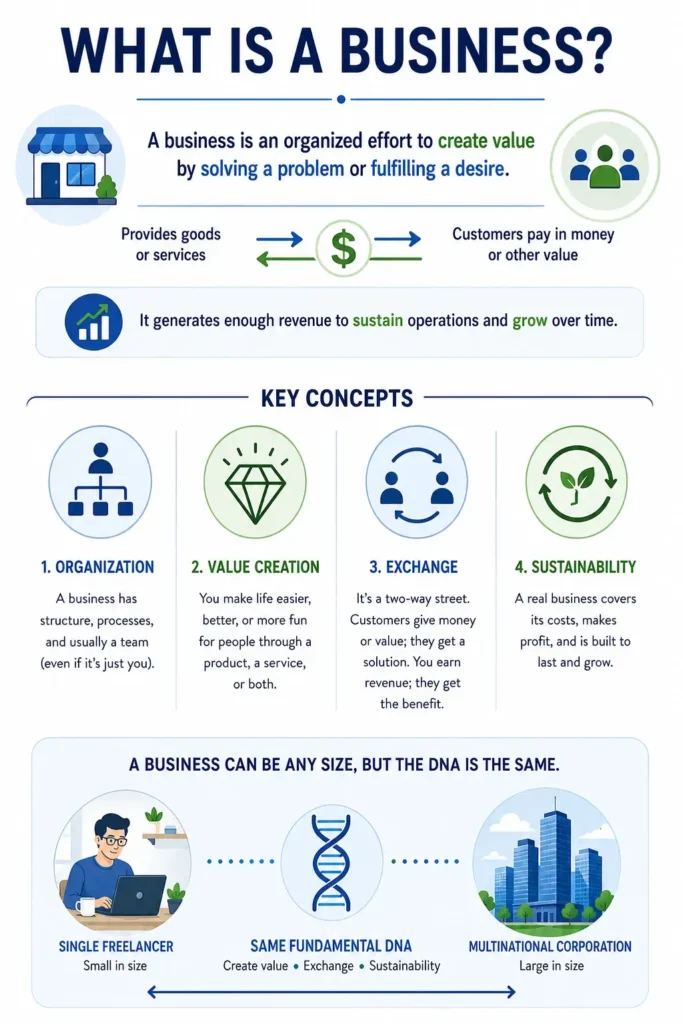
This definition contains several key concepts:
- 🏗️ Organization: A business isn’t a one-off hobby. It has some sort of structure, processes, and usually a team (even if that team is just you).
- 💎 Value creation: This is the heart of it. You’re making someone’s life easier, better, or more fun—through a product, a service, or a mix of both.
- 🔄 Exchange: It’s a two-way street. Customers hand over money or something of value; they get a solution in return. You earn revenue; they get the benefit.
- ♻️ Sustainability: The plan isn’t just to make a quick buck and disappear. A real business aims to cover its costs, generate profit, and stick around.
A business can be as tiny as a single freelancer working from a home office 🏠💻, or as enormous as a multinational corporation 🌐. The fundamental DNA is the same.
🕰️ A Brief History of Business
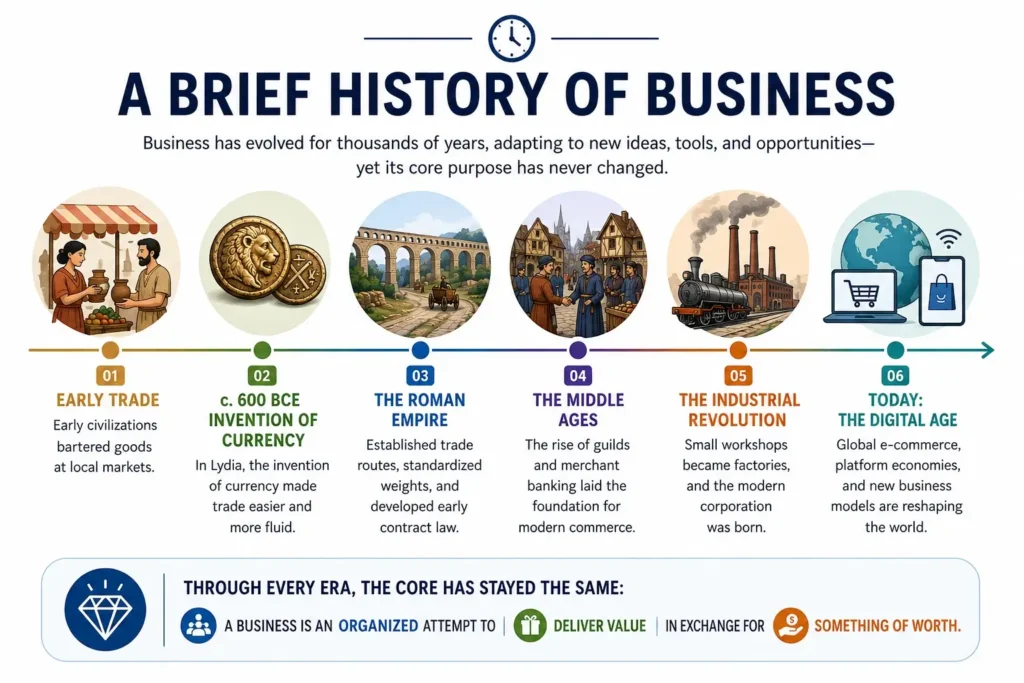
🤝 Early Trade and Barter
The origins of business can be traced back to ancient civilizations, where people exchanged goods and services through barter systems. Farmers, craftsmen, and traders met in local markets to trade items such as food, tools, livestock, and clothing. While barter allowed commerce to begin, it was often inefficient because both parties needed to want what the other offered.
🪙 The Invention of Currency (c. 600 BCE)
A major breakthrough occurred with the invention of currency in Lydia (present-day Turkey) around 600 BCE. Coins provided a standardized medium of exchange, making transactions easier and enabling trade over larger distances. The use of money also encouraged savings, investment, and the growth of more complex economies.
🏛️ The Roman Empire
The Roman Empire played a significant role in advancing business practices. It:
- 🛣️ Built extensive road networks that improved transportation
- ⚖️ Standardized weights and measures for fair trade
- 📜 Developed legal systems and contract laws
- 🏪 Encouraged the growth of marketplaces and commercial centers
These innovations created a more stable environment for businesses to operate and expand.
🏰 The Middle Ages
During the Middle Ages, commerce continued to develop despite political and economic challenges. Key developments included:
- 👥 Guilds, which regulated quality, training, and pricing within trades
- 🚢 Expansion of international trade through merchant networks
- 🏦 Emergence of merchant banking and credit systems
- 📈 Early accounting practices that improved financial management
These institutions helped establish trust and structure in commercial activities.
🏭 The Industrial Revolution (18th–19th Centuries)
The Industrial Revolution transformed business more dramatically than any previous era. Innovations such as steam power, mechanized manufacturing, and improved transportation systems led to:
- ⚙️ Mass production of goods
- 🏭 Large-scale factories
- 🚂 Faster transportation through railways
- 👨💼 Professional management structures
- 🏢 The rise of modern corporations
Businesses could now produce goods more efficiently and serve much larger markets.
💻 The Digital Age (21st Century)
Today, technology drives business innovation. Modern businesses benefit from:
- 🌐 Global e-commerce platforms
- 📱 Mobile applications and digital services
- ☁️ Cloud computing and data analytics
- 🤖 Artificial intelligence and automation
- 📦 Digital supply chains and logistics systems
Companies can reach customers worldwide instantly, creating opportunities that were unimaginable just a generation ago.
🔮 The Future of Business
Emerging trends are expected to shape the future, including:
- 🤖 Advanced AI and machine learning
- 🌱 Sustainable and environmentally responsible practices
- 🔗 Blockchain and decentralized technologies
- 🛒 Personalized customer experiences
- 🌍 Greater global connectivity and remote work
🎯 The Constant Purpose of Business
Although business has evolved from simple barter exchanges to sophisticated global enterprises, its fundamental purpose remains unchanged:
💡 A business is an organized effort to create, deliver, and exchange value while meeting the needs and wants of customers.
🧱 The Five Core Elements of Every Business
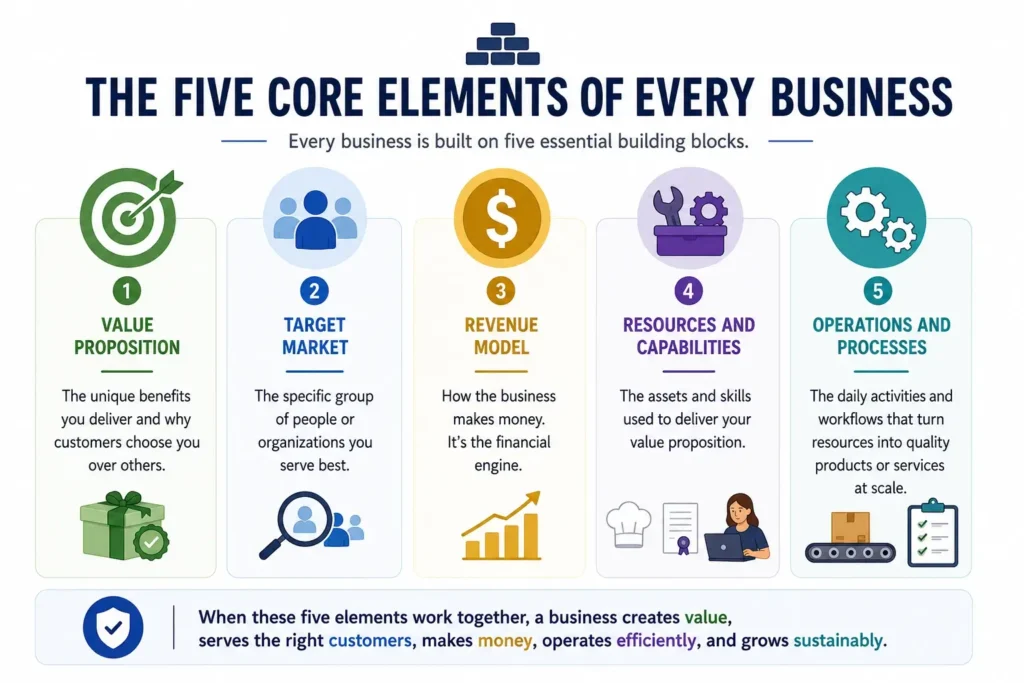
Every business, regardless of its size or industry, is built on five essential building blocks. If even one of these is missing or weak, the entire operation becomes fragile.
- 🎯 Value Proposition
Why should a customer choose you over any other option? Your value proposition is the unique mix of benefits—price, quality, convenience, innovation, service—that you promise to deliver. - 👥 Target Market
No business can serve everyone. Your target market is the specific group of people or organizations whose problem you can solve. Defining this group by demographics, behaviors, location, or needs is essential. - 💰 Revenue Model
How will the business make money? Will it sell products outright, charge a subscription, take commissions, or earn from advertising? The revenue model is the financial engine of the business. - 🛠️ Resources and Capabilities
These are the assets used to deliver the value proposition—physical assets (a restaurant kitchen 🍳), intellectual property (a patent 📄), human talent (skilled employees 👩💻), and financial capital. - ⚙️ Operations and Processes
This is the “how.” Operations include the daily activities, workflows, supply chains, and quality controls that transform resources into the final product or service. Efficient processes allow a business to scale 📈.
🌍 The Purpose of a Business Beyond Profit
Many people reduce a business to a money-making machine. Profit is vital—it keeps the business alive. But a business also:
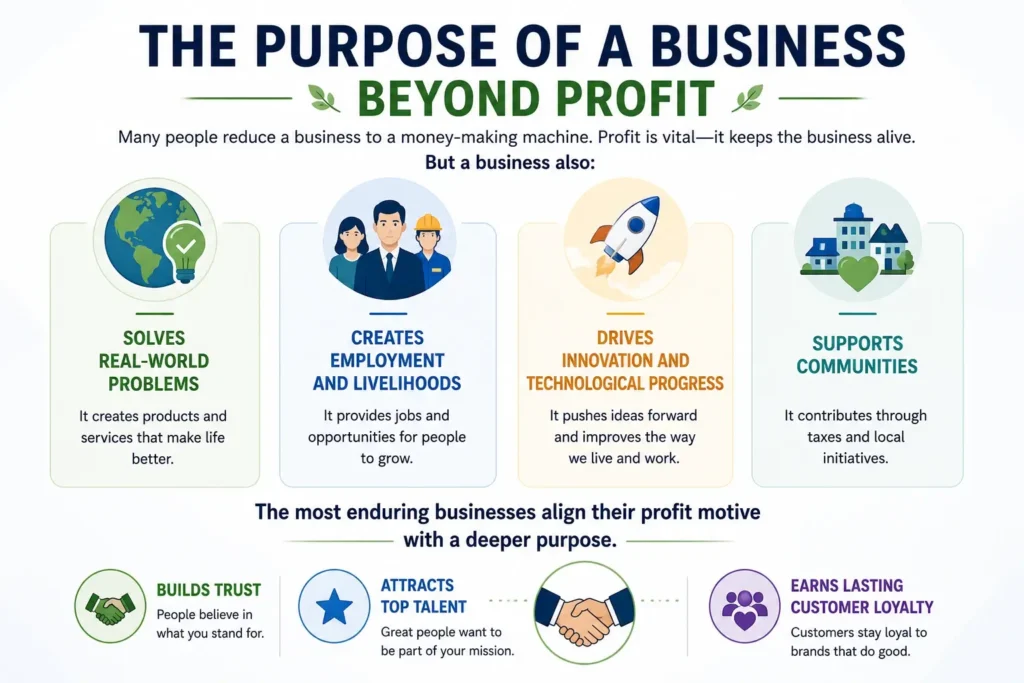
- ✅ Solves real-world problems
- 🧑🤝🧑 Creates employment and livelihoods
- 🚀 Drives innovation and technological progress
- 🏘️ Supports communities through taxes and local initiatives
The most enduring businesses align their profit motive with a deeper purpose. This alignment builds trust 🤝, attracts top talent ⭐, and earns lasting customer loyalty.
💎 How a Business Creates Value
Value can be delivered in three main ways:
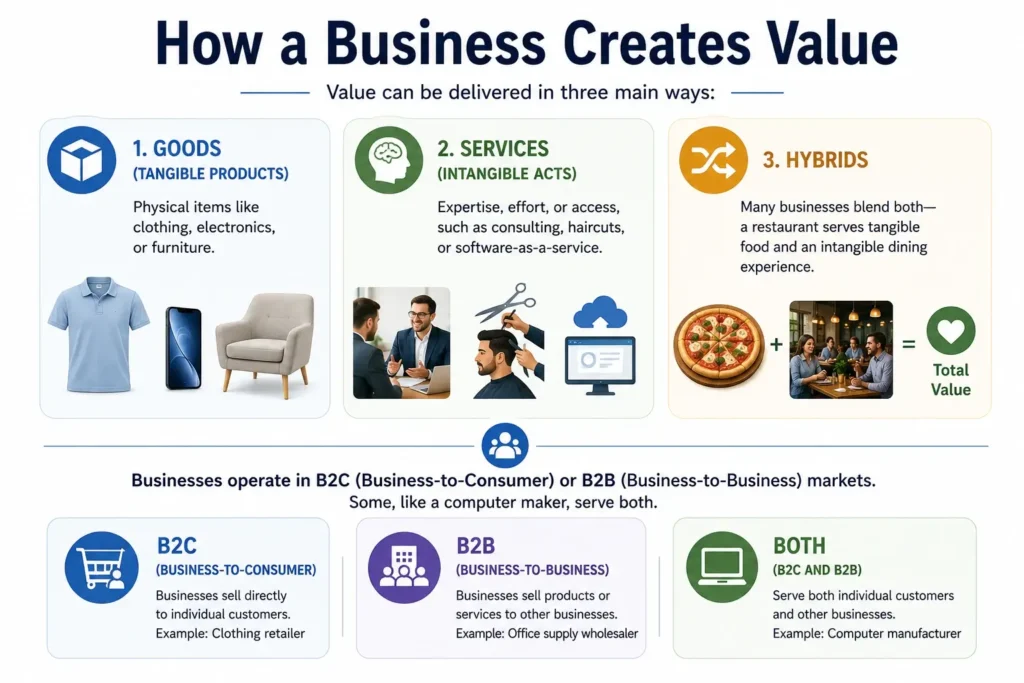
- 📦 Goods (tangible products): Physical items like clothing 👗, electronics, or furniture.
- 🧠 Services (intangible acts): Expertise, effort, or access, such as consulting, haircuts ✂️, or software-as-a-service.
- 🔀 Hybrids: Many businesses blend both—a restaurant serves tangible food 🍕 and an intangible dining experience.
Businesses also operate in B2C (Business-to-Consumer) or B2B (Business-to-Business) markets. Some, like a computer maker, serve both.
🧩 What Separates a Business from a Hobby?
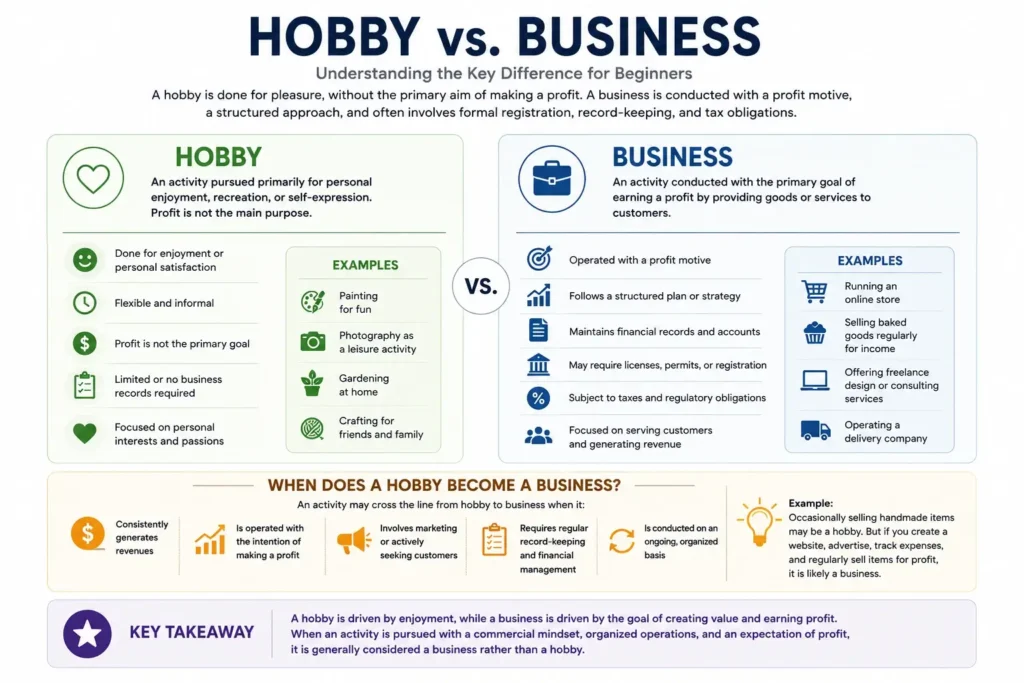
A crucial distinction for beginners is understanding the difference between a hobby and a business.
🎨 Hobby
A hobby is an activity pursued primarily for personal enjoyment, recreation, or self-expression. While a hobby may occasionally generate income, making a profit is not its main purpose.
Characteristics of a Hobby:
- 😊 Done for enjoyment or personal satisfaction
- ⏰ Flexible and informal
- 💰 Profit is not the primary goal
- 📝 Limited or no business records required
- 🎯 Focused on personal interests and passions
Examples:
- 🎨 Painting for fun
- 📸 Photography as a leisure activity
- 🌱 Gardening at home
- 🧶 Crafting handmade items for friends and family
🏢 Business
A business is an activity conducted with the primary goal of earning a profit by providing goods or services to customers. Businesses typically operate in a structured manner and may be subject to legal, financial, and tax requirements.
Characteristics of a Business:
- 💵 Operated with a profit motive
- 📊 Follows a structured business plan or strategy
- 📋 Maintains financial records and accounts
- 🏛️ May require licenses, permits, or registration
- 💰 Subject to taxes and regulatory obligations
- 🎯 Focused on serving customers and generating revenue
Examples:
- 🛍️ Running an online store
- 🍰 Selling baked goods regularly for income
- 💻 Offering freelance design or consulting services
- 🚚 Operating a delivery company
⚖️ When Does a Hobby Become a Business?
An activity may cross the line from hobby to business when it:
- 💲 Consistently generates revenue
- 📈 Is operated with the intention of making a profit
- 📢 Involves marketing or actively seeking customers
- 📋 Requires regular record-keeping and financial management
- 🔄 Is conducted on an ongoing, organized basis
For example, someone who occasionally sells handmade jewelry as a pastime may have a hobby. However, if they create a website, advertise products, track expenses, and regularly sell items for profit, the activity is likely operating as a business.
💡 Key Takeaway
A hobby is driven by enjoyment, while a business is driven by the goal of creating value and earning profit. When an activity is pursued with a commercial mindset, organized operations, and an expectation of profit, it is generally considered a business rather than a hobby.
🧑💼 Key Functions Inside a Business
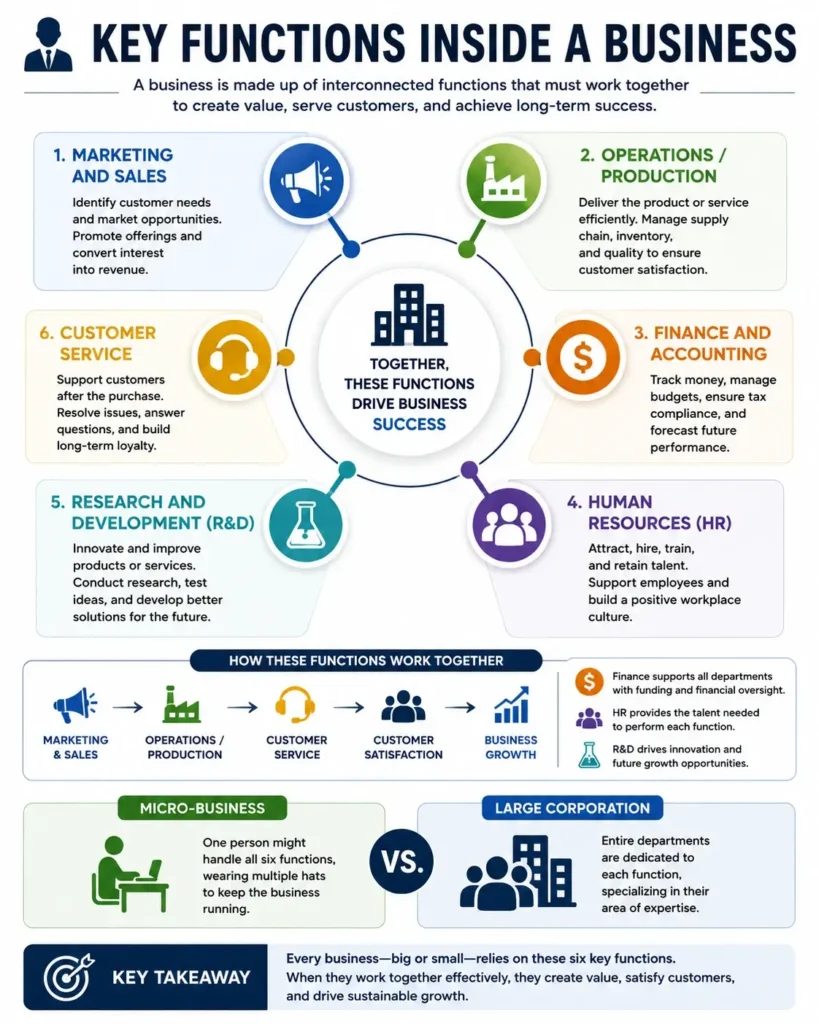
A business is made up of several interconnected functions that work together to achieve organizational goals. Each function plays a vital role in creating value, serving customers, and ensuring long-term success.
📣 Marketing and Sales
Purpose: Attract customers and generate revenue.
Key Responsibilities:
- 🔍 Identify customer needs and market opportunities
- 📢 Promote products and services
- 🎯 Develop branding and advertising campaigns
- 🤝 Convert prospects into paying customers
- 📈 Increase sales and market share
Goal: Create demand and drive revenue growth.
🏭 Operations and Production
Purpose: Deliver products or services efficiently and effectively.
Key Responsibilities:
- ⚙️ Manage production processes
- 📦 Control inventory and logistics
- 🚚 Coordinate supply chain activities
- ✅ Maintain quality standards
- ⏱️ Improve efficiency and productivity
Goal: Deliver value to customers while minimizing costs.
💹 Finance and Accounting
Purpose: Manage the organization’s financial resources.
Key Responsibilities:
- 💰 Track income and expenses
- 📊 Prepare financial statements
- 💵 Manage budgets and cash flow
- 📋 Ensure tax compliance
- 🔮 Forecast future financial performance
Goal: Maintain financial stability and support decision-making.
👥 Human Resources (HR)
Purpose: Manage and develop the workforce.
Key Responsibilities:
- 🎯 Recruit and hire employees
- 🏫 Provide training and development
- 🤝 Manage employee relations
- 🏆 Design compensation and benefits programs
- 😊 Promote employee engagement and retention
Goal: Build and maintain a productive, motivated workforce.
🧪 Research and Development (R&D)
Purpose: Drive innovation and continuous improvement.
Key Responsibilities:
- 💡 Develop new products and services
- 🔬 Conduct research and testing
- 🚀 Improve existing offerings
- 📈 Identify emerging trends and technologies
- 🛠️ Solve technical and operational challenges
Goal: Keep the business competitive and innovative.
🎧 Customer Service
Purpose: Support customers before, during, and after a purchase.
Key Responsibilities:
- 📞 Answer customer inquiries
- 🛠️ Resolve complaints and issues
- 💬 Provide product support
- ⭐ Enhance customer satisfaction
- 🤝 Build long-term customer relationships
Goal: Create positive customer experiences and loyalty.
Meanwhile:
- 💹 Finance supports all departments with funding and financial oversight.
- 👥 HR provides the talent needed to perform each function.
- 🧪 R&D drives innovation and future growth opportunities.
💡 Key Takeaway
Whether it’s a small startup or a multinational corporation, every business relies on these core functions to operate successfully. In a micro-business, one person may perform all six roles. In a large organization, entire departments specialize in each function, working together to achieve common business objectives.
🔄 The Business Lifecycle
Every business goes through a series of stages, from the birth of an idea to long-term sustainability. Understanding the business lifecycle helps entrepreneurs anticipate challenges, allocate resources effectively, and plan for future growth.
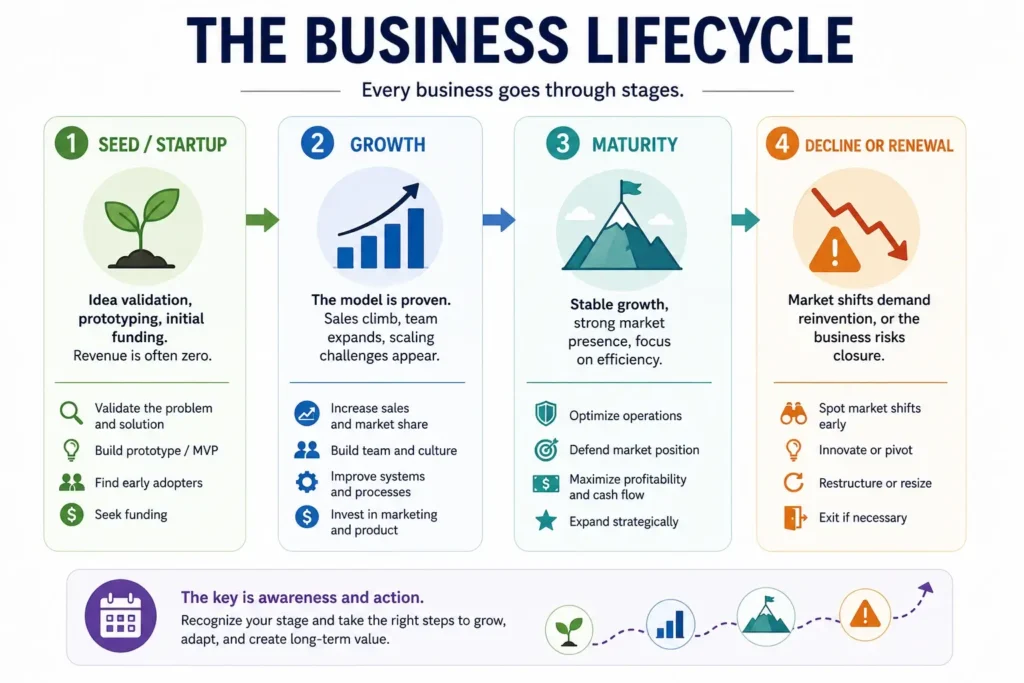
🌱 Seed / Startup Stage
Focus: Turning an idea into a viable business.
At this stage, entrepreneurs identify a problem, develop a solution, and test whether customers are willing to pay for it. The business is often in the planning and experimentation phase.
Key Activities:
- 💡 Idea generation and validation
- 🧪 Product or service prototyping
- 👥 Market research and customer feedback
- 💰 Seeking initial funding or investment
- 📋 Developing a business plan
Common Challenges:
- Limited financial resources
- Uncertain market demand
- Building a customer base
- High risk of failure
Typical Revenue:
💸 Little to no revenue
📈 Growth Stage
Focus: Expanding the business and increasing sales.
Once the business model has been proven, demand begins to grow. The company hires employees, expands operations, and invests in marketing to capture more market share.
Key Activities:
- 🚀 Increasing sales and customer acquisition
- 👥 Expanding the workforce
- 📢 Scaling marketing efforts
- 🏭 Increasing production capacity
- 🌍 Entering new markets
Common Challenges:
- Managing rapid growth
- Maintaining product or service quality
- Hiring and training employees
- Cash flow management
Typical Revenue:
📊 Rapidly increasing revenue and profitability
🏔️ Maturity Stage
Focus: Maintaining market position and maximizing efficiency.
The business has established itself in the market and enjoys stable revenues. Growth slows compared to earlier stages, and management focuses on efficiency, customer retention, and profitability.
Key Activities:
- ⚙️ Improving operational efficiency
- 🤝 Strengthening customer relationships
- 💰 Maximizing profits
- 📊 Optimizing processes and costs
- 🏆 Defending market share
Common Challenges:
- Increased competition
- Market saturation
- Innovation slowdown
- Maintaining customer loyalty
Typical Revenue:
💵 Stable and predictable revenue streams
⚠️ Decline or Renewal Stage
Focus: Adapt or risk becoming irrelevant.
Changes in technology, consumer preferences, competition, or economic conditions can reduce demand for a company’s products or services. Businesses must innovate and reinvent themselves to survive.
Option A: 📉 Decline
- Falling sales
- Loss of market share
- Reduced profitability
- Potential closure or bankruptcy
Option B: 🔄 Renewal
- Launching new products or services
- Adopting new technologies
- Entering new markets
- Rebranding and restructuring
Common Challenges:
- Responding to market changes
- Managing organizational change
- Funding innovation initiatives
Typical Revenue:
📉 Declining revenue or 📈 renewed growth if transformation succeeds
💡 Key Takeaway
A business is not static—it evolves through different stages over time. Companies that successfully innovate, adapt to market changes, and continuously create value are more likely to move from startup to growth, sustain maturity, and achieve renewal rather than decline.
🏙️ The Role of Business in Modern Society
Businesses play a vital role in shaping modern economies and improving the quality of life for individuals and communities. Beyond generating profits, businesses contribute to economic growth, innovation, employment, and social development.
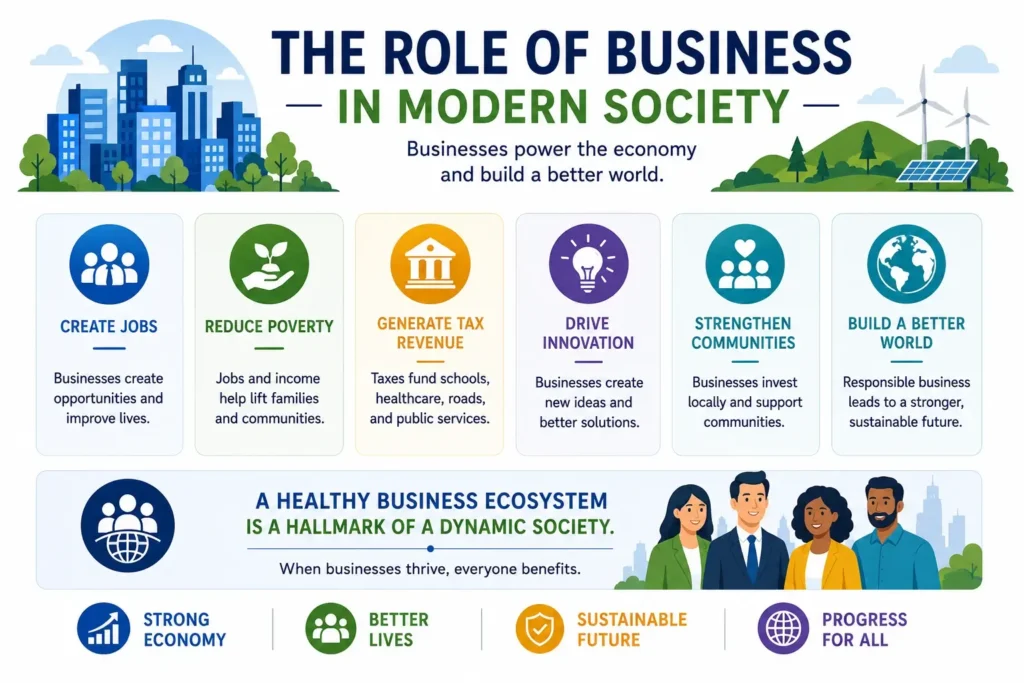
💼 Create Jobs
One of the most important contributions of businesses is providing employment opportunities.
How Businesses Help:
- 👨💼 Create jobs across various industries
- 💰 Provide wages and income for families
- 🎓 Offer training and skill development
- 🚀 Support career growth and advancement
Impact: Higher employment levels contribute to improved living standards and economic stability.
🌱 Reduce Poverty
Businesses help reduce poverty by creating opportunities for people to earn income and improve their quality of life.
Contributions:
- 💵 Generate income for workers and entrepreneurs
- 🏘️ Support local communities through economic activity
- 🤝 Create opportunities for small suppliers and contractors
- 🌍 Encourage economic development in emerging regions
Impact: Strong business activity helps lift individuals and families out of poverty.
🏛️ Tax Revenue and Public Services
Businesses contribute to government revenues through taxes and fees.
These Revenues Help Fund:
- 🏫 Education and schools
- 🏥 Healthcare systems
- 🛣️ Roads and infrastructure
- 👮 Public safety services
- 🌳 Community development programs
Impact: Business taxes support essential public services that benefit society as a whole.
💡 Drive Innovation and Progress
Businesses are major drivers of innovation and technological advancement.
Examples of Innovation:
- 🤖 Artificial intelligence and automation
- 📱 Smartphones and digital technologies
- 🚗 Transportation advancements
- 🩺 Medical breakthroughs
- 🌱 Sustainable and renewable energy solutions
Impact: Innovation improves productivity, solves societal challenges, and enhances quality of life.
🌍 Economic Growth
Businesses stimulate economic activity through production, investment, and trade.
Key Contributions:
- 📈 Increase national income and GDP
- 🏭 Produce goods and services
- 🌐 Facilitate domestic and international trade
- 💹 Attract investment and capital
Impact: Economic growth creates more opportunities for businesses and individuals alike.
🤝 Community Development
Many businesses contribute directly to the communities in which they operate.
Examples:
- 🎓 Sponsoring educational programs
- ❤️ Supporting charities and non-profit organizations
- 🌳 Funding environmental initiatives
- ⚽ Supporting local sports and cultural events
Impact: Strong businesses help build stronger communities.
💡 Key Takeaway
Businesses are much more than profit-generating organizations. Collectively, they form the backbone of the economy, creating jobs, reducing poverty, generating tax revenue, supporting communities, and driving innovation. A healthy and competitive business ecosystem is a key characteristic of a prosperous, dynamic, and forward-moving society. 🌍🚀
⚡Common Challenges for New Businesses
Regardless of size or industry, every business encounters obstacles that can affect growth, profitability, and long-term success. Understanding these challenges helps business owners prepare and respond effectively.
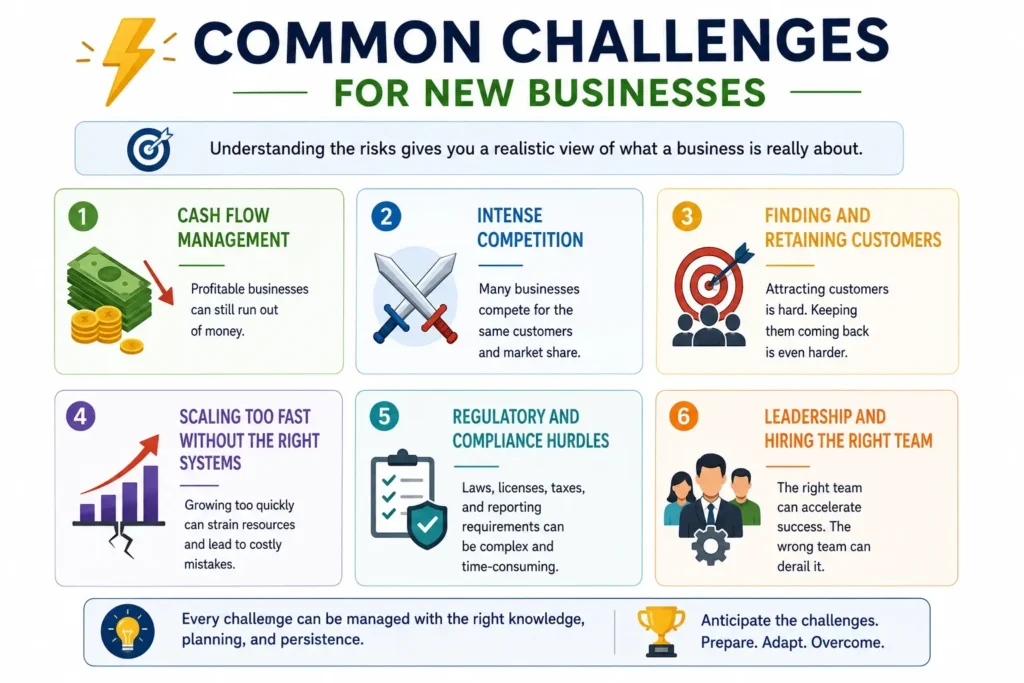
💸 Cash Flow Management
A business can be profitable on paper yet still run out of cash.
Why It Happens:
- Customers pay invoices late
- High operating expenses
- Poor budgeting and forecasting
- Excess inventory tying up funds
Impact:
- Difficulty paying employees and suppliers
- Delayed business operations
- Increased financial stress
Key Lesson:
💡 Profit does not guarantee cash availability. Cash flow is the lifeblood of a business.
⚔️ Intense Competition
Businesses operate in competitive markets where rivals constantly seek customers and market share.
Challenges:
- Price wars
- New market entrants
- Changing customer preferences
- Competitive innovations
Success Strategy:
🎯 Differentiate through quality, service, innovation, branding, or customer experience.
🎯 Finding and Retaining Customers
Customers are essential to business survival.
Common Difficulties:
- Attracting new customers
- Building brand awareness
- Maintaining customer satisfaction
- Reducing customer turnover
Success Strategy:
🤝 Deliver consistent value and build long-term customer relationships.
📉 Scaling Too Fast
Rapid growth can be as dangerous as slow growth.
Risks:
- Operational inefficiencies
- Declining product or service quality
- Employee burnout
- Cash shortages due to expansion costs
Success Strategy:
⚙️ Build strong systems, processes, and infrastructure before expanding.
📋 Regulatory and Compliance Requirements
Businesses must comply with laws and regulations.
Examples:
- Tax obligations
- Employment laws
- Health and safety standards
- Industry-specific regulations
- Data privacy requirements
Risks of Non-Compliance:
- Fines and penalties
- Legal disputes
- Reputational damage
Success Strategy:
✅ Maintain accurate records and stay informed about legal requirements.
👨👩👧👦 Leadership and Talent Management
A business is only as strong as its people.
Leadership Challenges:
- Hiring the right employees
- Developing talent
- Managing performance
- Building a positive workplace culture
- Retaining high-performing staff
Success Strategy:
🌟 Invest in leadership development, employee engagement, and continuous learning.
💡 Key Takeaway
Successful businesses do more than generate sales—they effectively manage cash flow, competition, customers, growth, compliance, and people. Organizations that anticipate these challenges and develop proactive solutions are more likely to achieve sustainable long-term success. 🚀🏢
🏁 Conclusion
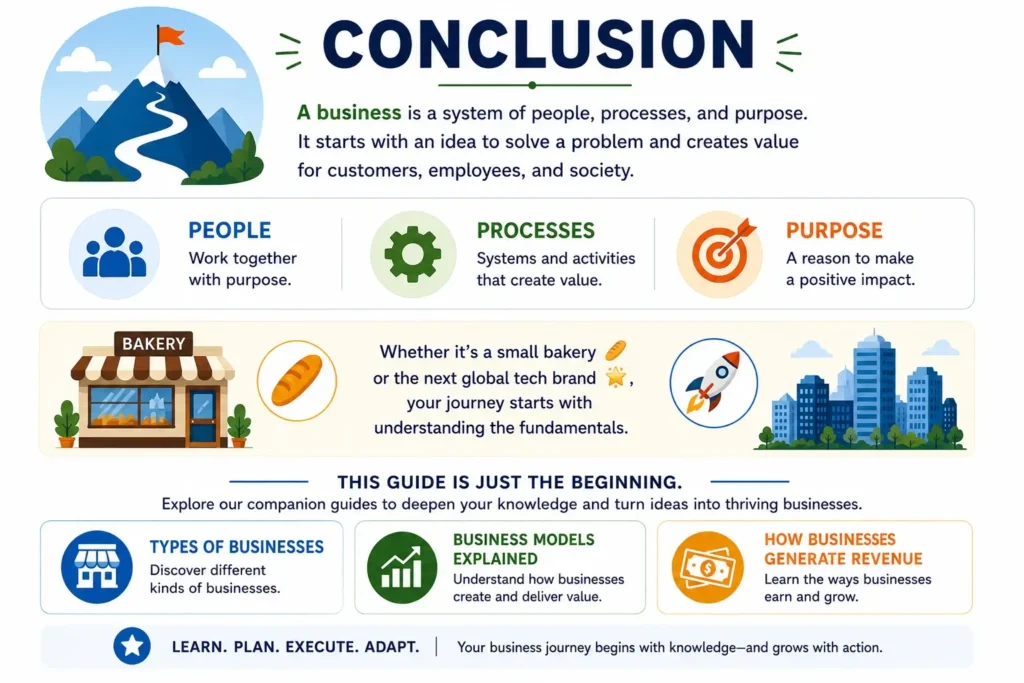
So, what is a business? It is a living system of people, processes, and purpose. It begins with an idea to solve a problem and translates that idea into a structured value-creation engine that benefits customers, employees, and society alike. Whether you dream of opening a small bakery 🥖 or launching the next global tech brand 🌟, your journey starts with understanding these fundamentals.
This guide is just the beginning. To deepen your knowledge, explore our companion guides on Types of Businesses 🏬, Business Models Explained 📊, and How Businesses Generate Revenue 💵. Each piece of the puzzle brings you closer to turning an idea into a thriving enterprise.
📚 References
- Barney, J. B., & Hesterly, W. S. (2021). Strategic management and competitive advantage: Concepts and cases (7th ed.). Pearson.
- Britannica. (n.d.). Business. Encyclopaedia Britannica. https://www.britannica.com/topic/business
- Burns, P. (2020). Entrepreneurship and small business: Start-up, growth and maturity (5th ed.). Red Globe Press.
- Daft, R. L. (2021). Management (14th ed.). Cengage Learning.
- Drucker, P. F. (2007). Management: Tasks, responsibilities, practices. Harper Business. (Original work published 1973)
- Hisrich, R. D., Peters, M. P., & Shepherd, D. A. (2023). Entrepreneurship (12th ed.). McGraw-Hill Education.
- Kotler, P., Keller, K. L., & Chernev, A. (2022). Marketing management (16th ed.). Pearson.
- Mankiw, N. G. (2021). Principles of economics (9th ed.). Cengage Learning.
- Scarborough, N. M., & Cornwall, J. R. (2019). Essentials of entrepreneurship and small business management (9th ed.). Pearson.
- World Bank. (n.d.). Understanding poverty. https://www.worldbank.org/en/topic/poverty
- World Trade Organization. (n.d.). The history of trade. https://www.wto.org

 Inar Learn